Monday, February 23, 2026

Foxes In Waste Places – A Monologue

 Based on a real discussion:

Foxes In Waste Places – A Monologue

#MolueMonOLogUEs


(Lights up. The speaker stands center stage, charged with emotion. Words land like punches. Pauses are intentional.)


You say,


“The globalists masquerading as ‘Liberal Democrats’ have already started depopulating Africa…”

Really?


Why don’t you stop watching Fox News long enough for your brain to recover—

and regrow—

to fill its cranium?


These are the stories they tell the gullible.

The mentally enslaved.


Let me tell you a story.

A story about propaganda.


Cambridge. May 1997.

I met two Lithuanians. I asked,

“What was it like in the Soviet Union?”


They looked at each other and said one word:

"Lies."


“They told us people in the West were starving... desperate to get into the Soviet Union… but their governments wouldn’t let them.”

We laughed.

It was absurd.


But here we are again—

Same tactics.

Same playbook.

Same lies.


Fox News.

The propaganda machine—now in HD.


White supremacists—

The same ones who once lynched Black people—

Went on to create a perverted version of Christianity:

The Prosperity Gospel.


A gospel they use to control the ill-informed,

The poor,

The under-educated

All across the Global South.


They agree on a scheme Saturday afternoon.

By Sunday afternoon,

A hundred million spiritual castaways

Have a new, second-hand article of faith.


They tell you what to think—

About “liberals,”

About “depopulation,”

About Africa.


Not unlike Nietzsche,

They believe God is dead.

They don’t say it—

But their policies scream it.


They mock every virtue,

Then replace them with works of the flesh.


They deface the signposts of Christianity:

A shepherd doing their job for God and country?

“Virtue-signalling.”

Care about the environment?

“You’re a tree-hugger.”

Stand for the poor?

“You’re a socialist—you hate America.”

Believe in social justice?

“You’re a woke-mob, virtue-signalling globalist.”


Cruelty is the new charity.

Lying, the new measure of honesty.


And you believe they love Africa?


You say liberals want to depopulate Africa?

The same liberals who fight for diversity,

For dignity, equality, inclusion?


The same liberals who preach the brotherhood of all men,

Who cry, Liberté, Égalité, Fraternité—

They want to wipe out Africa?


(He exhales. Slowly.)


And to checkmate these “liberals,”

You turn to white supremacists.

Let them whisper into your itchy ears.


They say they're your “watchdogs.”

Your new prophets.

Defenders of Africa.


And you believe them.


“If Fox News were evil,” you say,

“They would have warned us!”

So now, you believe every smear campaign

Against anyone who genuinely tries to help.


Bill Gates.


Why do they hate him so much?


Is it because his philanthropy shames their selfishness?

Because he works—tirelessly—

To improve health outcomes for the poorest of the poor?


Why do they hate improved health outcomes so badly?


During COVID, they lied.

They lulled people to their deaths—

By the hundreds of thousands.


There were real reports

Of people being assaulted in public

For wearing a mask—

Because of their disinformation.


And you—yes, you—

With all your education, your exposure—

Told me, “Masks don’t protect.”


You sent me a video to “prove” it.


Remember?

A young Chinese man with an American accent

Blowing through a mask to extinguish a candle.


How many lives did that lie snuff out?


Did you ever stop to ask: Why?


Why would a church—

A church—

Spread such misinformation?


Misinformation that killed millions?


Why did they fight vaccines so hard?

Still do?


Why do they hate improved health outcomes so badly?


You want an answer?


(Scratches his head. Grins darkly.)


What if I told you: Depopulation.

Not by liberals.

No.


By the foxes in waste places.

By the wolves in wolves’ clothing

Who now say they are vegetarians—

That they “love Africa” so very, very much.


So much…

That they defund the very programs that save lives.

They cut aid.

They abandon the poor.

They let people die.


And you believe that somehow,

That will lead to better health outcomes?


That these “better outcomes”

Will repopulate Africa?


You don’t think that’s madness?


You say:


“Liberals are introducing gay culture to destroy families in Africa—

And you support them because you're blind.”

First—

I’d rather be blind than claim I see—yet see nothing.


Second—

Ask anyone from Northern Nigeria about Dan Daudu:

Male prostitution in the North—centuries old.

Brothels—existed well into the 1970s.

Maybe still.


But now, it’s liberal Democrats who are “introducing” gay culture?


Half-education is dangerous.

And you, my friend—are living proof.


I know what you’ll say next:

“Insults! Insults!!”


(Pause. A beat. He quiets. The rage becomes grief.)


Yes. These are insults.

But they’re born of grief—

Grief over what you’ve become.

What you’ve been made to believe.


Grief over the common sense you once had—

Now buried beneath a mountain of lies.


(He sits on a table, one foot on a chair. His hand under his chin.

Is he sobbing? The lights begin to fade slowly. Then a soft female voice begins to read, offstage.)


Foxes In Waste Places

(A poem inspired by Ezekiel 13:4–7)


Your prophets…

They are like jackals—

Foxes, digging through ruins,

Scavenging among broken stones

Of a once-holy place.

They are not builders.

Not watchmen.

Not healers.

They are foxes…

In your waste places.

They see the breach in the wall—

The opening where evil will pour in—

But they do nothing.

No mortar in their hands.

No courage in their hearts.

Only whispers.

Only lies.

They have not repaired the broken places.

They have not helped you stand.

But oh—how quick they are

To slander the ones who look on with compassion.

And when you fall—

In the day of battle,

As they expect you to—

They will mock you.

They will say,

“This is the word of the LORD.”

But God has not sent them.

O people,

You have trusted the wrong voices.

You have followed jackals, not shepherds.

You have clothed yourselves in prophecy,

But you are naked in truth.

(A pause. The voice softens but cuts deeper.)


Turn back.

Turn off the lies.

Turn off the television.

Turn off the noise.

Before the wall collapses.

Before the day of the LORD descends like fire.

Before the foxes scatter—

And leave you alone

In the ruins they helped create.

Return to the light.

Return.

(Lights fade to black. Silence.)


I rest my case.


#dk

#MolueMOnoLogUEs

Saturday, February 21, 2026

Theologia Acediosa: How Lazy Theology Sanctifies Evil

How Theologia Acediosa
(Lazy Theology) Sanctifies Evil....


A reflection on 2 Thessalonians 2, the Lord’s Prayer, and how “God can use anyone” becomes dangerous when Christians sanctify evil.


God Can Use Anybody?

God can use anybody. But by making them devise evil? Go astray?

We need to pay more attention to this line in the Lord’s Prayer. It teaches more than we admit:

“Lead us not into temptation, but deliver us from evil.”

People choose their actions.
They act out of the condition of their hearts.

Where those actions are evil, and the victims are evil, read my lips, God stands by.

We find corroboration in 2 Thessalonians 2:9–12.

Those who already perish, already, who reject the truth that would have saved them, to them is sent a grand delusion so that they may believe a lie.


The Grand Delusion

I used to ask, why would the Lord send a grand delusion to those who already perish?

Let me try to explain.

Remember solving a quadratic equation. You worked through the rigor, arrived at the answer, and then underlined it. Not because the teacher needed help seeing it, but because you were saying, I know I am right. Give me full marks.

It appears the Lord allows a person to underline his erring ways in the same fashion. To present them back with swagger. To insist, This is truth.

That is not cruelty. That is justice meeting freedom.

It aligns with God’s nature: all love, all justice, yet all mercy.

Now imagine a man who already perishes. To whom that grand delusion comes, perhaps in the form of a political figure, a movement, an ideology. Imagine he pauses and says, “This is wrong.”

Has he not stepped back from the brink?
Has he not refused the lie?
Has he not been delivered from evil?

The delusion does not destroy him.
His rejection of the grand delusion delivers him from evil.


The Harder Truth

But here is the harder truth.

While we all know that a certain divisive figure devises evil and has clearly gone astray, we choose to sit ensconced, at rest, tucked safely in a cleft on the sides of the limestone mountain called Torpor Animi (Lazy Theology).

Spiritual sloth.
Comfort disguised as prudence.

We have no problem with the fact that though he needs salvation, we would rather it be delayed.

That though a part of his soul is diminished daily with every act of gratuitous wickedness, we are not bothered.

It serves our ends.
“He’s making our faith great again.”

It is thus acceptable to us that he stand in sin.
In the sight of God, for our sake.

A role he appears to relish. As any false messiah seeking to replace Jesus of Nazareth would.


The Deeper Danger

And here is the deeper danger.

While we pray, “Lead us not into temptation” for ourselves, we pray, “Lead him, O Lord, into further temptation” for the man of lawlessness.

We sanctify his going astray.

We whisper, God can use anyone.

True.

And you?

Can He not use you to redeem the times?
To plant tiny acorns of truth daily?
To defy and, like Daniel, boldly declare, Non Serviam?
I shall not serve. I shall not follow this falsehood.

God cannot use you for that?

Yes, God can use anyone. Anything. He is sovereign. YHWH. I Am That I Am.

But sovereignty does not excuse complicity.

“Lead us not into temptation, but deliver us from evil.”

Sometimes the evil is not only in the one who acts.

Sometimes it is in the one who watches, calculates, benefits, and calls it providence.


The Four Horsemen

The four horsemen of the apocalypse, it is Jesus who allows them.

Scripture is clear: it is the Lamb of God, Jesus Christ, who releases the four horsemen by breaking the first four of the seven seals on the scroll.

Each time a seal is broken, one of the four living creatures around God’s throne summons a horseman to bring judgment to the earth.

The first horseman, the one on the white horse, is a deceiver.

Wearing a stephanos, a crown he has done nothing to deserve.
Carrying a bow but no arrows. His lies, those are the arrows.

Now let us talk about the second horseman.
The one on the red horse.

In the Book of Revelation, the second horseman is given power to take peace from the earth.

Not to create righteousness.
Not to heal.
Not to reconcile.

To divide.

To make men turn against one another.

That is the spirit of the second horseman.

And here is the danger.

When we chant “God can use anybody” without discernment, we risk confusing sovereignty with endorsement.

Yes, God can use anybody.

But the second horseman is also used.

Used to reveal what is already in men’s hearts.
Used to expose allegiances.
Used to test whether we love truth or power.

And so the question is not whether God can use a divisive figure.

The question is whether we recognize the spirit at work.

Is peace being built?
Or is peace being removed?

Because the second horseman rides only where hearts are already ready for war.

We shall speak about the other two horsemen in due course, as the Spirit leads.

Brethren.

Do not be deceived.


I rest.

Don Kenobi
#OldManInTheMolue
#MyFrancisEssays

Thursday, February 19, 2026

Culture: The Software Behind National Failure


ReCulture Not ReStructure

Restructuring won’t save a corrupt nation.
Real change begins with culture, the invisible operating system 
that shapes leaders and citizens alike.

We keep saying:

Restructure! Restructure!
Enforce the laws.
Sanction those who break the laws.
Change the Constitution.

Or blame the amalgamation of North and South Nigeria in 1914, 112 years ago. By implication, blame the British.

But when are we going to look inside ourselves and hold accountable the very hands that have wrecked this bounteously blessed country?

Before you point at “leaders,” point at yourself.

We all need to take a step back and think this matter through carefully.


Some Levity

Try a simple self-audit.

Record yourself in a verbal argument about restructuring.
Play the recording back in the evening.
See if you can make sense of your own arguments.

If you can, Einstein has nothing on you.


Seriously Now

How can restructuring a corrupt nation be the solution to anything?

#ReCultureNotReStructure
#CultureNotStructure

We can see this clearly in America: a lawless man running from his past, ready to drag his country to the depths in order to make every lie he has told appear true.

Where does culture come in?

That is the software he has run on all his life. Lies. Corruption. Anything goes.

And that software traveled with him from the streets of New York to what was once the most respected office in the world.

Culture is like the shell of a tortoise. It cloaks us. We carry it wherever we go.

And it will degrade or ennoble everything we touch.


Culture Is Not Food and Fashion

When we say culture, we are not talking about food, fashion, or festivals.

We are talking about operating system.

Culture is the invisible code that runs a people.

It is what feels normal.
What feels acceptable.
What feels shameful.
What feels admirable.

It is the unwritten constitution beneath the written one.

Culture determines:

  • What leaders get away with

  • What citizens tolerate

  • What is rewarded

  • What is punished

  • What is laughed at

  • What is feared

Structure is hardware.
Culture is software.

You can restructure endlessly, but if the software is corrupt, the hardware will malfunction.


What Reculturing Means

Reculturing simply means:

  • Recapturing our moral center

  • Reclaiming high standards

  • Restoring dignity to service

  • Re-anchoring a people to truth

  • Reinstalling lost values

Redrawing maps and returning to a regional system is like sellotaping a broken blade onto a propeller. The plane might still fly, but you have ignored the real problem: why did the blade break in the first place?

To fix it, you must unbolt that blade, replace it, and test run.

Reculturing means moving from an anything-goes mentality
to a some-things-must-never-go mindset.


A Parting Thought

The major difference between Abraham Lincoln and Trump is culture, the software that runs their lives.

The same can be said about Nigerians and Germans. Or the Congolese and Singaporeans.

The only difference between decline and dignity
is the code a people choose to run.

And that code is not written in their constitution.

It is written in their character.

I rest my case

Don Kenobi
#BigAgendaAfrica 

Wednesday, February 18, 2026

Service is Love: Hubert Humphrey The Happy Warrior of American Liberalism


Hubert Humphrey

The Happy Warrior of American Liberalism


From Small-Town Roots to National Politics

Hubert Humphrey was born in 1911 in South Dakota and began his career far from Washington, working in his father’s pharmacy. But politics called him early. After serving as mayor of Minneapolis, he rose quickly within the Democratic Party, eventually becoming a U.S. senator from Minnesota.

Energetic, articulate, and relentlessly optimistic, Humphrey built a reputation as a passionate advocate for working people, civil rights, and social reform. His style was earnest and moral rather than calculating. He believed politics was a vehicle for justice.


The Civil Rights Crusader

Humphrey’s defining political moment came at the 1948 Democratic National Convention. In a bold speech, he urged his party to “walk forthrightly into the bright sunshine of human rights.” It was a turning point. His words helped push the Democratic Party toward a stronger civil rights platform at a time when such a stance was deeply controversial.

Throughout his Senate career, Humphrey supported landmark legislation, including the Civil Rights Act of 1964 and the Voting Rights Act of 1965. He became one of the most consistent liberal voices for racial equality in American politics.


Vice President in a Time of Turmoil

Humphrey served as Vice President from 1965 to 1969 under Lyndon B. Johnson. These were turbulent years. The Great Society programs expanded social welfare and civil rights, but the Vietnam War overshadowed everything.

Humphrey’s loyalty to Johnson tied him closely to the administration’s Vietnam policy. When he ran for president in 1968, the nation was fractured by war protests, assassinations, and cultural upheaval. He secured the Democratic nomination but narrowly lost the general election to Richard Nixon.


The “Happy Warrior”

After his presidential defeat, Humphrey returned to the Senate, where he continued advocating for labor rights, arms control, and social justice until his death in 1978. He was often called the “Happy Warrior,” a phrase that captured both his cheerful demeanor and his fierce commitment to progressive causes.

Hubert Humphrey’s legacy is not one of quiet moderation but of moral conviction. He believed government could and should be an instrument of human dignity. In an era of cynicism, he remains a reminder that politics, at its best, can be rooted in hope.

Conclusion: Service is love

Tuesday, February 17, 2026

Poisonous Mushrooms & Counterfeit Christianity: When Death Looks Like Food

When Death Looks Like Food

Poisonous Mushrooms & Counterfeit Christianity

The deadliest mushroom in the forest does not look dangerous.
Neither does spiritual deception.
A meditation on counterfeit life and hidden destruction.


The most dangerous mushroom in the forest does not have fangs. It does not hiss. It does not announce itself with a roar.

It simply grows.

I just learned a new term: aposematic coloration, a biological term for warning colors in nature. Warning colors? Yes.

In evolution, some organisms develop bright, high-contrast colors to signal that they are toxic, venomous, bad-tasting, or dangerous.

Nature, in spite of its tight schedule, still cares enough to put out signposts for us: do not touch. It is dangerous.

Examples?

Coral snakes, red, yellow, black bands. Wasps, yellow and black.

Digression:

A certain musician, before fame, had just one sweater and it was yellow and black. His mates took to calling him Sting.
The name stuck, and every little thing he did afterwards was magic.
Magic, magic, magic.
Sorry for the digression.

Aposematic coloration, sadly, is useful only for those who can see. Many cannot, born that way. We call it color blindness.

They thus need assistance: true friendship and assistance from those who see clearly, to steer them away from poison, from harm.

St. Paul admonishes those who can and do see: “Preach the word; be ready in season and out of season; reprove, rebuke, and exhort, with complete patience and teaching.” 2 Timothy 4:2.

That is responsibility.


But Nature Does Not Color All Poison

Nature does not advertise every danger. Mushrooms show us how this works.

Poisonous mushrooms did not evolve to look like edible mushrooms. It was the other way around. Edible mushrooms evolved to look like poisonous mushrooms.

Why?

Because poison mushrooms have a winning formula. No one messes with them. “Let’s begin to look like them.”

So thus it was that the good imitated the bad. Reason? To survive.

Does this sound familiar?

Reminiscent of a church becoming more and more worldly, in order to “survive” as they defined survival to be?

But let’s leave that train of thought for a second.

No. Let’s remain there.

In order to survive, the Church, sorry, the good mushrooms took on the nature of the world, the bad mushrooms.

And so the spiritually hungry, the stragglers searching for food, walking in unfamiliar terrain, see these perfectly formed mushrooms, the kind Grandma made soup with.

See that? Grandma made mushrooms familiar. Grandma told us, as we made our way into the world, “Go to church every Sunday!” See that?

So?

So, the spiritually hungry, searching for food for the soul, in unfamiliar terrain, see these perfectly formed spiritual mushrooms.

Grandma would have known the difference.
She has been round the world twice or thrice, seen almost everything under the sun.

She would not pick those mushrooms, but 9 out of 10 times, you will pick wrong. You ingest the poison. It does not kill immediately. It simply grows in you.

That is how deception works.

Scripture never warned us that the Antichrist would look monstrous. It warned us he would look convincing. It warned us he would resemble light.


St. Paul speaks directly about false apostles.
He says he will continue his work in order to undercut those who boast and claim equality with the true apostles.

See that?

It is of utmost importance that all true apostles speak out.

If you are not speaking out in these days of multidimensional heresies, leaning on lazy theology, absolving yourselves with “God can use anybody,” St. Paul calls you out.

Read it yourself: https://biblehub.com/2_corinthians/11-12.htm

We’ve got to move on.

Paul calls them what they are: false apostles, deceitful workers, masquerading as apostles of Christ.

He did not hide under the huge “God can use anyone” umbrella and hail false apostles, deceitful workers, masquerading as apostles of Christ, devastating the Christscape.

Paul goes on to explain why this should not surprise us, for Satan himself masquerades as an angel of light.

Here are the Bible verses quoted verbatim:

But what I do, I will also continue to do, that I may cut off the opportunity from those who desire an opportunity to be regarded just as we are in the things of which they boast.

For such are false apostles, deceitful workers, transforming themselves into apostles of Christ.

And no wonder! For Satan himself transforms himself into an angel of light.

2 Corinthians 11:12–14


The death cap does not scream, “I am death.” It whispers, “I am dinner.”

The false prophet whispers: “I am the bread of life... the bread of life... whoever comes to me shall not hunger, and whoever believes in me shall never thirst.”

There is no greater lie than that, and that is the tragedy.

It looks like what you need.

It offers itself as bread, never as destruction.

Like the toxic mushroom does not look alien. It looks like food.

Exactly like a counterfeit gospel looks like Christianity.


Delayed Consequences

One of the most unsettling aspects of the death cap is this: symptoms are delayed. After ingestion, a person may feel fine for hours. Sometimes a day. Then liver failure begins.

In theological symbolism, deception often works the same way. It does not destroy immediately. It reassures first. It flatters. It stabilizes. It promises. Only later does the internal damage surface.

That is a sobering metaphor.

The forest contains true nourishment, but it also contains convincing counterfeits.

In Matthew 7:16, we are told, “By their fruits you shall know them.” The warning is not about appearances. It is about outcomes.

And what is the fruit of the antichrist?

Death.

Not always immediate. Not always dramatic. But eventual. A slow hollowing out.

The dead cannot cry out for justice. Discernment thus matters before the harvest, not after.

Not everything that grows is good.
Not everything that glows is light.
Not everything that calls itself bread gives life.

Question:
What are we consuming?
(What am I consuming?)
What will it produce in us?
(What will it produce in me?)

I rest my case.

Don Kenobi 
#OldManInTheMolue | #MyFrancisEssays 


On Obama, The Loss of Christian Witness, and the Reckoning to Come


Don Kenobi's critique of African Evangelicalism,
Theological colonialism, the Prosperity Gospel, 
and the spiritual cost of choosing political power over Christ.

Barack Obama?
He is a credit to his race: the human race.
Check this out:

Ever graceful. Ever in pursuit of “whatsoever things are true, whatsoever things are honest, whatsoever things are just, whatsoever things are pure, whatsoever things are lovely, whatsoever things are of good report.”

If that sounds familiar, it should — it’s from your Bible, dear African evangelical.

Here it is: https://biblehub.com/philippians/4-8.htm

Sadly, those who will DISAGREE with me most vociferously about Obama will be Africans, not African Americans, but Africans. African evangelicals, Pentecostals because sadly, they are not fully independent yet. 

Many still operate under a kind of theological colonialism.

Their colonial masters? Take your pick from the high priests of the “Word of Faith,” - the so called “Name-it-and-Claim-it” movement.

This brotherhood led by the likes of Oral Roberts (I hear Kenneth Copeland was his driver) has deeply shaped, and in many ways distorted, African Christianity over the last five decades. Its influence runs wide and deep. To this day.

Whether knowingly or not, the effect has been a subtle substitution: Jesus, the Son of God, displaced by a different figure, an anti-Jesus; one who works hand in glove with Mammon, that ancient spirit of greed and insatiable appetite.

From that substitution flows a gospel that sanitizes avarice: the so-called Prosperity Gospel. But let us not digress.


Evangelicalism and the Reckoning to Come

Evangelicalism will answer to God for many things, one of which will be Barack Obama.

It will have to reckon with the ease with which it baptized suspicion, racial anxiety, and political hostility as discernment.

It will have to explain how outrage drowned out charity.

How it became comfortable with Trump.

How it could canonize a young man who arrogantly, at the top of his voice boasted, “I hate empathy. It's a made up word”

That his parents failed him, that's an inescapable conclusion. 


Was There Ever Such a Time?

Was there really ever a time when Christian witness came first in the Word Of Faith Movement? A time when standing in truth, even when it cost you something, meant everything?

Or have we deluded ourselves into believing there really was such a time?

There is a Nigerian phrase you hear on every corner: the more you look, the less you see. It applies here.

The more you look for Christianity in much of what now passes for Evangelicalism, Word of Faith, Pentecostalism, the less you see.


I Was There

I am not speaking as an outsider. I was an evangelical.

T.D. Jakes was my pope and Joel Osteen my archbishop.

I have the receipts. Literally. They are a mouse click away. No, I will not post them. They are none of your business.

I was a member of T.D. Jakes’s BC. Find out what BC means.

I was there the very first time T.D. Jakes preached at Lakewood. “Look at me, I’m at Lakewood!” he declared. I have the video. I recorded it myself on my iPhone. It is still here.

I was at The Potter’s House the Sunday after Obama defeated John McCain, exhausted from driving all the way from Houston. We only made the second service. T.D. Jakes was not there in person. I assumed he had gone to be with the young president-elect.

There was a time when being right with Christ meant saying what was right whether or not it won applause. It meant accepting loss, marginalization, even persecution, rather than bending the knee to expedience.

Witness was moral clarity without calculation.

And this is where T.D. Jakes lost me. 

He seemed powerless to say uncomfortable Truths...

(For all his stature and masculinity, he was a weak man)

I love TD Jakes we both are Ibos - but I'm not powerless to say uncomfortable Truths...


Did Something Shift?

Many like to believe something shifted.

No.

I do not think so.

We may have been deluded into believing something that simply was not there.

Why?

Because we were perishing. And this false gospel seemed like a lifeline. Perhaps, at first, it even felt like one.

But here we are now, standing at a fork in the road. Two gates before us.

One is wide and gilded. Behind it, an autobahn stretches into the distance, immaculately kept lawns on both sides, immaculately dressed gatekeepers beckoning us: come.

The other is narrow and wooden, barely hanging on its hinges. No attendants in sight. Through its cracks, we glimpse a steep, winding, jagged descent.

The words of Jesus replay loudly in our heads:

“Enter by the narrow gate. For wide is the gate and broad is the way that leads to destruction…”

The words are loud. They are clear.

But sadly, “many there be which go in thereat.”

Many reject the path that leads to life.

Someone once said that many acts of cowardice are based on sound information.

I would add: many acts of self-destruction are as well.

Only in this case, the ability to discern sound information has been lost.

Yes, we were perishing. Yes, the false gospel gave us something to hold on to. But when we choose the wide gate, we reject the truth that would have saved us.

2 Thessalonians 2:9–12 warns of deception against those who refused to love the truth and so be saved.

That is the true danger of the prosperity gospel.

Standing at the fork in the road, it makes all but the most sincere seekers of Christ choose the wide gate, every time.

Does this mean you can continue attending those churches if you are a sincere seeker?

No.

Scripture is blunt:

“Be not deceived: evil communications corrupt good manners.”
1 Corinthians 15:33 (KJV)

In full:
“Be not deceived: evil communications [or company] corrupt good manners [or morals].”

Close association with negative influences, harmful conversations, or immoral patterns will gradually degrade one’s character, behavior, and values.

If Scripture says, “Be not deceived,” then do not kid yourself.


A Case Study: God's Generals

There is a book titled God’s Generals by Robert Liardon. It sold like wildfire in the Christian community in Nigeria. I still have a copy on my shelf. Perhaps it is time to let it go.

Why?

Because one man’s hero worship was presented as history.

Flawed men were told as if they were almost flawless. Their excesses were toned down. Their racism brushed aside. Even their abuses were dressed up and called “anointing.”

Yes, God uses broken people. That is not in dispute. Fire melts ice.

But there is a difference between acknowledging human frailty and canonizing it.

Meanwhile, ordinary believers travail, praying for purpose, asking God for something to do for the Kingdom. Yet we are told that God routinely bypasses the faithful and makes a beeline for the spectacularly compromised and “anoints” them.

Scripture gives sobering warnings.

2 Thessalonians 2:10 speaks of deception “against those who are perishing, because they refused to love the truth and so be saved.”

2 Corinthians 6:14 asks, “What partnership has righteousness with lawlessness? Or what fellowship has light with darkness?”

And 2 Corinthians 4:3–4 says:

“And even if our gospel is veiled, it is veiled to those who are perishing. The god of this age has blinded the minds of unbelievers, so they cannot see the light of the gospel of the glory of Christ, who is the image of God.”

Those verses should give every believer pause.

Have you crossed a line? Have you become unable to see the light of the gospel of the glory of Christ?

Has God honored your choice to believe certain lies by allowing you to be carried further into them?

Yes, God uses sinners. That is not in dispute.

It was Jesus Himself who broke the seals in Revelation and set loose the four horsemen upon the earth, riders that brought conquest, conflict, famine, and death in their wake. Sovereignty is not the same thing as approval.

But when you can look at cruelty and call it strength, look at deceit and call it strategy, look at vulgarity and call it authenticity, something has shifted, not in heaven, but in you.

When you declare one man who strives, publicly at least, to embody the fruit of the Spirit as irredeemably evil, and another who openly mocks virtues honored by every major faith as a messenger of God, you must pause.

You must ask whether the gospel has become veiled to you.

You must ask, quietly and honestly:

Am I perishing?


The Real Problem

The problem is not that God can redeem the worst of us.

It is that power has become more urgent than witness.
Influence more urgent than integrity.
Access more urgent than truth.

Dear Evangelicals, history will remember what you chose. It will remember where you stood, and what you were willing to excuse.

May Jesus have mercy on us all.

Don Kenobi

#OldManInTheMolue | #MyFrancisEssays | MolueMonOLogUes

Sunday, February 15, 2026

Thomas Sowell: When Statistics Become Dogma.

Thomas Sowell, Minimum Wage, and the War on Poverty


CEO pay soared 1,322% while workers gained 18%.
1,322% Vs 18%? Blame 18% 
A sharp critique of Thomas Sowell, trickle-down economics, 
and the myth that the War on Poverty failed.

A Revisit

This is an old essay. I am somewhat intrigued by the moderation I extended to the man at the time. Here is what I wrote:

“Thomas Sowell is not quite an ass. Many of the things he says, I agree with. But he should be wary of being the darling of the virulent right wing.”

If I were writing that today, I would not be so generous.

Thomas Sowell is far less careful with his conclusions than his reputation suggests. Even that may be charitable.

What passes for rigor is often assertion wrapped in confidence.
What is marketed as dispassionate analysis frequently arrives pre-loaded with ideology.

To call that scholarship is misleading.

Sowell is not merely provocative. He appears to revel in being reviled by his own demographic, even as he finds acceptance in another.


How I First Encountered Sowell

I first got to know of him on Twitter.

It gave me a perverse joy to drop into right-wing threads and state my preferences as bluntly as I could. It was important for me to put my ideas out there. Yes, perhaps to annoy, but also to see whether there were persuasive counter-arguments that might cause me to rethink or modify them.

Eventually, I discovered he was a favorite of the virulent right wing. So I read more about him.

To be honest, I was impressed. Why not? He attended Harvard and Columbia and earned a PhD from the University of Chicago. A first-rate intellectual by any conventional measure.

So why do I now think differently?

The Problem: Statistics Without Humanity

He is a statistician. To him, people and the outcomes of their choices, vis-à-vis government policy, can only be understood through the prism of statistics.

To be fair, he seemed a little slow in the interview. That might be age, or perhaps a desire to please the Hoover Institution, which sent him on a wondrous intellectual journey studying statistics around the world.

But that does not excuse the fact that he is plainly wrong.

He mocks the minimum wage.

His argument: it causes inflation and reduces the number of jobs available.

Fine. Let’s assume that is true.

But he offers no alternative to paying people peanuts.

A Simple Question

If scientists are smart enough to go to the moon, could they not help economists devise a way to raise minimum wages without causing inflation?

After all, they already devised a way of spending money you don’t have. It’s called credit cards.

Why?

To keep production higher than “real demand.”
To keep the economy producing tomorrow’s needs today.
To keep industrialists happy.
And they, in turn, keep us happy by employing us.

A kind of trickle-down happiness.

Except their happiness apparently collapses if they pay living wages.

The CEO Gap

Let me drop this here:

Between 1978 and 2020, CEO compensation grew 1,322%.
Typical worker pay grew just 18%.

From 1965 to 2020, the ratio of average CEO compensation to the lowest-paid workers grew from 21:1 to 351:1.

Astounding.

Here’s a depiction of the disparity.

Picture the height of the Empire State Building. Now compare it to the height of a homeless man’s tent at its entrance.


It makes no sense. Yet these statistics are rolled out with hesitation, for fear of being labeled “envious” or worse, a communist.

It is difficult to find this level of imperviousness to reason anywhere else in the animal kingdom.

Imagine the head of a pack of wolves eating 351 meals for every single meal the lowest member receives.

Absurd.

Wolves know better.

They hunt together. They survive together.

Can anyone imagine a healthy, well-fed wolf hunting effectively alongside half-starved, worse, starving pack members??

Dear Trickle-Down Defenders

If raising the minimum wage causes inflation, then find a way to prevent inflation when minimum wages rise. America has attracted some of the most intelligent people on the planet. It has created one of the most advanced educational systems on earth.

You can do it. Yes, you can.

The Divorce Statistics Argument

Then Sowell links increases in the minimum wage to divorce rates. Fine. There may be a correlation, however specious.

So what do we do next?

By his logic, we treat minimum wage increases as evil. That is  quite the leap.
When we place too much weight on our own biases, we create the illusion of causality.

Consider this:
Many people who buy ice cream on hot summer days also have sunburns.
Therefore, ice cream causes sunburns.

On hot summer days, people buy more ice cream. On hot summer days, people spend more time in the sun.

Ice cream does not cause sunburns.

The War on Poverty

Then comes the part that broke me.

The interviewer references the Great Society and the War on Poverty, now six decades old.

Sowell responds:

“This has not worked. The evidence is in. After a century, they still refuse to look at the evidence.”

Deep sigh.

Where does one begin refuting something so manifestly simplistic?

Let’s start with Mitch McConnell. Born into a struggling family. Contracted polio as a child. Received treatment his parents could not afford. He is now worth hundreds of millions and sits at the top of the Republican Party.

He too says: “The war on poverty has not worked.”

The irony writes itself.

Who Looked at the Evidence?

Let’s move beyond personalities.

We have had numerous Republican administrations since Clinton. If liberals refuse to look at the evidence, surely conservatives have looked at it?

What did they do with it?

Apart from enormous military spending and wars that depleted American resources and diminished its aura of invincibility, what structural poverty solution was implemented?

Every Republican administration since Clinton has left office amid economic instability. The last one ended in something resembling an attempted coup.

Yet the refrain remains:

“This has not worked.”

The Kenyan Analogy

I love word pictures.

Imagine I am running a long-distance race chasing a Kenyan.

The gap does not close.

Statistically, over the last six Olympics, when you chase a Kenyan athlete, he hears your labored breathing and increases his pace just enough to keep the gap constant.

You lose again.

After six losses, you conclude: running hard is the problem.

You do not propose a new strategy.
You do not improve training.
You simply imply that trying hard was wrong.

That is the logic.ng that had you run less intensely, you might have won the gold.

Absurd.

Final Thoughts: 

Statistics Are Not Moral Verdicts

For too long, right-wing sponsored intellectuals have treated statistics as moral verdicts.

Numbers matter.

But they are not the whole story.

Policy is not merely about numbers and how they 'rithmetic. 

It is about human beings and how they writhe, whether helped, ignored, or abandoned.

The Wolves and the Sheep

The wolves breed faster than we cull them and our sheep keep getting killed in greater numbers.

Sowell: Stop culling them.

Me: When the race is not won, the answer is not to stop running. It is to run smarter.

Surely, if scientists are smart enough to go to the moon, they can devise a strategy to help win the war on poverty.

The problem is not intelligence. It is incentive. The system is functioning exactly as designed, just not for the people at the bottom.

I rest my case.

Don Kenobi 
Co-Founder 
#BigAgendaAfrica 

The Netherlands vs Nigeria: 1 Million Hectares vs 34 Million Hectares

The Netherlands vs Nigeria
1 Million Hectares vs 34 Million Hectares


Nigeria has 34 million hectares of arable land, yet imports food, 
while the Netherlands thrives on just 1 million hectares. 
This analysis explores how systems, management, and discipline, 
not size, determine agricultural success.

The Numbers

The Netherlands: Arable land ≈ 1 million hectares
Nigeria: Arable land ≈ 34 million hectares

The Netherlands is the second largest exporter of agricultural products in the world.

Nigeria imports food.

I have nothing more to say about this.

Except perhaps to note the following.


A Small Country That Engineered Its Survival

The Netherlands is smaller than many Nigerian states.

It has cold winters.
Limited land.
Much of it reclaimed from the sea.

Yet it exports vegetables, flowers, dairy, meat, seeds, and high-tech greenhouse systems to the world.

Why?

Because agriculture there is not treated as a “nice to do.”
It is treated as existential. A must do.

And so the Dutch engage in:

  • Precision farming

  • Water management

  • Logistics optimisation

  • Agro-processing

  • Research-driven production

  • Port efficiency to evacuate agricultural produce globally

They farm by design.

Oh, by the way:

The population of the Netherlands is approximately 17.9 to 18 million people, 2025 estimate.

That is roughly the population of Lagos.


A Large Country Living on Potential

Nigeria, by contrast, has thirty-four times more arable land.

It has a tropical climate.
High rainfall in the south.
Major river systems.
Year-round growing potential.

Yet:

  • Low mechanisation

  • Minimal irrigation

  • Poor storage

  • Massive post-harvest losses

  • Weak processing capacity

  • Infrastructure bottlenecks

  • Bad roads

  • Virtually non-existent rail system

  • No coherent policy focused on making agriculture a system

  • Security disruptions

  • Police checkpoints

  • Twelve-hour road transport windows

We have everything needed to replace the Netherlands as the number two exporter of agricultural goods in the world.

Except the system.


Let Us Build the System

Let us build that system. Yes, it will be hard. But as the saying goes, when you wake up, that is your morning.

If there ever was a speech that literally moved mountains, it was John F. Kennedy’s moon-landing speech. African leaders would do well to motivate their people with any portion of that address.

Hear Kennedy:

“First, I believe that this nation should commit itself to achieving the goal, before this decade is out, of landing a man on the moon…”

This line can be appropriated by Nigeria and used to drive forward an ambitious program to overhaul its agricultural output:

First, I believe that this nation, Nigeria, should commit itself to achieving the goal, before this decade is out, of surpassing the Netherlands as the world’s 3rd largest exporter of food.

Kennedy’s speech, perhaps one of the most brilliant ever delivered by an American president, highlights something few have articulated so well: mastery of the art of journeying together is just as important, perhaps even more so, than arriving. Because as JFK posits, “that goal will serve to organize and measure the best of our energies and skills…”

And those skills are what we need to build systems.

To make agriculture a system.
Security a system.
Transportation a system.
Justice a system.
Tax a system.

That is the work.

For when we have a system, waste will be felt more acutely.

The president will not have a 200-car convoy.
The senate will not pay itself unsustainable salaries.

Governors will not allocate to themselves humongous “security votes.” Rather, they will gear themselves to efficiently allocate every penny received in their coffers.


The Difference in Questions

The Dutch ask:

How do we incentivise our farmers to maximise yield per square metre?
How do we further support the export of agricultural products?

We ask:

When will the rain come?
Policy? What policy?

God made our ecosystem.

They built theirs.

We inherited an ecosystem from nature.

They engineered one.


The Real Issue

This is a management story.
Output is not determined by size.

It is determined by structure, systems, incentives, and discipline.
Thirty-four million hectares without systems is just grass.

One million hectares with systems becomes a global food superpower.
Simple arithmetic.


Don Kenobi
#BigAgendaAfrica

Join the discussion: 

Thursday, February 12, 2026

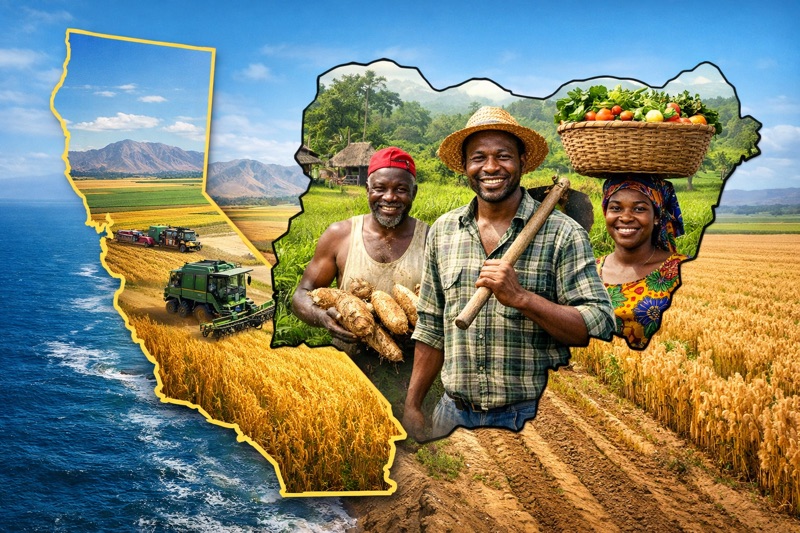
#BigAgendaAfrica: Nigeria vs California: A Blueprint for a $100 Billion Agriculture Economy

What Nigeria Must Learn from California’s Agriculture Model

Nigeria possesses twice the land mass of California
and far greater ecological diversity,
yet it generates only a fraction of the agricultural value.

This is not a story about climate alone. It is a story about management.
About irrigation. About processing. About institutions.

It's a story about how Nigeria’s untapped 36.9 million hectares
can be strategically activated, disciplined, integrated,and transformed
to build an agriculture economy on the scale of California’s.

Bring out your writing pads....


Folding his arms across his chest, he spoke without emotion: “Nigeria holds two Californias in her palm,”

He started, voice a low and steady hum, “With soil more varied, more rain.... Yet for all the emerald richness Nigeria generates only a fraction California's agricultural value"

He stopped abruptly, leaving his words to hang in the air.

“For those joining for the first time, I’m Sanni, Professor of Thermodynamics.”

Editor:

Remember him?

The professor who began each class with a 30-minute digression, during which he spoke about any subject he pleased? Hundreds of students, even journalists and professors, attended those sessions. They only left when he rang his little bell, signalling that the Thermodynamics lecture was about to begin. As the crowd grew, the university assigned him the amphitheatre behind Oduduwa Hall.

That's him: 

Ahhhh… now you remember?

I knew you would.

“As I was saying,” he continued. Then he stopped.

Looked down. Then looked at those gathered.

“I’ve forgotten what I wanted to say.”

“Agriculture!” someone called out.

(Actually, I did.)

“Yes! Thank you,” he said, looking in my direction and smiling.

(I told you he had a striking resemblance to Farrakhan, right? Smaller in size, same hair parting, devout Muslim.)

As he spoke, I wrote.These are my notes, reorganized into a blog.

Reorganising the Nation

There may be advantages in reorganising the country into geopolitical zones:

  1. North-Central
  2. North-West
  3. North-East
  4. Mid-Central
  5. Mid-Central West
  6. Mid-Central East
  7. South-South
  8. South-West
  9. South-East

And in each of these zones, we build brand-new urban areas.

Purpose-built cities.Not ornamental capitals. Not administrative monuments.Cities dedicated to the workers of a new economy - The #AgricultureEconomy.

“I will lecture more on that structure soon,” he said. “Right now, I want to compare agriculture in Nigeria to agriculture in California.”

Why California?

It may seem arbitrary. It is not. Nigeria is roughly twice the size of California.

Since I conducted this study independently, and because time and bandwidth are finite, I proposed one simplifying assumption:

The effects of desertification are equally felt in both Nigeria and California.

Not perfect.

But it allows measurement.

And as we know: If you cannot measure it, you cannot improve it.

Country X

Consider a country. Call it Country X. For our lecture, let X = Nigeria

Location: Inner corner of the Gulf of Guinea, West Coast of Africa.

Extent: 923,768 sq km — about 4 times the size of the UK and 2 times the size of California.

Population (2020): 206,139,589 (about 2.64% of the world’s population).

GDP: $446.543 billion.

Your task: Make this nation work. Increase GDP per capita. Do this by transforming Nigeria’s agriculture. Do this by learning from the California agriculture model.

Keep this in mind, always: If you cannot measure it, you cannot improve it.

Cultivation Comparison

When we compare cultivation intensity:

RegionTotal Arable Land (Hectares)% Currently Cultivated
Nigeria~36.9 million~41% to 46%
California~3.8 million~90% to 95%

Nigeria has vast arable potential — but much of it remains unused.

California’s arable land, though smaller, is almost fully cultivated and beginning to contract.

Climate Comparison

Nigeria

Nigeria spans multiple climate zones:

  1. Arid and semi-arid in the far north
  2. Savannah and Guinea forest in the middle belt
  3. Tropical rainforest and coastal swamps in the south

Rainfall ranges from low in the north to very high in the south, with long growing seasons and high temperatures.

California

California’s climates include:

  1. Mediterranean (wet winters, dry summers)
  2. Semi-arid and arid interiors
  3. Alpine mountains

Agriculture thrives largely due to engineered water systems, not rainfall.

Semi-arid comparison:

**Northern Nigeria’s rainfall often exceeds that of California’s productive interior zones — yet California yields far more because of water infrastructure and management systems.**

The Agriculture Benchmark

California:

• ~100 million acres total land

• ~43 million acres agricultural use

• ~27 million acres cropland

Nigeria:

• ~228.3 million acres total land

• Arable estimates vary from ~37% to ~77%

Variations in arable land estimates tell a story of its own: unreliable data. A problem in itself.

Nigeria has twice actually, 2.28 times) California’s land mass and roughly five times its population.

Mission: Build an agriculture economy at least as large.

How Do We Get There?

1. Start With the Scoreboard

Define the numbers that matter and track them regularly — land utilisation, yields, loss rates, irrigation coverage, logistics times, financing access, market prices, export volumes. Measurable goals create accountability.

2. Choose Priority Value Chains

Instead of generic “agriculture,” focus on specific industries that fit each zone — rice, cassava, tomatoes, cocoa, poultry, dairy, aquaculture, etc. Link production to processing and markets.

3. Build Purpose-Driven Agro-Industrial Cities

These are cities built around agricultural production, processing and logistics, not politics. With reliable power, water, storage, labs, training centres, housing and services for workers.

4. Fix Water Like It Is Electricity

Water is the backbone of production. Map basins, restore existing infrastructure, expand irrigation with solar pumps and drip systems, and protect watersheds.

5. Make Logistics Reliable and Cheap

Transport and loss reduction are major constraints. Secure corridors, aggregation hubs, weighbridges and cold chains should be standard.

6. Improve Inputs

No scaling through fake seed or adulterated fertiliser. Certified seed systems, traceability and mechanisation as a service must be the norm.

7. Finance Value Chains, Not Speeches

Structured capital, warehouse receipts, blended finance, index insurance and payment on verified delivery — not scattered loans.

8. Make Processing the Magnet

Processing adds value, creates jobs, reduces waste and builds exports. Tomato paste, starch, flour, edible oils, dairy and feed products should be expanded everywhere climate permits

9. Standards and Data

Effective standards, functioning labs, predictable enforcement and a national data platform are foundational to confidence and trade.

10. Governance That Delivers

Zone Agriculture Delivery Units with clear targets, public dashboards, transparent procurement and accountability will keep progress visible.

A Simple 90–180 Day Start

  1. Select pilot zones and anchor industries
  2. Publish baseline metrics
  3. Identify aggregation and processing sites
  4. Rehabilitate irrigation in pilot zones
  5. Sign enforceable offtake agreements
  6. Enforce input certification
  7. Publish weekly price and volume reports

Conclusion

“Nigeria!” he said in a loud voice, “is ecologically diverse and, in aggregate, more naturally endowed for agriculture than California. But California is systemically superior in agricultural organisation. Climate does not determine output. Management does.”

He rang the little silver bell he carried to indicate the general lecture was over and the Thermodynamics class was about to start.

(That was the day, I believe, that he got a standing ovation.)

Don Kenobi

#BigAgendaAfrica

#CultureNotStructure