#BigAgendaAfrica: Nigeria vs California: A Blueprint for a $100 Billion Agriculture Economy
What Nigeria Must Learn from California’s Agriculture Model
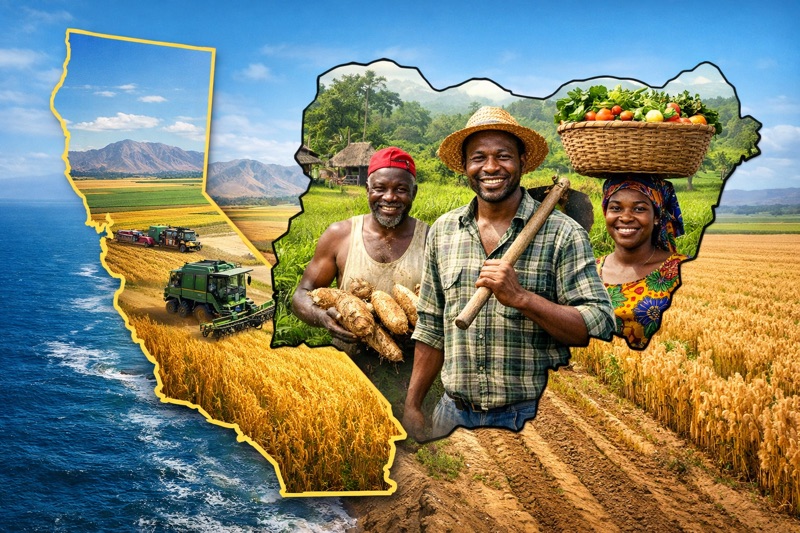
Folding his arms across his chest, he spoke without emotion: “Nigeria holds two Californias in her palm,”
He started, voice a low and steady hum, “With soil more varied, more rain.... Yet for all the emerald richness Nigeria generates only a fraction California's agricultural value"
He stopped abruptly, leaving his words to hang in the air.
“For those joining for the first time, I’m Sanni, Professor of Thermodynamics.”
Editor:
Remember him?
The professor who began each class with a 30-minute digression, during which he spoke about any subject he pleased? Hundreds of students, even journalists and professors, attended those sessions. They only left when he rang his little bell, signalling that the Thermodynamics lecture was about to begin. As the crowd grew, the university assigned him the amphitheatre behind Oduduwa Hall.
That's him:
Ahhhh… now you remember?
I knew you would.
“As I was saying,” he continued. Then he stopped.
Looked down. Then looked at those gathered.
“I’ve forgotten what I wanted to say.”
“Agriculture!” someone called out.
(Actually, I did.)
“Yes! Thank you,” he said, looking in my direction and smiling.
(I told you he had a striking resemblance to Farrakhan, right? Smaller in size, same hair parting, devout Muslim.)
As he spoke, I wrote.These are my notes, reorganized into a blog.
Reorganising the Nation
There may be advantages in reorganising the country into geopolitical zones:
- North-Central
- North-West
- North-East
- Mid-Central
- Mid-Central West
- Mid-Central East
- South-South
- South-West
- South-East
And in each of these zones, we build brand-new urban areas.
Purpose-built cities.Not ornamental capitals. Not administrative monuments.Cities dedicated to the workers of a new economy - The #AgricultureEconomy.
“I will lecture more on that structure soon,” he said. “Right now, I want to compare agriculture in Nigeria to agriculture in California.”
Why California?
It may seem arbitrary. It is not. Nigeria is roughly twice the size of California.
Since I conducted this study independently, and because time and bandwidth are finite, I proposed one simplifying assumption:
The effects of desertification are equally felt in both Nigeria and California.
Not perfect.
But it allows measurement.
And as we know: If you cannot measure it, you cannot improve it.
Country X
Consider a country. Call it Country X. For our lecture, let X = Nigeria
Location: Inner corner of the Gulf of Guinea, West Coast of Africa.
Extent: 923,768 sq km — about 4 times the size of the UK and 2 times the size of California.
Population (2020): 206,139,589 (about 2.64% of the world’s population).
GDP: $446.543 billion.
Your task: Make this nation work. Increase GDP per capita. Do this by transforming Nigeria’s agriculture. Do this by learning from the California agriculture model.
Keep this in mind, always: If you cannot measure it, you cannot improve it.
Cultivation Comparison
When we compare cultivation intensity:
| Region | Total Arable Land (Hectares) | % Currently Cultivated |
| Nigeria | ~36.9 million | ~41% to 46% |
| California | ~3.8 million | ~90% to 95% |
Nigeria has vast arable potential — but much of it remains unused.
California’s arable land, though smaller, is almost fully cultivated and beginning to contract.
Climate Comparison
Nigeria
Nigeria spans multiple climate zones:
- Arid and semi-arid in the far north
- Savannah and Guinea forest in the middle belt
- Tropical rainforest and coastal swamps in the south
Rainfall ranges from low in the north to very high in the south, with long growing seasons and high temperatures.
California
California’s climates include:
- Mediterranean (wet winters, dry summers)
- Semi-arid and arid interiors
- Alpine mountains
Agriculture thrives largely due to engineered water systems, not rainfall.
Semi-arid comparison:
**Northern Nigeria’s rainfall often exceeds that of California’s productive interior zones — yet California yields far more because of water infrastructure and management systems.**
The Agriculture Benchmark
California:
• ~100 million acres total land
• ~43 million acres agricultural use
• ~27 million acres cropland
Nigeria:
• ~228.3 million acres total land
• Arable estimates vary from ~37% to ~77%
Variations in arable land estimates tell a story of its own: unreliable data. A problem in itself.
Nigeria has twice actually, 2.28 times) California’s land mass and roughly five times its population.
Mission: Build an agriculture economy at least as large.
How Do We Get There?
1. Start With the Scoreboard
Define the numbers that matter and track them regularly — land utilisation, yields, loss rates, irrigation coverage, logistics times, financing access, market prices, export volumes. Measurable goals create accountability.
2. Choose Priority Value Chains
Instead of generic “agriculture,” focus on specific industries that fit each zone — rice, cassava, tomatoes, cocoa, poultry, dairy, aquaculture, etc. Link production to processing and markets.
3. Build Purpose-Driven Agro-Industrial Cities
These are cities built around agricultural production, processing and logistics, not politics. With reliable power, water, storage, labs, training centres, housing and services for workers.
4. Fix Water Like It Is Electricity
Water is the backbone of production. Map basins, restore existing infrastructure, expand irrigation with solar pumps and drip systems, and protect watersheds.
5. Make Logistics Reliable and Cheap
Transport and loss reduction are major constraints. Secure corridors, aggregation hubs, weighbridges and cold chains should be standard.
6. Improve Inputs
No scaling through fake seed or adulterated fertiliser. Certified seed systems, traceability and mechanisation as a service must be the norm.
7. Finance Value Chains, Not Speeches
Structured capital, warehouse receipts, blended finance, index insurance and payment on verified delivery — not scattered loans.
8. Make Processing the Magnet
Processing adds value, creates jobs, reduces waste and builds exports. Tomato paste, starch, flour, edible oils, dairy and feed products should be expanded everywhere climate permits
9. Standards and Data
Effective standards, functioning labs, predictable enforcement and a national data platform are foundational to confidence and trade.
10. Governance That Delivers
Zone Agriculture Delivery Units with clear targets, public dashboards, transparent procurement and accountability will keep progress visible.
A Simple 90–180 Day Start
- Select pilot zones and anchor industries
- Publish baseline metrics
- Identify aggregation and processing sites
- Rehabilitate irrigation in pilot zones
- Sign enforceable offtake agreements
- Enforce input certification
- Publish weekly price and volume reports
Conclusion
“Nigeria!” he said in a loud voice, “is ecologically diverse and, in aggregate, more naturally endowed for agriculture than California. But California is systemically superior in agricultural organisation. Climate does not determine output. Management does.”
He rang the little silver bell he carried to indicate the general lecture was over and the Thermodynamics class was about to start.
(That was the day, I believe, that he got a standing ovation.)
Don Kenobi
#BigAgendaAfrica
#CultureNotStructure
posted by #Dk @ 3:03 PM
0 Comments


0 Comments:
Post a Comment
Subscribe to Post Comments [Atom]
<< Home