Friday, July 31, 2026

The Snake, the Saw, and Pastor Niemöller: How Hatred Turns on Itself

The Snake, the Saw, and Pastor Niemöller: How Hatred Turns on Itself


What do an ancient parable,
Martin Niemöller, and the Bible have in common?
They all warn that hatred, division, and injustice
eventually consume those who embrace them.


THE SNAKE AND THE SAW

There is an old parable about a snake.

One night, it entered a carpenter’s workshop looking for rest.

As it slithered across the floor, it accidentally crossed a handsaw.

The blade made a small cut on its belly.

The snake assumed it had been attacked.

In anger, it bit the steel—only wounding itself.

Still enraged, it wrapped itself tightly around the saw, determined to crush its “enemy.”

But the saw only cut deeper.

Until the snake died.

The saw had never attacked it.

The snake destroyed itself fighting what it misunderstood.


PASTOR MARTIN NIEMÖLLER UNDERSTOOD THIS TRUTH

“First they came…”

His words were not merely about Nazi Germany.

They were a warning about silence.

A warning about division.

A warning about what happens when we permit injustice to be done to others because we imagine it will never reach us.

Many people vote believing the pain will fall on someone else.

Immigrants.

LGBTQ people.

Minorities.

Political opponents.

“The undeserving.”

But hatred is never selective in its consequences.


WHAT FOLLOWS IS ALWAYS CHAOS

When politics becomes about enemies instead of solutions:

• Trust collapses.
• Institutions weaken.
• Families divide.
• Democracy begins to erode.
• Society grows unstable.
• Eventually, everyone pays the price.

Those who elect chaos to hurt others soon discover that chaos does not recognise allies.

It consumes them too.

The snake hugs the saw.

The saw remains a saw.

The snake bleeds.


THE LESSON IS AS OLD AS SCRIPTURE

“Whoever digs a pit will fall into it.”
— 
Proverbs 26:27

“Whoever digs a pit may fall into it.”
— 
Ecclesiastes 10:8

“He made a pit and dug it out, and has fallen into the hole that he made.”
— 
Psalm 7:15

When we celebrate injustice because it happens to “them,” we merely prepare the ground for the day it comes for us - #OldManInTheMolue 


CHRIST TAUGHT A DIFFERENT WAY

Love your neighbour.

Love your enemy.

Protect the vulnerable.

Stand with the stranger.

Not because compassion is sentimental.

Because it is the foundation of every enduring civilisation.

Hatred always promises victory.

More often than not…

It delivers only self-inflicted wounds.

Think of the haunting photographs from the end of the Second World War.

A nation that had once marched in immaculate uniforms, saluting its imagined racial superiority, was reduced to utter ruin. Civilians stood in long lines as Allied soldiers dusted them with DDT to combat the lice and disease that accompany war and devastation.

The contrast is unforgettable.

The arrogance remained only in memory.

The consequences remained in reality.


THE CONCLUSION

From Pastor Martin NiemöllerEvil never stops with its first victim.

From the snake and the sawHatred always destroys the hater.

From Scripture“Whoever digs a pit will fall into it.”

Three witnesses. One truth.

I rest my case.
Don Kenobi
#MyFrancisEssays


In loving memory....


The Gospel, LGBTQ, and the Problem of Performative Christianity

The Gospel, LGBTQ, and the Problem of Performative Christianity 

A Christian Reflection on Christ's Treatment of Sinners, the Dignity of LGBTQ People, and the Meaning of Grace

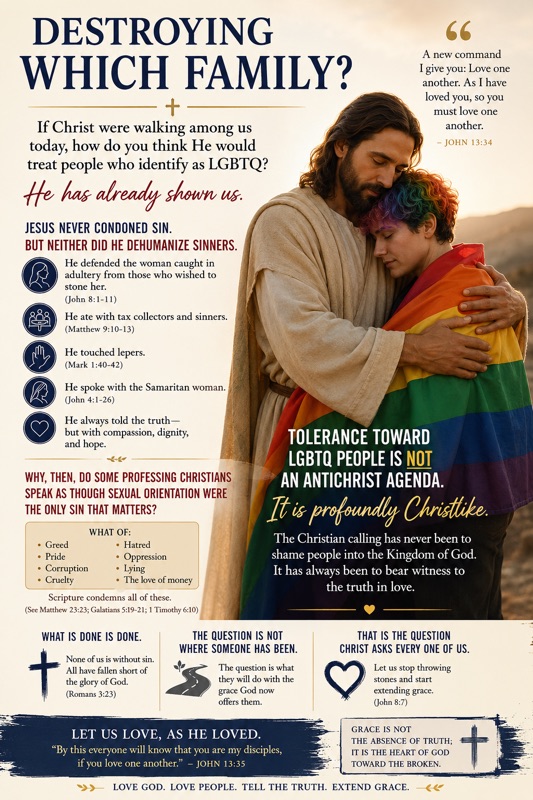
"Destroying Which Family?"

Man 1:
"You extreme leftists are bent on destroying the family with your LGBTQ agenda and your anti-Christ ideology."

Man 2:
Destroying which family?

The people destroying families are not those who insist that every human being deserves dignity.

The people destroying families are those who strip healthcare from seniors, undermine the social safety nets that keep vulnerable people afloat, and pursue policies that make life increasingly difficult for ordinary families.

They keep giving themselves tax breaks while everyone else is expected to tighten their belts.

Parents are forced to work longer hours simply to keep food on the table, leaving them with less time to raise their children.

Seniors who lose access to affordable healthcare suffer unnecessary anxiety, declining health, and, in some cases, premature death.

Families lose not only loved ones but also the wisdom, stability, and affection of grandparents who should have been there longer.

Those are the things that destroy families.

Not treating people with dignity.

So stop deceiving yourselves.


How Would Christ Respond?

If Christ were walking among us today, how do you think He would treat people who identify as LGBTQ?

He has already shown us.

Jesus never condoned sin.

But neither did He dehumanize sinners.

He defended the woman caught in adultery from those who wished to stone her.

He ate with tax collectors and sinners.

He touched lepers.

He spoke with the Samaritan woman.

He always spoke the truth—but He did so with compassion, dignity, and hope.


Are We Focusing on the Wrong Sins?

Why, then, do some professing Christians speak as though sexual orientation were the only sin that matters?

What of greed?

Pride?

Corruption?

Cruelty?

Hatred?

Oppression?

Lying?

The love of money?

Scripture condemns all of these.


Truth Without Dehumanization

Treating people with dignity is not an antichrist agenda.

It is profoundly Christlike.

The Christian calling has never been to shame people into the Kingdom of God.

It has always been to bear witness to the truth in love.

What is done is done.

The question is not where someone has been.

Taking a public stand against LGBTQ+ people does not make us holier.

Grace is not cheap.

The question is what they—and we—will do with the grace God now offers.

For that is the question Christ asks every one of us, not just "them."

I rest my case.

Don Kenobi

#OldManInTheMolue

#MyFrancisEssays


Wednesday, July 29, 2026

Austria's 42% Income Tax, Culture, and What Vienna Taught Me


Vienna Reflections: Culture, Identity, and the Emotional Labour of Being Black

A reflective essay on Austria's 42% income tax, Vienna, culture, identity, hospitality, and the emotional labour of being Black. A Nigerian perspective on society, civilisation, and intercultural understanding.


An Evening To Remember

July-26-2024: 42% income tax. Austria. That was the figure shared with me by a highly intellectual Nigerian gentleman I had the privilege of spending an evening with.

I told him he is one of Nigeria's best-kept secrets—and I meant it. Easily one of the most brilliant Nigerians I have met in a long time.

PhD holder. Federal Government College, Sokoto alumnus. (If you think you know who I'm talking about… na you sabi.)

Our host that evening was warm, thoughtful, and deeply engaging.

I hope I'm able to write about the wonderful evening I spent in his palatial home in a manner that fosters genuine intercultural understanding.

But for now, I want to focus on what it opened in my mind.

Vienna: A Moment That Stayed With Me

During my stay in Vienna, I did not see a single person sleeping on the streets.

But I did notice one shirtless, unkempt man with jagged hair and no shoes walking briskly near St. Stephen's Cathedral.

I am ashamed to admit this:
I avoided eye contact.

Why?
Because he was black.

Since then, I've tried to rationalise it.

Maybe it was a skit.
Maybe there was a camera.
Maybe it wasn't real.

Perhaps.
But perhaps not.

What stayed with me was not what I saw—but what I did.

A Conversation About Civilisation and Culture

That evening, our conversation drifted into politics, culture, and the future of civilisation.

He was brilliant.

And I found myself listening more deeply than I usually do—taking mental notes not just of his words, but of the direction they opened.

At the centre of it was a provocative idea.

That perhaps liberal democracy has largely run its course.

That the United Nations was phenomenally successful in advancing that project.

And that perhaps it is now time for the world to organise itself more intentionally around the cause of culture—around respect for all cultures.

Perhaps we should increasingly pursue our aspirations on the basis of the things that unite us, and culture is surely one of them.

What Small Countries Reveal About Big Questions

Consider:

  • Austria: — ~9 million people

  • Switzerland — ~8.5 million

  • The Netherlands — ~18 million

Combined, they are still smaller than Lagos, Kano, and one large Nigerian state.

Each of these countries has a relatively cohesive cultural identity.

Nigeria does not.

Why, then, are we surprised that they are able to organise themselves around production and build infrastructure that serves their everyday needs?

Nigeria's challenge has been the far more complex task of building unity across hundreds of languages, histories, and worldviews.

And despite what politicians say, that is not a flaw—it is a reality, no different from gravity. Yet machines are engineered—organised precisely—with that reality in mind.

Gravity exists. The challenge is to design systems that work with it rather than pretend it does not.

Hospitality, Humility, and a Nigerian Moment in Europe

At the end of the evening, we called an Uber.

Our host looked at us as though we were completely mad!

"This may be Europe - but we are Nigerians" he said.

Then he called his son.

"Go and drop them."

(And it was in the biggest and grandest Mercedes I'd ever entered)

That simple act of hospitality stayed with me.

Nigerians! I love you all!!

Did I mention he was Muslim?

Moments like that remind you that culture is not theory. It is lived generosity.

Austria Again: The Quiet Discomfort

But back to Austria and its 42% income tax.
There were beggars.

A limbless man.
A man sitting quietly near the cathedral exit.

And again, I confess:
Though I wanted to, I gave neither of them anything.

I also avoided eye contact.
Not because they were black this time.

But because I am black, 
and they were not.

Even now, I cannot fully explain that instinct. It was not logic. It was reflex.

And that is what unsettles me most.

The Emotional Labour of Being Black

The emotional labour of being black is rarely spoken about.

It is:

  • Constant awareness.

  • Constant recalibration.

  • Constant perception management.

  • Constant fear of reinforcing stereotypes.

  • Split-second identity calculations.

It is exhausting.

And often invisible.

Maybe one day I will fully understand my own reactions.

For now, I simply document them honestly.

Because sometimes honesty is not resolution.

It is the beginning of clarity.

Closing Thought

Austria gave me more than clean streets and high taxes.

It gave me a mirror.

A conversation about culture gave me a framework.

And personal moments of discomfort and gave me questions I still carry.

Perhaps the real link between all three is this:

How societies organise externally often reflects how individuals organise internally—around identity, perception, and belonging.

And sometimes, the hardest borders to cross are not national.

They are internal.

Don Kenobi

#BigAgendaAfrica
#CultureNotStructure 
#ReCultureNotReStructure 

Wendi & Mum


Tuesday, July 28, 2026

A Theological Reflection on Genesis, the Gospel, and the Counterfeiting of Christ


The Counterfeiting of Jesus Christ

Have you Fallen For The Counterfeited Christ? Are you following him confidently?

Did the ancient rebellion of the Nephilim foreshadow humanity's recurring temptation to replace the true Christ with a counterfeit?

Don Kenobi reflects on: Genesis, the Gospel, the example of Perpetua and Felicity, and the Counterfeiting of Christ...


A Theological Reflection

What follows moves beyond history into theological reflection.

Whether or not one accepts this interpretation, it offers an interesting lens through which to consider both the Gospel and humanity's recurring temptation to replace Christ.

Perhaps one way of viewing the Gospel is through the lens of the Nephilim.


God's Rescue Plan

If the corruption before the Flood involved not only moral decay but also the corruption of humanity itself, then perhaps Christ's mission was, in part, God's great rescue operation: to preserve and redeem humanity.

Perhaps the Lord came so that every man and woman willing to receive Him, however few remained faithful, would still have a path back to God.

For God is love.
God is grace.
He would not abandon humanity without first making a way home.

Perhaps, then, the Gospel can be viewed as God's determination to preserve humanity while extending redemption to every person who freely chooses the way of Christ.

If so, the Cross declares that no corruption, no ancestry, no lineage, and no darkness lie beyond the reach of Christ's redeeming blood.


The Oldest Deception

But another question naturally follows: What if the ancient rebellion did not end?

What if the same spirit that sought to corrupt humanity before the Flood now seeks to corrupt humanity's understanding of Christ?

If so, perhaps the greatest deception is not to deny Christ altogether.

Perhaps it is to redefine Him—to replace Him with a counterfeit Christ.

A Christ who tolerates evil instead of calling people to repentance.
A Christ who excuses injustice instead of confronting it.

A Christ who blesses oppression instead of defending the oppressed.

A Christ who blames victims rather than bearing their burdens.
A Christ who plays favourites among races.

A Christ whose blood is somehow incapable of washing away the mythical "curse of Ham."

In short: A Christ fashioned in the image of fallen humanity rather than the image of God.


The Christ of the Gospels

Yet this is not the Christ of the Gospels.
The real Christ crossed every boundary that human beings erected.

He touched the untouchable.
He welcomed the outcast.

He defended the powerless.
He broke down walls instead of building them.

His blood was shed for every tribe, every tongue, every nation, and every people.

Could it be, then, that the "curse of Ham" fable is itself a product of the very spirit that sought to corrupt humanity before the Flood—and now seeks to corrupt humanity's understanding of Christ?

For Scripture nowhere teaches that Christ's redeeming work is limited by race, ancestry, or genealogy.

Let me say that again:

Nowhere.
In Scripture.

Is it taught that Christ's redeeming work...
...is limited by race, ancestry, or genealogy.

Instead, Scripture declares:

"But as many as received Him, to them gave He power to become the sons of God, even to them that believe on His name." (John 1:12)

And the so-called "curse of Ham" raises its voice in protest:

"What about me?"

But Scripture smiles and replies:

"I have already answered you."

And then it speaks:

"There is neither Jew nor Greek, there is neither bond nor free, there is neither male nor female: for ye are all one in Christ Jesus." (Galatians 3:28)

If that is the testimony of Scripture, then no tradition, no ideology, and no man or woman—regardless of office, rank, or title—has the authority to say otherwise.


Perpetua and Felicity: One Humanity in Christ
The Witness That Shook an Empire

Perpetua and Felicity: One Humanity in Christ (The Witness That Shook an Empire)

The earliest Christians understood the truth of the Gospel in a way that should put many modern Christians to shame.

The story of Perpetua and Felicity reminds us why.

Perpetua and Felicity could scarcely have come from more different worlds.

Perpetua was a young noblewoman of Carthage—well educated, from a prominent family, and the mother of a nursing infant.

Felicity was an enslaved woman, heavily pregnant when she was arrested, with none of Perpetua's status or legal privileges.

Yet both had embraced Christ, and for that they were imprisoned together during the persecution under Emperor Septimius Severus.

In Christ, noblewoman and slave became sisters.

Their shared imprisonment, steadfast faith, and eventual martyrdom proclaimed a revolutionary truth: the Gospel creates a new humanity in which class, wealth, status, and privilege are eclipsed by a common allegiance to Jesus Christ.

Together, they entered the arena convinced that death was not defeat, but the doorway to eternal life.

The Roman Empire could imprison their bodies.

It could take their lives.

But it could not conquer the faith that united them or the hope that sustained them.

Their witness exposed the spiritual poverty of an empire built upon domination.

Rome arranged humanity into ranks.

Christ made them sisters.

That is the Gospel.

And any Christianity that cannot see the full dignity of every human being—regardless of race, ethnicity, social status, or background—has already ceased to see Felicity standing beside Perpetua as an equal.

That Christianity has already begun to replace Christ with a counterfeit.


The Counterfeit Christ

The Counterfeit Christ

If this reflection contains even a grain of truth, then the great spiritual battle is not merely over whether people believe in Jesus.

It is over which Jesus they believe in.

False religions openly reject Christ. But False Christianity does something far more dangerous - It keeps His name while quietly replacing His character.

Perhaps, then, the oldest deception has never been to reject Christ - but to replace Him....

....To preach His name while emptying Him of His nature.

To speak of Jesus while following:

  • A Christ who sanctifies pride.
  • A Christ who baptises prejudice.
  • A Christ who excuses cruelty—even to the tired, the poor, and the huddled masses.
  • A Christ who blesses hatred.
  • A Christ who leaves the old man untouched instead of making him a new creation.

The enemy achieves his greatest victory not in  persuading the world to reject Christ, but in persuading it to embrace a counterfeit Christ...

And the deepest battle of our age is not whether humanity rejects Christ, but whether it can still recognise Him.

I rest my case

Don Kenobi
#OldManInTheMolue
#MyFrancisEssays

Discernment in an Age of Propaganda: Be Wise

Beware: Those Who Banalise, and Launder Evil Are At The Door!

What happens when evil is no longer denied, but explained away?Drawing on Hannah Arendt, engineering, and personal reflection, this essay explores the subtle process by which commentators launder evil  until atrocities begin to seem understandable—and why discernment has never been more important.

About thirty years ago, a prominent Nigerian intellectual—whose name I will not mention—told my brother something that has stayed with me ever since.

He said he had studied cultures around the world and had encountered one with no concept of the devil.

At first, that sounded admirable.

He did not think so.

He found it deeply disturbing.

Why?

Because where there is no devil, there is often no evil.

Deceiving another person, manipulating them, or taking advantage of them is no longer regarded as morally wrong.

It simply becomes part of the game of life.

That conversation returns to me whenever I listen to certain commentators today. They refuse to call evil by its proper name. Instead, they present themselves as balanced, nuanced, objective, sophisticated—even intellectual.

But moral neutrality in the face of evil is not wisdom.

It is surrender.

Hannah Arendt famously wrote about the banality of evil. Increasingly, however, I find myself thinking about something related, yet distinct:

The laundering of evil.

We have all heard the arguments.

"Yes, they committed atrocities... but look at the infrastructure."

"Yes, thousands died... but look at the technology."

No.

Progress never cancels wickedness.

Roads do not justify murder.

Economic growth does not erase cruelty.

Every act of evil demands an accounting.

The moment we begin weighing bridges against bloodshed, or prosperity against persecution, we have already lost something essential—and civilization itself begins to unravel.

As an electronics engineer, I often think of the old telegraph system.

A signal travelling a long distance becomes weakened by the resistance of the copper wire. To restore it, relay stations were placed along the line. Many people do not realise that the earliest relays effectively served as signal amplifiers.

Some commentators perform a similar function.

They amplify narratives.

They strengthen weakened signals.

But instead of amplifying truth, they amplify the banality of evil. They launder the reputations of individuals, empires, and nations, making atrocities appear understandable—even reasonable.

We should be wary of this.

Deceit comes in many forms.

Indeed, I think deceitfulness may be among the worst traits a human being can possess.

A deceiver corrupts not merely actions, but perception itself. He makes evil appear good and good appear evil.

That is profoundly dangerous.

I will not go much further, except to say this:

We must remain vigilant.

I have often thought about Padre Pio.

People came to him for confession, and on occasion he would send them away abruptly—sometimes with harsh words—because, it was said, he discerned that they were not truly repentant.

It was even said that he could "smell" sin.

Whether one takes those stories literally or not is beside the point.

The point is that some people develop an extraordinary sensitivity to deception.

People sometimes accuse me of overreacting.

Perhaps.

But I would rather be overly sensitive to deceit than become incapable of recognising it.

The world order is shifting before our eyes. This is precisely the time for heightened discernment.

Choose your friends carefully.

Test motives.

Question narratives.

And above all...

Speak the truth.

Civilization depends on it.

I rest 

Don Kenobi

#BigAgendaAfrica #Discernment #Truth 
#MoralClarity #TheBanalityOfEvil #Character
#BigAgendaAfrica #CultureNotStructure


Sunday, July 26, 2026

Aryan Paganism and the Replacement of Christ


Aryan Paganism: White Supremacism and the Replacement of Christ

Why Did Influential Figures Within Nazi Germany Seek to Replace Christianity With a Mythic Aryan Religion? This researched article explores the spiritual dimension of Nazi ideology and then asks a deeper theological question: What happens when race, nation, or politics takes the place of Christ?

The Spiritual Experiment Behind Nazi Germany

One of the lesser-known aspects of the Third Reich was its attempt to forge an entirely new spiritual identity for Germany.

What has come to be known as Nazi Aryan Paganism was an ideological and quasi-religious movement promoted by influential figures within the Nazi regime, particularly Heinrich Himmler and elements of the SS.

It sought to revive, or in many cases reinvent, a pre-Christian “Aryan” faith rooted in Germanic mythology, racial mysticism and hostility towards Christianity.

Rather than merely governing a nation, some Nazi leaders envisioned creating an entirely new civilisation, with its own myths, rituals, symbols, heroes and theology.

This raises an intriguing question.

Why Do Supremacist Ideologies So Often Find Themselves in Conflict With Christ?

History suggests that this is no coincidence.

The Gospel proclaims a Kingdom open to every tribe, every tongue, every nation and every people.

The New Testament teaches that every human being bears the image of God and that salvation is offered without distinction of race or ethnicity.

That universal message sits uneasily beside any ideology that elevates one race above another

Christ breaks down walls,
Supremacist ideologies build them.

Christ calls people to humility.
Supremacist ideologies glorify pride.

Christ commands us to love our neighbour.
Racial ideologies divide humanity into the "superior" and the "inferior."

The two visions cannot peacefully coexist.

The next time you hear someone claiming to speak for Christianity dismiss compassion as the "weakness of Western civilization,"

Or ridicule empathy as though it were a vice.

Or mock the poor while dismantling the fragile safety nets that keep many from utter despair.

Pay close attention.

When you hear such words or witness such actions, recognize the spirit at work. It is not the Spirit of Christ.

For we are God's workmanship, created in Christ Jesus to do good works, which God prepared in advance for us to do (Ephesians 2:10).

Any ideology that exalts one people over another,
That glorifies hardness of heart,
Or treats mercy as weakness,

Is anathema.

It stands in direct opposition to the Gospel.

Christianity Was Seen as an Obstacle

For many Nazi ideologues, Christianity was not rejected merely because they regarded it as “Semitic.”

It was rejected because its moral vision challenged the foundations of racial supremacy.

The Gospel’s emphasis on mercy, humility, forgiveness, compassion and the equal dignity of every person stood in direct conflict with a worldview built upon bloodlines, conquest and biological destiny.

Not every Nazi leader held identical religious views, and historians continue to debate Adolf Hitler’s personal beliefs.

Nor did the Nazi regime completely replace Christianity throughout Germany.

Nevertheless, influential figures such as Heinrich Himmler deliberately promoted alternative myths, symbols, ceremonies and rituals within the SS. These were intended to displace Christianity and cultivate a new spiritual identity rooted in an imagined Aryan past.

This was about more than politics.
It was an attempt to relocate the sacred.

Race became sacred.
Blood became sacred.
The nation became sacred.
History became sacred.

For many followers, even the Führer assumed an almost messianic significance.

Politics had begun to function as religion.

When Politics Becomes Religion

Political philosopher Eric Voegelin warned that politics can become a substitute religion whenever it claims ultimate authority over human destiny.

History has witnessed this in many forms.

Whenever race, nation, ideology or political power occupies the place that belongs to God alone, politics ceases to be merely political.

It becomes an object of worship.

For Christians, this presents a profound challenge.

Whenever any movement asks us to place race above Christ...
Nation above Christ...
Leader above Christ...
Party above Christ...
Or ideology above Christ...

Christians should recognise the danger immediately.
The issue is not merely political.
It is profoundly spiritual.

It is the replacement of Christ.

Perhaps that has always been the oldest deception - not merely to deny Christ, but to redefine him.

Don Kenobi
 
#OldManInTheMolue 
#MyFrancisEssays 


Tuesday, July 21, 2026

Lord, I Saw Him: Seeing Christ in the Forgotten

Lord, I Saw Him

A MOnoLogUE on Friendship with a man in a wheelchair (at the GloverRoad-AlfredRewane Intersection becomes a reflection on compassion, dignity, poverty, and finding Christ in the forgotten among us.


May His Soul Rest in Peace

Sunday, July 19, 2026

“Where's my friend?” I asked the little guy who sometimes pushed his wheelchair around. The same little guy who sold DVDs featuring little people.

His face fell.

“I know,” I said quietly. “The last time I saw him…”

The traffic light turned green.

“I'll come again,” I shouted. “We'll talk, okay?”

He nodded.

I drove away.


I Saw Him

The last time I spoke with him, I realized I hadn't seen him for quite a while.

So I asked,

“Where have you been? I haven't seen you around?”

He sighed.

“These environmental people keep driving us away.”

I looked at him, puzzled.

“Driving you where?”

He shook his head.

“Nowhere. They just drive us away. They don't want us hanging around the roads begging. Once they see our wheelchairs and our things, they chase us.”

Not to a shelter.

Not to a rehabilitation centre.

Not to somewhere they could receive food, medical care, or dignity.

Just...

...away.

I drove off feeling suffocated by the quiet cruelty we have learned to normalize.


We Would Rather They Disappear

It struck me that perhaps the greatest tragedy is not poverty itself.

It is our desire not to see it.

The little these men and women do, sitting quietly by the roadside hoping someone might stop and help, has somehow become too much for society.

So rather than solve the problem...

...we remove the evidence of the problem.

We would rather they simply disappear.


"Lord... I Saw Him"

Later that day I found myself unexpectedly emotional.

There were tears in my eyes.

Not because I had done something extraordinary.

Quite the opposite.

I simply whispered,

"Lord... I saw him."

Thank You for giving me eyes that can still see.

Because it is frighteningly easy to stop seeing.

To drive past.

To become accustomed to suffering.

To become comfortable with invisible people.

Yet another question would not leave me.

Obi... did you do enough?


How I Came to Notice Him

People often ask how I came to know him.

The answer is simple.

I passed him almost every time I drove to the Ikoyi Club.

Like many Lagosians, I was often in a hurry.

And like many Lagosians, I hardly ever carried cash.

So I would lower my window, bow slightly, smile, and gesture,

"I'll circle back."

He always nodded.

Not impatiently.

Not suspiciously.

Just...

...gratefully.


The Gift of Trust

Looking back, I think that was what first caught my attention.

Unlike many who asked for alms, he never continued pleading once I had spoken.

He never chased the car.

Never argued.

Never tried to make me feel guilty.

Instead, he did something remarkable.

He trusted me.

In that brief exchange, he gave me something I had not expected.

He gave me dignity.

It was as though he was saying,

"I believe you will keep your word."

That simple act of trust made it much harder for me not to.


More Than Money

Sometimes I genuinely had no cash.

But once or twice I happened to have a bottle of cold water with me, probably left over from a packed lunch.

I would hand it to him.

It wasn't much.

But he always received it with the same gratitude.

Looking back now, I realize our relationship was never really about money.

It was about recognition.

About acknowledging another human being.

About seeing one another.


One of Our Last Conversations

One of the conversations we shared, I took the liberty of recording.

Today, I am grateful that I did.

It is now one of the few remaining memories I have of my friend.

Watch our conversation here:

▶️ https://www.facebook.com/share/v/1cKkop7vCE/


The Tyres of a Wheelchair

One day I asked him,

“Is there anything you think I can do for you?”

His answer surprised me.

He didn't ask for money.

He pointed at his wheelchair.

“The tyres.”

I asked how much they would cost.

Perhaps ten or twelve thousand naira.

A few days later I returned with the money in an envelope.

He was deeply grateful.

It wasn't a fortune.

But it mattered.

Sometimes compassion is not measured by how much we give.

It is measured by whether we listened.


I Want to Know My Friend

I had planned to go back.

This time with a camera.

Not because I wanted another "poverty video."

Quite the opposite.

I wanted to know my friend.

Who was he?

Where was he from?

How did he end up here?

What had he dreamed of becoming before life took this turn?

What hopes did he still carry?

Because before he became "the man in the wheelchair," he was someone's son.

Perhaps someone's brother.

Perhaps someone's father.

A man with a name.

A story.

A life.

Now...

I never will.


A Small Idea

His passing has strengthened an idea that has been growing in my mind.

What if we created a simple interview format?

Nothing elaborate.

Just honest conversations.

Questions like:

  • What is your name?
  • Where are you from?
  • How do you survive each day?
  • Do you have a bank account or an Opay account?
  • What number is linked to it?
  • What are your hopes?
  • What would you like the world to know about you?

The videos could be recorded by volunteers and uploaded to the Intent Makers community.

Not to make people objects of pity.

But to restore something even more valuable.

Their identity.


One Person. One Connection.

I've also been thinking about how people should help.

Should everything go into one central charity account?

Perhaps.

But I increasingly believe something else may be even more powerful.

One person.

One relationship.

One act of kindness.

You hear someone's story.

You decide what you want to do.

Perhaps you send ₦1,000.

Perhaps ₦5,000.

Perhaps more.

Perhaps you simply call every now and then to ask,

"How are you today?"

Real compassion is personal.


Technology Can Help Us See

Our lives are busy.

Most of us don't have the time to stop and get to know everyone we pass.

But technology gives us another opportunity.

From your living room.

From your office.

From your car.

You could watch a three-minute interview.

Learn someone's name.

Pray for them.

Call them.

Encourage them.

Help them.

Suddenly, the invisible become visible again.


Compassion Is Good Economics

Compassion is not only good Christianity.

It is also good economics.

Imagine one million disabled Nigerians becoming more productive because ordinary citizens helped them obtain mobility, medical care, equipment, training, or employment.

If each created just the equivalent of US$1,000 of economic value every year...

Nigeria's GDP would increase by US$1 billion annually.

Helping people become productive does not make society poorer.

It enriches us all.


"You Did It Unto Me"

Jesus spoke about these people far more often than we remember.

"I was hungry and you gave me food.

I was thirsty and you gave me drink.

I was a stranger and you welcomed me.

I was sick and you visited me."

Then He added words that should unsettle every Christian:

"Whatever you did for one of the least of these brothers and sisters of mine, you did for me."

Matthew 25:40

Perhaps that man in the wheelchair was never merely a beggar.

Perhaps Christ was sitting there all along.

Perhaps every time I slowed down at that traffic light...

...it was Jesus waiting patiently by the roadside.


Let Us Become Our Brother's Keeper

This is only the beginning of an idea.

But perhaps ideas like these can become something larger than charity.

A community.

A movement.

A network of compassion.

A society that refuses to look away.

Let us use the technology we now have to restore names, stories, dignity, and hope to those we have forgotten.

Because the opposite of love is not hatred.

The opposite of love is invisibility.

And perhaps our first duty is simply this:

To see.

For perhaps the greatest miracle is not that we see Christ in the poor...
but that, in learning to see the poor, we finally begin to see Christ.


Obi Akaraiwe | Don Kenobi

#OldManInTheMolue
#MyFrancisEssays

Baptismal Pools, Political Religion, and the Kingdom of God

  Baptismal Pools, Political Religion, and the Kingdom of God Baptismal Pools, Political Religion, and the Kingdom of God,  is a reflective ...