Monday, April 27, 2026

The Loss Of Discernment In Christendom: When Gullibility Becomes A Choice...

The Loss of Discernment: When Gullibility Becomes a Choice

At what point does believing lies become a moral failure?A reflection on truth, discernment, and responsibility in Christian life 


I. The Real Issue Is Not Gullibility

Gullibility is not a mortal sin.
But don’t relax too quickly.

Because what the Catechism of the Catholic Church does not list explicitly, it still addresses indirectly, and sometimes more seriously.

The issue is not gullibility.
The issue is the refusal to discern.


II. From Weakness to Complicity

A person can be deceived.
That is human.

But a person who chooses not to question,
who outsources their judgment,
who refuses to examine what they are told,

has crossed a line.

Not into error,
but into responsibility for error.

At that point, gullibility stops being a weakness.
It becomes participation in falsehood.


III. The Sin Beneath the Surface

Catholic tradition would not call this “gullibility.”
It would call it:

  • A failure of prudence

  • A neglect of reason, which is itself a gift from God

  • A quiet surrender to falsehood dressed as truth

Scripture does not treat this lightly.

The Bible repeatedly warns, not just about evil, but about deception:

  • False prophets

  • Wolves in sheep’s clothing

  • Teachers who tickle ears

Which raises a harder question:

If deception is everywhere,
what does it mean to refuse to discern?


IV. When Gullibility Becomes Dangerous

Gullibility becomes spiritually dangerous when it is:

  • Comfortable – you believe what flatters you

  • Convenient – you accept what fits your tribe

  • Selective – you reject truth when it is inconvenient

At that point, it is no longer innocence.
It is alignment.


V. Christendom’s Quiet Crisis

A people can be trained
not just to believe lies,
but to prefer them.

To be suspicious of truth.
To distrust decency.
To hate what is good.

Not because they are evil,
but because they have stopped examining,
stopped testing,
stopped thinking.


VI. The Moral Turning Point

In Catholic thought, the danger is not that you were misled.

The danger is that you chose not to see.

Because truth is not hidden from those who seek it.
But it is often invisible to those who have already decided
what they want to believe.


VII. The Molue Question

So the Old Man would lean forward,
look at the bus,
and ask quietly:

If Scripture warned you about deception…
If reason was given to you…
If truth is still available…

Then at what point
does gullibility stop being misfortune…
and become a choice?


VIII. From Principle to Practice

Discernment is not tested in theory.
It is tested in what we see,
who we judge,
and what we choose to believe.


IX. A Case in Point

Barack Obama

He is a credit to his race: the human race.

Ever graceful. Ever in pursuit of:

“whatsoever things are true… honest… just… pure… lovely… of good report.”

If that sounds familiar, it should.

Sadly, many who disagree most vociferously about him will be Africans, not African Americans.

Many still operate under a kind of theological colonialism.

Their colonial masters?

Figures like Oral Roberts and Kenneth Copeland.

Over decades, this influence has reshaped African Christianity.

The result is subtle but devastating:

Jesus displaced.
Mammon enthroned.

And from that substitution flows the Prosperity Gospel.


X. Evangelicalism and the Reckoning to Come

Evangelicalism will answer to God for many things.
One of them will be Barack Obama.

It must reckon with:

  • How outrage drowned out charity

  • How suspicion was baptized as discernment

  • How it became comfortable with Donald Trump


XI. Was There Ever Such a Time?

Was there ever a time when Christian witness came first?

Or have we imagined it?

“The more you look, the less you see.”

The more you look for Christianity in much of what passes today as Evangelicalism,
the less you see.


XII. I Was There

I am not speaking as an outsider.

T. D. Jakes was my pope.
Joel Osteen my archbishop.

I was there.

And I watched something shift.
Or perhaps, I watched an illusion collapse.


XIII. Did Something Shift?

Many believe something changed.

No.

Perhaps we were simply deceived from the beginning.


XIV. The Fork in the Road

Two gates stand before us:

  • One wide, polished, inviting

  • One narrow, broken, almost hidden

Christ’s words are clear:

The wide path leads to destruction.

Yet many choose it anyway.


XV. The Warning We Ignored

Scripture is blunt:

“Be not deceived: evil communications corrupt good manners.”

Association shapes destiny.

And deception, once embraced, reshapes the soul.


XVI. A Case Study: God’s Generals

God’s Generals

A book that turned flawed men into near-saints.

Human weakness was not acknowledged.
It was canonized.

And many followed blindly.


XVII. The Real Problem

Power has become more urgent than witness.
Influence more urgent than integrity.
Access more urgent than truth.


XVIII. So, Is Participation in Falsehood a Mortal Sin?

According to the Catechism of the Catholic Church, a sin is mortal if three conditions are met:

  • Grave matter

  • Full knowledge

  • Deliberate consent

So the real question is not:

Is participation in falsehood a sin?

It is:

When does it rise to the level of grave moral responsibility?


Grave Matter

Spreading falsehood knowingly becomes grave when:

  • It leads others into error

  • It distorts faith or moral truth

  • It causes real harm


Full Knowledge

If a person:

  • Is genuinely misled

  • Lacks formation or education

  • Is operating in confusion

Then the sin may be real, but not mortal.

But once the person recognizes the falsehood and continues anyway,
the situation changes.


Deliberate Consent

This is the decisive line.

There is a difference between:

  • Being deceived

  • Choosing to remain in deception

If someone:

  • Avoids truth because it is inconvenient

  • Prefers comforting lies

  • Defends what they know is false

They are no longer merely misled.
They are participating.


Where It Becomes Mortal

Participation in falsehood becomes a mortal sin when:

  • The falsehood involves serious moral or spiritual harm

  • The person knows it is false, or strongly suspects it

  • The person freely chooses to support or spread it

At that point, it aligns with:

  • Sin against truth

  • Failure of prudence

  • Cooperation with evil


XIX. The Final Molue Question

At what point does gullibility stop being weakness
and become consent?

At what point does deception stop being something done to you
and become something you have chosen?

May Jesus have mercy on us all.


Don Kenobi
#OldManInTheMolue | #MyFrancisEssays | #MolueMonOLogUes


The Restructuring Impediment - On The Long Road To National Development


Restructuring: The Grand Illusion

A hard look at Nigeria’s political rhetoric, the illusion of restructuring,
and the long road to real national development.

A Nation Without a Plan

Leaders have no real plans to develop the nation. In their psyche, the developed West, and even the more rapidly developing East, offer an escape route. To them, Nigeria represents a farm.

A farm with low-hanging fruits.

They even invite foreigners, come, my brother, bring a big basket.

They come down to Nigeria, fill their baskets, go back to Dubai, return when it is depleted, refill, and go back again to Dubai, London, Johannesburg, Doha, a cycle, or shall I say, a culture of replenishing their lives at the expense of the abjectly, totally, utterly poor.


The Extraction Economy

This is not accidental. It is a system.

A system where value is not created, but extracted. Where the elite do not build, but harvest. Where the nation is not a project to be developed, but a resource to be mined.

And like all extractive systems, it leaves behind depletion, despair, and deepening poverty.


The Mathematics of Inequality

In mathematical terms, I am not showing off. I was not particularly good at mathematics, but the little I learned helps me follow and analyze arguments by reducing them to their essence and testing for proportionality, or even inverse relationships.

For the abjectly poor:

[Their Cycle of Life] = k / [The Cycle of Your Life]

Where k is a constant.

The faster “their” cycle runs, the more depleted “yours” becomes.


The Restructuring Question

I have digressed.

Back to restructuring.

Ask the restructurenistas, “How about coming together to draw a proper roadmap, a plan?”

“No,” they will answer emphatically.
“No. That will be after restructuring.”

Often, they say it like this:

“That will be done after restructuring. Are you not listening? Have you not been listening?”

And many times, I respond very calmly:

“So what exactly is restructuring? How can we start it? What is stopping us from starting it now, on Monday, on the first of July, or on the first of October, our Independence Day?”


The Cabal Excuse

You will hear several different answers which all mean the same thing, the cabal.

“The cabal is stopping us from restructuring? Which cabal?”

Raised voices again:

“Are you not in this country?”

And that is where the conversation usually ends.


A Familiar Pattern of Deception

Ladies and gentlemen, this talk of restructuring is just another scam.

It sounds like a genuine, intelligent solution to our problems, but it is no different from all the debates we have had over the last three decades about the removal of fuel subsidies.

Remember these arguments?

  • Nigeria is the only nation where a bottle of Coke costs more than a bottle of petrol
  • Removing the subsidy, increasing the price, will stop smuggling
  • Increasing the price of petrol will make it possible to build new refineries

We have heard it all before.


The Latest Iteration of the Same Lie

They have lied to us for decades.

Restructuring is simply the latest iteration of that lie.

Wake up.


No Quick Fix

We are not one election, one initiative, or one restructuring away from a better country.

The truth is simple.

We are not one election, one initiative, or one restructuring away from a better country. Rather, we have a very long road to travel.

There is no quick fix, and the sooner we start, the better for us.


The Political Shamans

All this talk of restructuring reminds me of shamans dancing around a totem, painted in impressive colors, claiming to exorcise, claiming to cure illness.

We all know how diseases are caused, and how they can be healed.

Let no political shaman fool you.


Final Word

Don't be MUGU!

I rest my case.

Don Kenobi
#BigAgendaAfrica 
#CultureNotStructure 
#ReCultureNotReStructure
June 21, 2019. 

Friday, April 24, 2026

The Loss of Discernment in Christendom


Here's the picture that got me started: 


A passenger saw former U.S. President Joe Biden flying commercially and people online questioned why - but the story points back to his long-standing habit of living simply. 

After losing his wife and daughter in a tragic accident early in his career, Biden promised his sons he would come home every night. And he did.

For 36 years as a senator, he kept that promise by commuting daily on Amtrak, earning the nickname “Amtrak Joe.”

So seeing him on a regular flight isn’t unusual, it reflects a lifelong pattern: despite holding high office, he has tried to remain grounded, prioritizing family and staying connected to ordinary life.


The Loss of Discernment in Christendom


A Molue Monologue by Don Kenobi

#OldManInTheMolue #MyFrancisEssays


This is a man that most wicked amongst us have trained otherwise decent Christian folk to hate.


Just as they trained them, even Africans, to hate Obama.


A tragic loss of Christian witness.

And it is not accidental. It is deliberate.


When Guardrails Are Removed


When guardrails are removed, the unwary fall when they stumble.


Decency is a guardrail.


So when decent men are systematically rubbished and demonized, one after the other, it is not a coincidence:

  • Bill Gates

  • Barack Obama

  • Joe Biden

  • Jimmy Carter

  • On and on


It creates a vacuum, one that allows far less decent voices to rise and take their place.


Evil always seeks to replace good by pretending to be what it is not.


The Question We Refuse to Ask


The New Testament repeatedly warns about deception and spiritual wickedness.


So let me ask plainly:


Are we saying there is no deceit in the world today?

No spiritual wickedness in high places?

None even within the church?


Or was Scripture warning us about nothing?


Gullibility matters. It is not harmless. At some point, it becomes a choice.

And that choice has consequences.


A Picture of Humility


Now consider this:


Joe Biden, portrayed by some as a villain, sitting quietly on a commercial flight.


Strange, isn’t it?


The very picture of humility, one of the great virtues of Christendom.


Now compare that with the figures celebrated by the so-called “Christian right.”


Isn’t it startling that we carry on as though there is no grand deception unfolding in Christendom?


The Warning We Prefer Not to Hear


“Should I quote 2 Thessalonians 2:11, or are we ‘winning’ so much by obeying its warning that we’d rather not hear it one more time?”


Well, let me quote it just this once, along with the surrounding verses:


2 Thessalonians 2:8–13 (New Catholic Bible)


Then the lawless one will be revealed, and the Lord Jesus will slay him by the breath of his mouth and destroy him by the splendor of his coming.

His coming will be the work of Satan made manifest in all power and signs and wonders of falsehood, and in every wicked deception designed for those who are perishing because they refused to accept the love of the truth and thereby gain salvation.

For this reason, God imposes on them a powerful delusion. They believe what is false, so that all who have not believed the truth but instead have taken pleasure in wickedness will be condemned.

However, we must always give thanks to God for you, brethren beloved by the Lord, because God chose you from the beginning to be saved through sanctification by the Spirit and through belief in the truth.


A Sobering Note from the Footnotes


The footnotes that accompany the Catholic Bible are striking. They must be read carefully:

  • 2 Thessalonians 2:8 — Paul describes a final offensive of evil, a great apostasy, before the triumph of Christ. The lawless one appears powerful, but he is ultimately defeated by Christ.

  • 2 Thessalonians 2:10 — “Love of the truth” refers to embracing the Gospel fully. To reject it is to reject love itself.

  • 2 Thessalonians 2:13 — Salvation requires perseverance: fidelity to truth, active good works, and adherence to apostolic teaching.

  • The passage also reveals the harmony of the Trinity in salvation:

    The Father calls, the Son shares His glory, and the Spirit sanctifies.


Final Word


Deception is not theoretical.

It is active.

It is persuasive.

And it is often welcomed.


Thank you for your attention.


Don Kenobi

#OldManInTheMolue

#MyFrancisEssays

The Illusion of Leadership: The Bucket That Cannot Hold a Nation’s Hopes


The Bucket That Cannot Hold a Nation’s Hopes 

A hard-hitting updated essay on Peter Obi, political laziness, and Nigeria’s culture of low expectations, revealing how talk is replacing real leadership and why the crisis goes beyond politics. 


Dear Eustace,

That’s the illusion he sells. His tenure was anything but excellent. He was impeached, a testament to his inability to lead people of diverse backgrounds, abilities, and opinions.

He showed his hand again in his leadership of the Labour Party, or rather, his lack of it. And then once more during the presidential elections, when he did a reverse Usain Bolt, celebrating from the 10-metre mark when he still had 90 metres to run.

“I don’t need structure. I don’t need a manifesto.”

On and on, he demonstrated a troubling lack of political acumen.

Yet, in spite of all this, I still voted for him. Not because I believed in him fully, but because I could not possibly vote for Atiku or Tinubu.

As it turns out, INEC cheated, if we are to believe APC decampees.

But here’s the question: what did he expect?

It took a former head of state to defeat an incumbent, and you think a lazy, lacklustre campaign would do it? Jogging from the 10-metre mark, celebrating a victory that had not been won?


Fast Forward to Today

By all indications, he appears even lazier now.

He seems to believe he has stumbled upon some secret cache of ideas for governance that no Nigerian in history has accessed. That is naïveté.

The challenge in Nigeria is not a lack of ideas. It is cultural.

We have done things the wrong way for so long that our minds have become twisted, literally out of shape.

Consider something simple. At a roundabout, people make a U-turn instead of going around, even when there is no traffic.

Why?

What are they saving? Nothing.

It is simply a mindset that enjoys cutting corners, rule-breaking, cheating.

And it is foolhardy to believe a viable nation can be built on the back of a citizenry that takes pleasure in disorder.

Even worse is the belief that this mindset has nothing to do with our national condition.


Leadership and the Cultural Crisis

Leadership matters, unquestionably. But leadership must be multidimensional. It must understand the deeper forces that shape society.

Peter has not shown this depth.

He loves to invoke Singapore. Let us talk about Singapore.

Lee Kuan Yew understood something profound. After sending Singapore’s brightest minds abroad, he noticed that their children behaved no differently from those raised without similar exposure.

His conclusion was unsettling but deliberate. He believed culture, especially early formation, came largely from the home. From mothers.

So he intervened, socially and structurally, to influence outcomes.

Over time, he observed change.

That is leadership that does not rest. Leadership that searches relentlessly for leverage points in society.

Not slogans. Not optics. Not self-presentation.

Peter, by contrast, comes across as a self-exalter. A self-glorifier.

He appears humble to many, yes. But true leadership requires the ability to move across levels of understanding, what we once called the “ladder of inference.”

I first encountered that idea nearly 25 years ago in a course by Tony Arabome in Port Harcourt. It stayed with me because it separates thinkers from performers.


The Cult of Low Expectations

Don D’Baptist said it plainly:

This is obscurantism layered on obscurantism.

You want people to vote, yet expect them to do the heavy lifting of discovering why they should.

Meanwhile, real politicians do the work.

Barack Obama crisscrossed America, repeating the same lines, showing up relentlessly.

Joe Biden, voice strained, still showed up.

That is the work.

What we are seeing instead is something else entirely, a lowering of standards so profound that supporters now proudly defend mediocrity.

A kind of political lassitude.

He posts pictures with EU representatives. To what end?

Always something, always optics, carefully arranged to mask a deeper inadequacy.


The Football Analogy

We say we don’t want another politician. We want someone willing to work.

Put in the hours.

But what we have is a man presenting himself as Cristiano Ronaldo while avoiding training, demanding captaincy without scoring goals.

Ten seasons. No goals.

Move him from one club to another, and he still demands the armband.

Ask him why, and he reminds you of his days in Awka youth league.

“Go and see what I did in Awka FC.”

That is not leadership. That is nostalgia masquerading as competence.


A Dangerous Pattern

What we are witnessing is familiar.

Donald Trump showed the world how exhausting leadership by noise can be. Talk more than action. When things go wrong, find someone else to blame.

Nigeria risks walking into a similar trap.

A leader who thrives on perception, who substitutes motion for progress, who mistakes attention for achievement.


Final Word

Let me be clear.

Peter Obi is not being condemned.
What is being said is simpler, and perhaps more damning:

He has not changed.
He has not learned.
He has not evolved.

And so, he is not the man for this moment.

If we are choosing him as a compromise, fine. 

Let us admit it honestly.
But let us not pretend we have found the best Nigeria can offer.
Because that would be the greatest illusion of all.

 I rest my case.

Don Kenobi

#BigAgendaAfrica | #CultureNotStructure | #BigAgendaAfrica | #MolueMonologue| #OldManInTheMolue |

Original Essay written 4-Nov-2025 may be found here: https://donkenobi.blogspot.com/2025/11/p2b-absurd-illusion-of-leadership.html


Monday, April 20, 2026

Misericordia: When Mercy Offends Justice

Betrayal, Identity, and Misericordia
A Reflection on Power, Deceit, and the Scandal of Mercy

If the worst man in history repented, would God forgive him? This gripping reflection on mercy, justice, and deceit challenges everything you think you know about faith.

Preamble

Some essays insist on being finished.
Others resist closure because the questions inside them are still alive.

This one… perhaps belongs to both worlds.

I cannot now remember what triggered this essay, started on the 21st of April 2026. I referenced “screenshotted” images, but I don’t recall what they depicted. The reference to Dan Quayle leads me to believe JD Vance had something to do with it. And since Pope Leo XIV is mentioned, it may have been about his rather rude advice to the Pope to stick to theological matters. 

Read on (make sense of it it you can!)


Don Kenobi writes:

Here are the links to the screenshotted posts. (That’s a word, right?) 

First Thought: Betrayal

The first Screenshot got me thinking, Poor Leo. A Vicar of Christ, just betrayed. The lukewarm, tepid, half-silent, semi-demi pushback from his fellow priests sounded almost as loud as the smack that followed Judas’s kiss"

Christ, after all, wasn’t betrayed by atheists.

He was betrayed by religious leaders, allied with the state, protecting their power.

That is the part we keep forgetting.

Not Rome alone.
Not Caesar alone.

But the quiet consensus of men who knew better…
and chose survival over truth.

Betrayal is rarely loud.
It is administrative.
Procedural.
Minuted.

Signed off in meetings where no one wants to be the one who says:
“This is wrong.”


Second Thought: Identity

The second screenshot got me thinking, What have we got here? A man without an anchor. A voice searching for a mirror. Dan Quayle can be very proud of himself. I mean it...

Because what we are seeing now is not just politics,
it is the manufacture of identity.

Not identity as inheritance,
but identity as performance.

A man becomes what the moment demands.
Not what truth requires.

And so he bends.
And bends again.

Until there is nothing left to bend.

Only a shell that echoes whatever power whispers into it.

Identity, in such a world, is no longer who you are.
It becomes who needs you to be.

And that is a dangerous place for any man to live.


Third Thought: Deceit

The third one…

It mad me think of many an angry monologue I’ve written.

What angers me? The deceit.

Not ignorance.
Ignorance can be taught.

Not weakness.
Weakness can be strengthened.

But deceit…

Deceit is deliberate.

It is the knowing smile behind the lie.
The careful construction of half-truths.
The weaponization of language.

Calling evil “complex.”
Calling compromise “wisdom.”
Calling silence “prudence.”

Deceit is not confusion.

It is strategy.


A Conversation in Orléans

I once met a Polish man in Orléans.

Actually, he was French. (Born in Poland)

The first thing he said to me was:

“See? I’m a Slav. My people were enslaved too…”

Albin. A lovable rogue.

He was in his mid to late 70s, about fifteen years ago.

A family member of his was very sick, and before the meeting we came for started, we held hands and prayed.

He choked first.

Then cried. Just a little.

Then he said something that stayed with me:

“My problem with God is His misericordia.”

I had never heard the word used that way before.

There was a church in my adopted city called Mater Misericordiae.

I thought it meant “misery-heart.”

It does, in a way.

But I wouldn’t have used it the way Albin had.

Turns out, the word mercy is derived from it.


The Question

“What do you mean, Albin?” I asked, hoping to understand.

He looked at me, troubled.

“If Adolf Hitler repented just before dying… he gets to go to heaven?”

He shook his head.

And there it was.

Not a political question.
Not even a theological one, at first glance.

A moral earthquake.


The Scandal of Mercy

Because what Albin was really asking was this:

Is justice negotiable?

Is there a door…
through which even the worst man who ever lived…
can walk in…
at the last second…
and sit beside his victims?

And if that door exists,
what does it say about God?

About justice?

About us?


The Answer We Resist

Christianity does not answer this question comfortably.

It answers it offensively.

Yes.

If repentance is real,
mercy is real.

And if mercy is real,
it does not ask our permission.

That is the scandal.

Because we want mercy…
for ourselves.

But justice…
for everyone else.

We want our sins contextualized.
Explained.
Understood.

But we want theirs…
remembered.
Recorded.
Punished.

Preferably forever.


The Cross and the Ledger

At the center of Christianity is not a courtroom.

It is a cross.

And the cross does something terrifying to human accounting.

It cancels debts
that we would never cancel.

It forgives
what we would never forgive.

It restores
what we would never restore.

Not because sin does not matter.

But because grace…
costs more than sin ever could.


The Real Betrayal

And so we return…

To betrayal.

Because the greatest betrayal is not Judas’s kiss.

It is the refusal to accept mercy
when it offends our sense of justice.

It is the quiet insistence that

“God must think like me.”

That His mercy must have limits
that make sense
to my pain.

To my anger.

To my history.


The Final Tension

Albin was not wrong to struggle.

In fact, he was closer to the truth than most.

Because he saw it clearly:

If mercy is real,
it is dangerous.

If mercy is real,
it is unfair.

If mercy is real,
it will one day offend you.

Deeply.

Personally.

Unavoidably.


So What Do We Do With That?

We stand where all men must stand eventually.

Between justice and mercy.

Hoping…

That when our own moment comes,
when our own life is weighed,
when our own hidden things are revealed…

That God will not give us
what we deserve.

But what He is.


(to be continued…)

Don Kenobi|#OldManInTheMolue
#Faith #Justice #Misericordia
#MolueMonologue|#BigAgendaAfrica

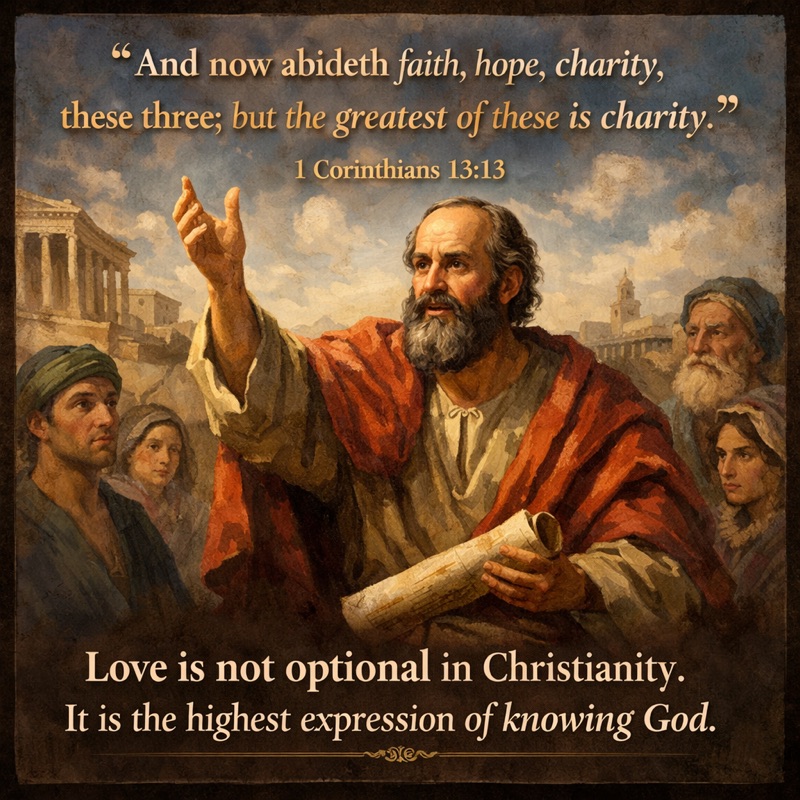
Christianity Without Charity Is Empty

Without Love, We Cannot See God

Love is not optional in Christianity; it is the highest expression of knowing God.

A life bereft of love is a life bereft of the knowledge of God.

A Molue Monologue on Empathy, Holiness, and Truth


The Scriptures

Epistle to the Hebrews 12:14

“Follow peace with all men, and holiness, without which no man shall see the Lord.”

First Epistle of John 4:8

“He that loveth not knoweth not God; for God is love.”

First Epistle of John 4:12

“If we love one another, God dwelleth in us, and His love is perfected in us.”


The Inference

From these, I infer:

Without love, we cannot know or behold God,

for love is the only true lens through which He is seen.


The Conclusion

Anyone, thus, who lacks empathy does not know God.

Period.

And those who extol the virtues of those who crucify Christ,

those who proudly declare, “Empathy is a made-up word, I hate it,”

they do not know God.


The Burden of Knowing

These are things I know.

Things I cannot un-know.

That’s all I have to say about the matter, for now.


Don Kenobi

#OldManInTheMolue #Faith #Justice #Empathy #CatholicChurch #IVF #HumanDignity #MolueMonologue #BigAgendaAfrica

Sunday, April 19, 2026

Nigeria Airways: Bad Memories And the Cost of a Broken Culture


Nigeria Airways: The Shame Of a Nation

A reflection on the collapse of Nigeria Airways,
the human cost of its liquidation, and the deeper question of 
justice legal and natural, memory, and national loss.

The Stories We Cannot Ignore

What I do know, because I have read multiple accounts from Nigerian passengers who bought tickets on Nigeria Airwaysto travel overseas, is this:

You could go to the airport and remain there for days, sometimes up to a week or more, trying to get on a flight to New York or London.

During that time, some staff would demand bribes, not token amounts, but sums that could be a significant fraction of the ticket price, sometimes even approaching the full cost.

I was especially disturbed by one account claiming that certain employees went further, allegedly demanding sexual favors from women, married or not, in exchange for being allowed to board. That claim is difficult to verify, but its mere suggestion tells you how broken the system was perceived to be.


A Story That Stays With You

One story stands out.

A man spent about a week at the airport, effectively living there, while his family believed he had already arrived in New York.

By chance, a well-known Nigerian footballer saw him and asked what he was still doing there. After hearing his story, the footballer intervened, and suddenly, he was allowed onto a flight.

What made it worse, when he finally boarded, he found the plane was not even full.

So you are left asking:

What exactly was going on?
How does a system become so distorted that access depends not on a valid ticket, but on who you know, or what you are willing to give?

And when people ask what the problem is, this is the kind of story that comes to mind.


The Poignant Part We Prefer to Forget

In 2004, Nigeria Airways was liquidated by the administration of Olusegun Obasanjo.

This left 5,996 staff without full benefits.

The impact has been severe.

Over the years, there have been reports of significant mortality among retired staff, many facing serious health challenges and unable to pay for medical care.

Families of deceased workers have also protested the exclusion of beneficiaries, especially those whose relatives died before 2010, from various proposed payment plans.


A Conversation in the Molue

A random man I met in a Molue expressed no sympathy at all for the suffering workers of the destroyed airline.

I told him he was cruel.

Then I paused.

And the larger picture began to settle.

The full weight of the loss inflicted on a nation by the failure of Nigeria Airways started to sink in.


The Arithmetic of Loss

Let’s strip emotion away for a moment and look at structure:

  • Emirates: ~250+ aircraft, ~$35–40B revenue
  • EgyptAir: ~70 aircraft, ~$2–5B revenue
  • Nigeria Airways: ~0 aircraft

And beyond that?

A vacuum.

A lost ecosystem.
A broken value chain.
A national capability that simply… vanished.


Memory vs Mercy

And somewhere between memory and mercy, you begin to understand.

Because the man in the Molue was not just being cruel.

He was remembering.

Remembering delays.
Humiliation.
Extortion.
A system that failed ordinary people in ways that were personal and repeated.

But mercy asks a different question:

Were all the workers guilty?
Did all of them deserve to be abandoned?

And there, the story refuses to simplify itself.


Final Thought

This is not just about an airline.

It is about what happens when systems collapse, and everyone inside them is painted with the same brush.

It is about a country still arguing with itself:

  • Between justice and compassion
  • Between memory and mercy
  • Between what was done… and what was lost

And somewhere in a Molue, that argument continues.


Don Kenobi
#BigAgendaAfrica 
#CultureNotStructure 

Sunday, April 12, 2026

Why the Old Testament Must Be Handled With Care

Does the Old Testament Distort Christianity? 

A sharp critique of how the Old Testament shapes modern Christianity, confronting false doctrines and “lazy theology,” and arguing that Christ must remain the lens through which all Scripture is read—because his is not one voice among many, but the voice of God.


There is a growing discomfort many refuse to name.

It sits quietly beneath sermons, beneath doctrines, beneath the strange contradictions of modern Christianity.

A discomfort born not out of rebellion, but out of observation.

Because when a man reads the words of Jesus Christ, he encounters something disarmingly clear:

  • Love your enemies.

  • Bless those who curse you.

  • Put away the sword.

  • Judge a tree by its fruit.

Simple. Direct. Almost impossible to manipulate.

But then, he turns a few pages back to the Old Testament… and the waters become troubled.

He encounters conquest.

He encounters chosen people and rejected others, Jews and Gentiles.

He encounters divine sanction for violence, hierarchy, separation—tribalism, racism, disdain for others, self-righteousness.

And without realizing it, something subtle happens:

The clarity of Christ becomes… negotiable.


When Clarity Becomes Negotiable

Even worse, practices such as payment of tithes, never taught by the disciples, creep into Christian doctrine.

When Christ preached against mammon, against filthy lucre, he was not speaking to Christians. He was speaking to those who still identified as Jews.

Ditto when he taught that:

“Whatsoever we do for the least amongst us, that we do unto God.”

The parable of the Good Samaritan was aimed at men who still identified as Jews.

Christ therefore meant for us to progressively challenge the parts of the Old Testament which fell short of his teachings—not to embrace them and elevate them to be at par with the new things he taught.


A Practical Analogy: Safety Over Everything

Back in Shell, my last job, we had to balance safety with operational needs.

We agreed that safety was not “first,” but equal to other considerations. However, whenever in doubt as to the best course of action, we were to raise safety higher than every other consideration—production, profit, everything.

That model works for the conflict between the Old and New Testaments.

Because the Old Testament introduces conflict into Christianity.

But more dangerously, it introduces permission.


The Dangerous Power of “But”

Permission to say:

  • “Yes, Jesus said love your enemies… but…”

  • “Yes, Jesus said turn the other cheek… however…”

  • “Yes, Jesus said judge by fruit… still…”

And in that “but,” entire theologies are built.


A Radical Question

Imagine a Christianity without the Old Testament.

Christ says, if your eyes cause you to sin, pluck it out.

Your eyes.

But if the Old Testament causes us to sin, what do we do?

Because what is undeniable is that it does cause us to sin.

What could be our defense?

The best defense we might give for falling short of Christian expectations would be worse than the defense of the wicked servant in the parable of the talents.

He did not break any law.
He did not cause anyone to hate their neighbor.
He simply misjudged the nature of God.


False Teachings and the Old Testament

The most persistent false doctrines draw strength from the Old Testament when detached from the filter of Christ.

A few:

1. The Theology of Power and Dominion

The idea that believers are meant to rule, dominate, and possess.

Often justified using “chosen nation” language.

Yet it sits uneasily beside:

“My kingdom is not of this world.”


2. Prosperity as Divine Approval

Wealth as a sign of God’s favor.

Drawn from covenant blessings, land promises, material rewards.

Yet Christ speaks repeatedly of poverty of spirit, warns about riches, and elevates the lowly.


3. Religious Nationalism

The merging of God with a nation, tribe, or political project.

Rooted in Israel’s identity as a people set apart.

Yet Christ dissolves that boundary:

“Neither Jew nor Greek…”

(as later emphasized by Paul the Apostle)


4. Justified Violence in God’s Name

The most dangerous of all.

The idea that violence can be sanctified if the cause is “righteous.”

This has echoed through history, from crusades to modern conflicts.

Yet Christ rebukes the sword, even in his own defense.


The Problem of Equal Weight

Giving the Old and New Testaments equal weight has helped create a faith where:

  • Jesus sets the ideal…

  • But the Old Testament supplies the exceptions.

And as we see, the exceptions begin to dominate.

Perhaps because it is easier to justify our fallen nature than to rise to Christ-like standards.


Where Do We Go From Here?

We must reorder the prioritization given to both books of the Bible.

We must insist that Christ is the lens.

Not one voice among many—but the Voice.

The voice of God.

We must also insist that every prior text—that is, the Old Testament—must pass through Christ, or be understood in light of Christ.


A Historical Note

Interestingly, early Christians even tried to throw out the Old Testament entirely, notably Marcion of Sinope in the 2nd century.

But the mainstream church rejected that move, insisting the tension must be held, not erased.


The Final Test

In the end, Christ leaves us with a test that bypasses all argument:

“By their fruits…”

No appeal to Moses.
No appeal to law.
No appeal to history.

Just outcome.


The Only Question That Matters

So the real question is not:

Old Testament or New?

It is:

What kind of men does your theology produce?

Because if a system consistently produces arrogance, cruelty, deception, and hunger for power…

Then no matter how ancient its sources…

It has already judged itself.


I rest my case.

Don Kenobi
#OldManInTheMolue
#MyFrancisEssays


Bread, Power, and the Soul: Join Or Be Damned,

Don Kenobi reflects on temptation, corporate conformity, the prosperity gospel, and Christ’s warning about gaining the world while losing on...