Service Is Love. Choose Life. Choose People.
A reflection on corruption, waste, governance, and moral failure in Nigeria. Exploring how normalized theft, public waste, and institutional decay quietly destroy lives, deepen poverty, and undermine national development.
Every Allocation Has Human Consequences
Every frivolous, unnecessary, non-audited allocation costs lives.
The perpetrators of such allocations often dismiss them as merely “ordinary stealing”, a phrase once used by a former Nigerian president.
In 2014, a former Nigerian President argued that most cases labeled as “corruption” in Nigeria were actually ordinary stealing rather than systemic corruption.
His anti-corruption czar, went even further, castigating Nigeria’s educated elite.
“Many educated people wrongly describe stealing as corruption.”
That, in a nutshell, explains part of the tragedy of Nigeria.
The debate gradually shifted away from confronting corruption itself, toward debating how corruption should be defined and discussed.
Corruption Behaves Like Contagion
“Ordinary stealing” compounds over time and helps create the multidimensional poverty we now see across Nigeria.
Consider this:
One man steals ₦1,000 and influences two others to steal ₦1,000 each, because he faced no consequences.
The next day, those two each influence two more people.
Then those four influence eight.
Then those eight influence sixteen.
The amount stolen each day still appears “small.”
Just ₦1,000 here and there.
But corruption behaves like contagion.
It multiplies socially before it multiplies financially.
By Day 20, over ₦1 billion would have been stolen cumulatively.
Not because one man stole a billion.
But because society normalized the first theft.
Nigeria Drowns in Waste
Nigeria is not the poverty capital of the world because it lacks resources.
Nigeria is the poverty capital of the world because the nation drowns in waste.
The choice before us is stark:
Cut waste, or watch opportunity disappear generation by generation.
Consider this.
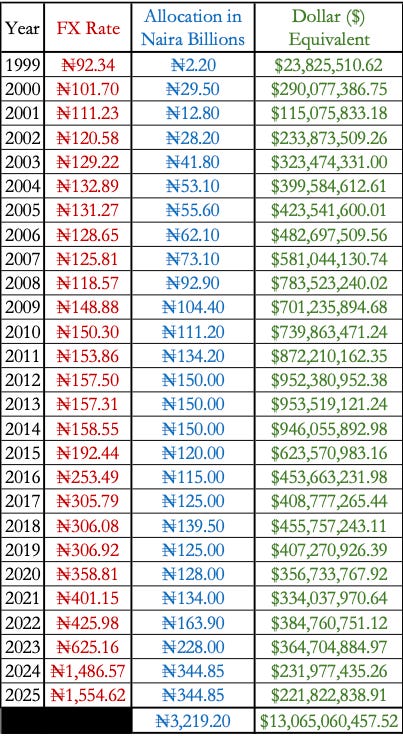
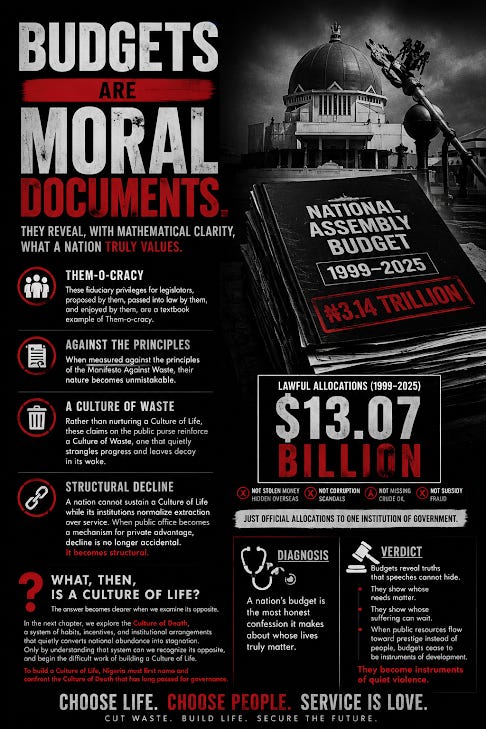
From 1999 to 2025, the cumulative allocation to Nigeria’s National Assembly amounted to approximately ₦3.14 trillion.
At today’s exchange rate, that figure would appear to be roughly $2.67 billion. But that would be misleading.
To understand the true historical value of these allocations, each year’s spending must be converted using the average exchange rate for that specific year.
When calculated properly, the cumulative allocation from 1999–2025 amounts to approximately:
$13.07 Billion
That is lawful expenditure.
Not stolen money hidden in foreign accounts.
Not corruption scandals.
Not missing crude oil.
Not subsidy fraud.
Just official allocations to one institution of government.
Before examining arguments, we must first examine arithmetic.
Below is a table calculating the lawful allocations to Nigeria’s National Assembly from the beginning of the Fourth Republic in 1999.
Budgets are moral documents - They reveal, with mathematical clarity, what a nation truly values.
These fiduciary privileges for legislators, proposed by them, passed into law by them, and enjoyed by them, are a textbook example of Them-o-cracy.
When measured against the principles of the Manifesto Against Waste, their nature becomes unmistakable.
Rather than nurturing a Culture of Life, these claims on the public purse reinforce a Culture of Waste, one that quietly strangles progress and leaves decay in its wake.
A nation cannot sustain a Culture of Life while its institutions normalize extraction over service. When public office becomes a mechanism for private advantage, Decline is no longer accidental. It becomes structural.
But what, then, is a Culture of Life?
The answer becomes clearer when we examine its opposite.
In the next chapter, we explore the Culture of Death, a system of habits, incentives, and institutional arrangements that quietly converts national abundance into stagnation.
Only by understanding that system can we recognize its opposite, and begin the difficult work of building a Culture of Life.
To build a Culture of Life, Nigeria must first name and confront the Culture of Death that has long passed for governance.
Diagnosis
A nation’s budget is the most honest confession it makes about whose lives truly matter.
Verdict
Budgets reveal truths that speeches cannot hide.
They show whose needs matter.
They show whose suffering can wait.
When public resources flow toward prestige instead of people, budgets cease to be instruments of development.
They become instruments of quiet violence.
Excerpt from:
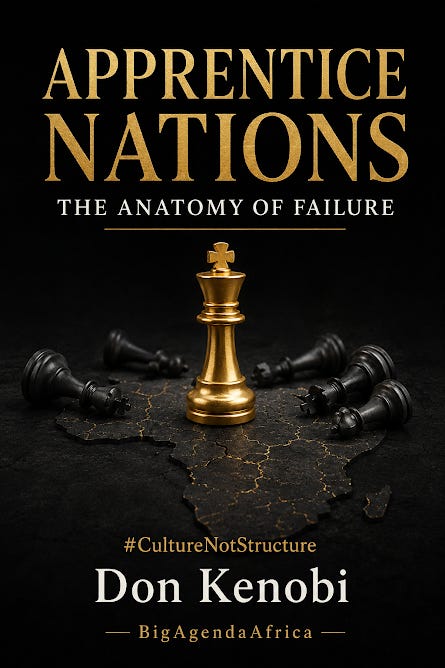
APPRENTICE NATIONS: The Anatomy of FailureDon Kenobi | BigAgendaAfrica
Don Kenobi
Author: Of gods and Negroes


No comments:
Post a Comment