I Used to Be a Cockroach
An old story about poverty, palm-wine tappers, a rat called Skippy, a burnt-down shack—and the day I finally walked away.
I used to be a cockroach.
Life was really hard.
I would eat, amongst other things, grass shoots, succulent leaves, unripe paw-paw—and postage stamps.
Unable to afford soap, I eventually gave up bathing altogether. I hated bathing with dirty water; it seemed pointless to rub filthy water over a body already greasy with sweat and dirt.
I had to leave that neighbourhood.
Fast.
There was nothing there for me.
Nobody liked me. Nobody cared enough to help me. And really, I wasn’t asking for much. Sometimes all a human being needs is a smile—a hand of friendship stretched in his direction.
Instead, they conspired against me.
Or at least that was how it felt.
They conspired to frustrate my soul.
They hated the sound of my second-hand transistor radio, permanently tuned to the BBC. They hated the smell of fried plantain that occasionally drifted from my section of the yard.
I must confess that I had a hand in this particular hatred.
On those rare days when I managed to get my hands on ripe plantains, I would fry myself some dodo and sing war songs at the top of my voice.
The first time I did it, I wasn’t trying to annoy anybody.
I merely wanted to let Eshu—the West African god of mischief—know that I was still holding on.
Still hangin’ in there.
And there was nothin’ he could do about it.
I was thoroughly battered, no question.
But I was still me.
I was who I was.
Still a spark of the great God in whose heart, I believed, I remained a dream.
I loved God.
And I was fearless.
They Burnt My Belongings
Where was I?
Ah, yes.
Let me tell you how it happened—how they burnt my belongings.
Don’t you remember?
They burnt my belongings just when it seemed I might actually be making my way in the world.
You remember now?
Right.
It was funny how the poor conspired against one another.
At least the rich held parties and hobnobbed together. They networked. They consolidated their wealth through marriage, friendship, favours and I-owe-you-ones.
But the poor?
We were really poor.
Poor in charity.
Poor in faith.
Poor in hope.
Poor in almost everything.
I still laugh when I remember how carefully they watched as I walked into the compound. They were expecting me, no doubt, to scream and run towards my burning abode, beating my chest, looking towards heaven and ululating:
“WOE IS ME!”
But I’m getting ahead of myself.
Even now, I sometimes wonder where the hell those creeps are.
What are they doing now?
What became of their lives?
Those appalling creatures…
Yes, yes, I’m getting ahead of myself again.
But allow me.
I am still struggling, certainly, but my heart is in the right place.
Not so the doubly wretched—wretched in body and wretched in mind.
Yes, they did me in somewhat. They made my heart angry.
But then, so do mosquitoes.
And tsetse flies.
And rats.
Do I despise them?
No.
Waiting for God’s Dream to End
Listen.
I was returning from the waterside, where I had gone to hear stories.
You guessed right: I had no job.
Or, shall we say, I was between jobs—waiting for God’s dream to end.
At the waterfront, you know, we traded stories. We laughed. We helped the fishermen with their nets and sorted their catch into grades.
This and that.
That and this.
We also “fiftied” cigarettes—two men sharing one cigarette—and sometimes we simply sat and watched the river gently flow by.
We were mostly gentle souls.
All we wanted was to pacify the raging despair within our souls until our dreams were ready for us to inhabit.
I hated my life.
But I was willing to soldier on.
Waka the Great
My heart quickened when I saw smoke rising from my section of the swampy compound, where I had been allowed to put up a batcher.
Batcher?
Basha?
Bacha?
I cannot vouch for the spelling.
I was a nouveau pauper.
I had actually been whistling as I approached the compound because Waka the fisherman had spent the afternoon regaling me with stories from his former life as a palm-wine tapper.
Waka the Great!
“Now das my luck,” he once complained, “to suffer-suffer for my daily bread.”
The only occupations really open to him, he explained, were palm-wine tapping and fishing.
“Just my luck,” he said without emotion. “I either falling down from those tall-tall trees or I drowning in de bad-bad river.”
“Waka!” the entire congregation shouted.
“Speak am well-well! Scatter de grammar!”
“Bookooroo!” someone else added shrilly.
Bookooroo was derived from “book” and was our euphemism for people who tried to show off their great learning.
Waka had fallen—yes, you guessed right—from what was probably the tallest palm tree in the whole Niger Delta.
“Him papa head good,” somebody said when he made a remarkably quick recovery two months later.
He walked thereafter with an endearing limp, the result of his injuries.
And so he became Waka—pidgin for walk.
In midlife, understandably reluctant to climb another palm tree, Waka did what working men the world over do when their industries become hazardous or obsolete:
He retooled.
He retrained.
He became a fisherman.
The Brothers of the Order of Palm-Wine Tappers
Such was the bond between Waka and his former colleagues that they would bring him a gourd or two of frothing, undiluted palm wine in the evenings after the day’s work.
He, in turn, would provide roasted fish—hotly spiced.
Waka was kind to me and shared his palm wine.
I also had the honour of serving as Fish Roaster in the evenings when the brothers of the Order of Palm-Wine Tappers returned.
And what men they were.
They were as arrogant as men anywhere—men who had full and total control of their lives and knew it for a dead certain fact.
The English milord could have learned a thing or two from them.
They were kings when they climbed the tall palm trees of the Niger Delta.
They were kings when they climbed down.
And even as they sat around eating roasted fish and drinking palm wine, they exuded a certain understated dignity.
These impoverished royals lived their lives to the hilt, and they knew it.
They set their own work schedules.
Drew up their own Gantt charts.
Decided what to do, whom to supply and who could wait.
I surpass myself…
Unfailingly, each evening they toasted Bacchus, the god of wine.
Bacchus, who had a thousand African names.
“To Mmanya-nmo!” they would say in unison.
“To you, great Mmanya-nmo—the cause of and solution to all life’s problems!”
“What do you mean? Mmanya doesn’t cause any problems,” someone would protest.
“Leave that matter for another day,” Gravelly Voice would retort. “I no get power for argue dis evening.”
“I say Mmanya-nmo doesn’t cause any problems. I don’t care whether you have power to argue or not. It doesn’t cause any problems.”
“But look at yourself! Are you not already a problem to yourself?”
“You’re a damn fool. No wonder your in-laws beat you up the other day.”
“They disgraced themselves, not me!”
And on and on they bantered.
“Who Is That Cockroach?”
Then one evening I heard Gravelly Voice ask:
“Who is that cockroach?”
I knew they were talking about me.
I kept a straight face and continued fanning the embers beneath the sooty basket of fish suspended over the fire.
“That cockroach is a doctor,” Waka explained.
“Doctors do not roast fish! Doctor of what?”
A new voice burst into laughter, sending palm wine shooting from his nostrils.
“I don’t know,” Waka replied. “He told me he is a doctor, and I believe him.”
“There are so many doctors these days,” another voice entered the fray. “I am a doctor myself.”
“Doctor of what?” asked the man with the ejaculating nostrils, doubling over with laughter and clutching his stomach as though in acute pain.
“Don’t kill me here!” he shouted as more palm wine escaped through his nose. “You will all be held responsible! You all know what a troublesome woman my wife is!”
“Answer now, Doctor,” Waka nudged the man who had declared himself one.
“Doctor of tree climbing,” he said resignedly.
His thunder had been stolen by the man with the ejaculating nose.
Then Gravelly Voice turned towards me.
“Come here,” he said. “Sit with us. My daughter has just finished Standard School. She wants to be a doctor. Are you really a doctor?”
And just like that, the cockroach had been invited to sit among kings.
The Smoke
So yes, I had been whistling when I approached the house that evening.
Then my heart quickened.
Smoke was rising from the section of the swampy compound where I had been permitted to put up my bacha.
My gait held.
It betrayed none of the emotions I felt.
I stepped smartly around what used to be my home.
Strangely, I felt gladness.
My miserable dwelling had been mercilessly incinerated by people who seemed to hate me and the very earth upon which I stood.
Yet what I felt at that moment was something close to “the peace that passeth all understanding.”
I remembered the damp floor.
I remembered the rats with whom I shared my space.
Especially Skippy.
Skippy and the Evolution of Rats
Skippy was a rat I had named because he would skip about on his hind legs whenever he sensed that I had finally had enough of his antics and was preparing to smash something hard against him.
I always spared him on account of his comic plight.
Evolution, I reasoned, meant rats like Skippy would multiply, and eventually we would have smart rats.
And if we had enough smart rats, perhaps one day we might reach a compromise with them.
We could teach them to stop stealing and annoying us by explaining that there was enough for everybody.
I reckoned it would be easier to explain this to Skippy and the other members of the rat race than to the great stealing machine called government.
But that is another matter.
Standing there before the ashes of my home, I felt surprisingly little.
My principal concern was that Skippy would now have to find somewhere else to live.
I worried that intelligent rats like him might be exterminated mindlessly before they had a chance to reproduce.
It seemed important that humanity should assist the evolutionary process by getting a little sense into its own head and learning not to destroy everything it did not understand.
Alas, the days of a reasoned tête-à-tête with rats—whether of the governmental or Rattus rattus variety—lay far ahead.
I Walked Away
Still whistling, my hands now in my pockets, I surveyed the remains of my home.
Then I walked away.
Head high.
I was free.
Freed from my shackles, I walked away.
I had had it.
I would first go to church and renew my relationship with Him who had been patient with me and would, verily, receive me.
Then I would beg something from the pastor.
After that, I would travel to Warri.
I was no longer a cockroach.
I had been smoked out of my hiding place and forced into the open.
Ready to make a hash of it.
Cockroaches are afraid to move. They have too many natural enemies. They prefer darkness, crevices, corners—anywhere they can blend into the background and remain unseen.
But I wasn’t afraid to move.
Not anymore.
Indeed, I had to move.
I had no cover left.
But scurry?
Scurry I would not.
I held my head high, turned around and walked out of that yard.
I half expected applause.
But that would have to wait for the movie version of my life story.
First, I would go to church and renew my relationship with Him who was patient and would verily receive me.
Then I would beg something from the pastor.
And somewhere out there was Gravelly Voice, whose daughter wanted to become a doctor.
Perhaps that mattered too.
Life was tough.
But, to my credit, I was hangin’ in there.
I used to be a cockroach.
I hated my life.
But I was willing to soldier on.
Willing to wait for God.
And life?
Life is still tough.
But I’m still hangin’ in there.
#DK
Wednesday, October 6, 2010
I used to be a cockroach...

How the west lost its glory...
How the west lost its glory...
Albinos were outcasts but these albinos were different! They - the albinos from the other side of the great divide were glorious to behold – the loose flying hair of all colours and shades, the unrepentant hedonist – – the swash buckling visitor who had no gods - representative all of we always wanted to be but were too cowardly .....too afraid of HIM who had our fate in his palm and dealt a treacherous hand when we stepped ever so slightly out of line.
Albinos were outcasts but these albinos were different!
We had always wanted to treat our gods with disdain because they turned our most begotten dreams to ashes and lent a helping hand only when we made burnt sacrifice of the last of our fattened livestock. We thus quite simply fell in love with him and his feckless ways... his godlessness was refreshing to behold and don't forget - he was a magician of sorts - a spell binder.....he had the stick which belched thunder, he had the great houses which floated on water....he sucked fire into his mouth and burnt his intestines but did not wince - I swear he burnt his insides and his nose was the chimney from which the smoke curled out from his bowels...
...but with the passage of time, lots of it, his magic became boring and common place and all too pervasive and quietly in our hearts we lost our enchantment. We lost our enchantment when we realised that the smiling loose haired visitor was a rogue of sorts. We had welcomed him and had given him land to practice his goodness... but so ungainly was he.... CARAMBA!!...not even one generation had passed...can you believe!... he wanted to be top dog... nay he became top dog and the smiles vanished. He turned out to be mean hearted, had a forked tongue, poor hygiene, and you realised that the great magician like a great work of art, had no soul and above all did everything for money - even the goodness he practised on us was tainted by his love for filthy lucre. He hated his craft but was frozen in his purposes - constrained to perform, and through his magic and wondrous arts sought to steal your soul.
You wonder and say to yourself: This guy cannot be my master! Perfidy! You realise you are probably the stronger in this relationship. You cannot bear to think the thought but realise that his godlessness was the bane of him - the cause of his soulessness.
You thus retrace your steps to your gods, and tell them of your great insight into the weaknesses of the magician. You truly are grateful for the constraints of your traditional ways and the restraints of your mean hearted gods. Grateful for your return, your emboldened gods whisper in your left ear close to your heart:
"He is your servant - destined to carry you through to your final confrontation with destiny. Let him invent those things, pay for them. See how dirty and unkempt he is..."
Emboldened by the voices of your gods, you turn your searchlight on the matter and to your chagrin realise that the half-eyed has somehow talked you into abandoning your purposeful march up destiny's ladder.
Like Etsu, the west-African god of mischief, the magician has tricked you. You have supplanted your destiny for one of consumerism. A destiny where your sense of worth is ultimately determined by sheer volume - your consumption index. You find yourself in a world in which you are condemned to be nothing. Not just in the eyes of all others but in your very own eyes because even you know it. You have little. Little to consume, little to show off with...and Etsu-like, the erstwhile foreigner ensures that you never will – he controls the fabrication of goods... don't you know?? It suits him to have you robbed of your profundity and emotional edge.....ensuring that the master remains a servant - in his very own garden..
Juxtapose the magician against those who have sustained civilisations for many thousands of years whose proud bards still sing and speak with awe of their heritage - of "ancient glamour keeping their youth", I speak of the land of Mencius...speaking of which we cannot but notice that the 'Mencians' have risen out of a fate prescribed for them by the magicians and also how the magicians (envious behind their masks) had only recently wished to draw them into war (over a spy plane) - in order no doubt to have a reason to destroy that which has been built by superior purposes and nobler endeavours..... The magicians like their ancestors seek to convince the rest of the world that the discredited, the puerile, the meaningless chaff which surround us are our gift from heaven - that to hanker for God, for things spiritual is to cop out.
The West has lost its glory. It lost it when it offered everything for the senses but nothing for the soul. It lost its glory when
the sad, the sullen eyed, the befuddled, the struggling are still today being stolen from and insulted with donated aid.
They no longer steal at musket point from the wretched of the earth - this they do by economic sleight of hand
which ensured perpetual servitude for those who groan twice - under the yoke of circumstance and under the yoke of the dispossessor. The West must rid itself of its filth - buy its glory back - and literally repay the hundreds of billions of dollars for all the wealth – human and natural stolen from all God's children (From the valleys of Montezuma to the 'verdant valleys' of Shaka the Zulu).
The brave new world promised by the technological marvels of the age has simply not materialised and our collectively stupidity as a race is underlined by the emptiness of the world we have tried to create. I hate the situation I find myself in: cursed to write and forever postulate here in the hidden rooms of my hidden heart.
I hate writing!
'On whose side is God on?' I once heard the BBC ask a Sage. 'On the side of suffering humanity', he had answered.
I hope he is damn right!!
Of Hubble and the death of religion
The Hubble telescope has given mankind great insight into how stars and galaxies are formed and how they die. And if celestial bodies be born and then die, why cannot gods the same be?
Today, we are witnesses - to the demise of global belief systems. It is doubtful if ever in recorded history, mankind has had a front row seat to watch or observe a religion locked in mortal combat – not with external forces as the unwary might be led mistakenly into believing, but with the great and mighty spirit called 'Truth' - that merciless examiner of all that we hold to be true and that most patient of collectors who allows us the freedom to believe all that we wish to, but not to escape its consequences.
Which is why when a religion tolerates no examination from within or without, which labels all forms of dissent as heresy, which imbues its clergy with powers both spiritual and temporal, it shall in the end, have nothing unique to offer. It becomes an irrelevancy and its tenets open to interpretation and abuse by the clergy class.
Why?
Because truth or the determination of the truth will not be rigorous and very soon, its skid-mounted, movable beacons and precepts, meant to delineate justice from injustice, truth from untruth, will lead to listlessness amongst its adherents. They are given the task of holding dear a religion which has become irrelevant in the modern world. Violence erupts.
These adherents will lash out at even those who tolerate its idiosyncrasies because it views all such tolerance as condescension. It will seek no force of argument – because it has none. Its new converts will be found amongst the most ignorant on earth - those it will rather not have!
It will be aware of its ungainliness amongst those it so desperately wishes to convert but are ensconced in deep romance with their gods. This will rile them to no end. They thus shall lash out and seek to hurt those who do so marvelously well without the sterling advice offered by their great book.....
Like Red Giant's in the throes of death however, it will first be seen to expand and consume a large part of the celestial skies causing much destruction on earth….but the laws of the universe are steadfast. In the end, it will shrink and become a dwarf - a blackbody - a net recipient of light (truth).
Saturday, August 21, 2010
The Scoffer's Song
You took a deep breath
To sigh in sympathy I thought.
But No!
You were beside yourself in mirth!
You were laughing at me!
Gulping air,
You filled and refilled your windbag
Bleating out the discordant chords
Of that ancient score - the scoffer’s song
Puncture your windbags I wish I could
But there I sat well beaten - head bowed
I sat and prayed, you mocked and brayed
I prayed how I prayed
(But you all night brayed)
My wounds were healed
My soul annealed
With a gentle wind, without a word,
He lifted my head
Praying I was dear Jesus lord
Bloodied I am but bowed?
Hell no!
Your braying has stopped –you little fool!
Now I ponder the reason you all night cry
Thursday, August 19, 2010
PRESS RELEASE for "of gods and negroes"
iUniverse
Approved PRESS RELEASE
of gods and negroes (by don Kenobi)
©2006
Q: Please supply us with a detailed summary of your book (between one and three pages).
A: How do you carry on when all you are or ever will be is explainable. How do you face life when it seems that everyone wants to lay his or her baggage on you?
Is it wrong to expect nothing from the world and so remain unfazed by the problems you face?
Is it better to cry in pain each time life hurts you?
Can you reject life and taunt it, with each breath you take?
Is it wise?
Why was I even born?
What is life?
Will I ever find happiness?
How happy are happy people?
Do I deserve to be happy?
Why was I born?
Why was I born….
It seems those questions were uppermost in my mind as I wrote this book – over a period of some 20 years. Yet while I wrestled with the thoughts that would form the chapters of the book, I felt a reassurance within that beneath it all was a fun and a loving essence which watched us as we took our first faltering steps and passed from being plain men – to well… men – those who will be men (as God created them to be). Who would swear to an oath and not waver….
In addition to the questions above, the book also seems to be saying:
You can find a better way
I know a better way
Come let us find a better way
Come let me show you …. how I survived.
It is a story of love and the search for love.
It is also a story of the search for self-acceptance
It is the story of a gentle man – lost because he runs a different script.
In the end, it is as much the why I wrote the book as it is about the what is the book about.
Q: Why did you write the book Mr. Don Kenobi
A: The why is simple:
There are many books out there and many stereotypes but you cannot find your story and you do not fit into any stereotype…… This sets up a need and cause, which will nag and tug at you every minute of your life not spent doing it. It will take up a whole chunk of your time and you may even grow to hate it - probably because you have to `relive it to tell it'. While writing the book, I sometimes had no idea if I was writing a book or the book was writing me! Yet the book is fiction.
Q: Is the book really not about you? Thinly disguised? Is it really fiction?
A: [Laughter] Fiction? What is fiction? Phew! I don't know anymore what fiction is - Maybe we all are fiction… fictitious characters taking ourselves far too seriously. We are all stories – fictional characters in Gods story! Who said that? I just did.
What do I think of my own writing?
Pure pain! I hate writing – and I hope when you read the book you will understand the first chapter. I'm so grateful I had a chance to mould a story around Uncle Joe - a real-life character…. I will probably write about him again…. But I love writing too. I really do!
It's everything to me. Its what I am: about 23 years ago, as I stood in line waiting for the letter which would post me out of the military-style camp onward to my primary national service assignment, I said a little prayer "If I get posted to a school to teach dear
Lord, it means you want me to be a writer. If I get posted to a factory, then you want me to be an engineer" I got posted to a cement factory…
I think I owe a lot to John Steinbeck…aha! I can see the nay Sayers looking for similarities – `whole copied pages'… it will not be found. When Steinbeck wrote he was da Createur! I have just created a word to hide my blasphemy. We are tricky we writers….
Steinbeck always made me feel the presence and power of the storyteller… he suffocates me – there is a pureness about his writing which… I can't say any more words really have no use when you want to tell the truth is a deep personal way.
Already I have seen a few ‘mistakes’ I would have loved to correct but I just had about had it and wanted no more of the manuscript. Let it take up its own wings and fly or crash
Why? Because I think I am guilty of overwriting this book!! And I am – it took me 20 years of chiseling and chipping away. Am I satisfied? No! In all honesty I need another 20 years to do justice to the story in my head.
I hope the elected leaders of my country Nigeria read the book especially the last two chapters. They need to know that their actions are being recorded (for posterity)
Q: Will readers love this book?
A: I don't know. What I do know is that I'm glad its over. I need to apply myself to other things…. But if you like it, you will read it more than once and each time you will read a different story. It is the loving story about a lovely man… there are several lovely characters.
I am not qualified to say this because I really do not know the whole story. The first time that I knew what the story was really about, was when the publisher…
I think I have said enough. I have said enough! I must not let too much light into the closet!
Q: What is the setting of your book?
A: Nigeria, San Diego, Boeria a fictional place that appears to be in Southern Africa, and Kenya…
Q: Who are the main characters, what are their relationships, and why are they important to the story?
A: Dedan Kimathi, the protagonist, Ollie the beautiful Nun who left the convent to be with him, Ay-ii the spirit guide who takes DK to the spirit world of Lokinanga, and Father A.E Lee the kind prince of the catholic church
Q: Why do you think that this book will appeal to readers?
A: It is a love story. We all love love stories. It is the story of a man determined to be the captain of his fate.
Q: Who is your target audience?
A: People. Spiritual people. People who want a better world.
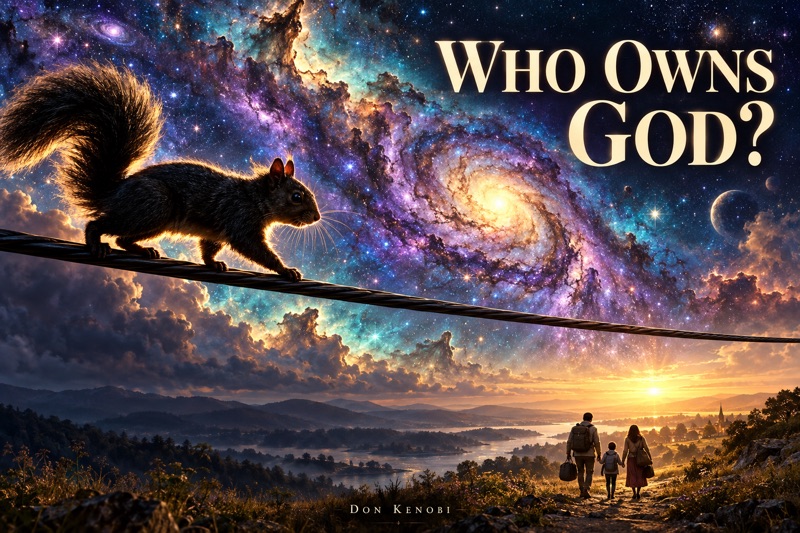
Who Owns God? Christian Faith, Immigration and Compassion
Who Owns God? On Christian Faith, Immigration and Compassion? From a squirrel on a cable to the vast cosmos and the stranger at the border,...
-
 Without Love, We Cannot See God. Without Peace & Holiness, God = Null A Monologue exploring holiness, empathy, and the nature of God t...
-
 THE CARGO PLANE THAT DELIVERED THE FAITH A reflection on the allure of Islam, the failures of the Prosperity Gospel, and one Christian’s jou...
-
 Talkers vs Builders: Nigeria's Intellectual Paralysis A Molue Monologue by Don Kenobi - Calling out Nigeria’s intellectual paralysis,...