Peter Thiel criticizes Pope Leo’s vision for AI, accusing him of serving China got me reflecting on technology, morality, and the steady erosion of VIRTUE…
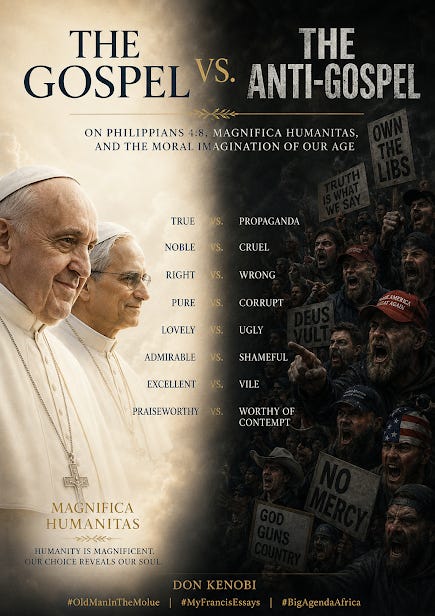
What exactly is wrong with Philippians 4:8?
The question sounds absurd.
After all, Philippians 4:8 is one of the most universally admired passages in all of Scripture:
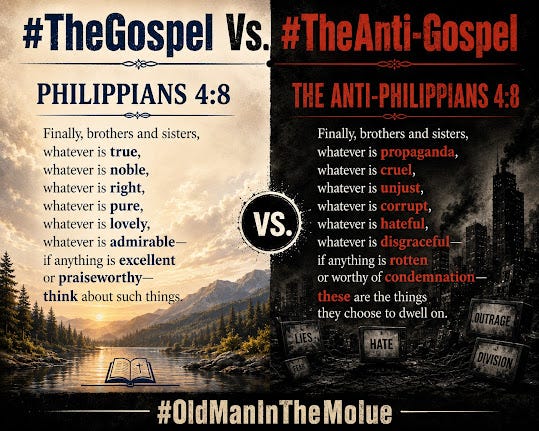
“Finally, brothers and sisters, whatever is true, whatever is noble, whatever is right, whatever is pure, whatever is lovely, whatever is admirable—if anything is excellent or praiseworthy—think about such things.”
It is difficult to imagine a more benign, more civilizational, more humanizing command.
Yet, if one pays close attention to our public discourse—particularly in this strange age of algorithmic outrage and ideological performance—it increasingly appears that many influential voices have, consciously or unconsciously, adopted its exact opposite.
So I decided to conduct a small experiment.
Rather than merely defend Philippians 4:8, I inverted it.
I asked:
What would the Anti-Philippians 4:8 look like?
It would sound something like this:
“Finally, brothers and sisters, whatever is false, whatever is cruel, whatever is wrong, whatever is corrupt, whatever is ugly, whatever is shameful—if anything is vile or worthy of contempt—set your minds on such things.”
Instead of truth — falsehood.
Instead of nobility — cruelty.
Instead of righteousness — wrongdoing.
Instead of purity — corruption.
Instead of loveliness — ugliness.
Instead of admirability — shame.
Instead of excellence — vileness.
Instead of what is praiseworthy — what deserves contempt.
It would look like this:
And perhaps most importantly:
Instead of deliberately fixing one’s mind on what elevates humanity, one deliberately dwells on what degrades it.
With that inversion, the landscape of modern outrage culture suddenly begins to make a terrifying kind of sense.
Do I need to spell it out?
It is a replacement.
A replacement of what?
Of an entire moral imagination.
From the spiritual to the political.
From the personal to the cultural.
At its heart lies a simple proposition:
These people do not seek the flourishing of all humanity.
The Gospel and the Anti-Gospel
This thought returned to me recently while watching two seemingly unrelated events unfold.
On one side, Peter Thiel launched yet another broadside against Pope Leo XIV and the moral vision he expressed regarding artificial intelligence.
Apparently, the Pope is now serving Chinese communism.
On the other side, Elon Musk—his ideological cousin in many respects—criticized MacKenzie Scott’s extraordinary philanthropy, lamenting that a woman who has voluntarily given away some $26 billion of her own wealth is somehow making the world worse.
Pause for a moment.
A woman gives away enough wealth to transform universities, hospitals, charities, communities and lives across the world.
The criticism is not that she has given too little.
It is that she has given at all.
At some point, one must stop asking political questions and begin asking theological ones.
Because beneath politics lies anthropology.
And beneath anthropology lies theology.
What, exactly, do these men believe a human being is?
What Did Pope Leo Actually Do?
He did something rather dangerous.
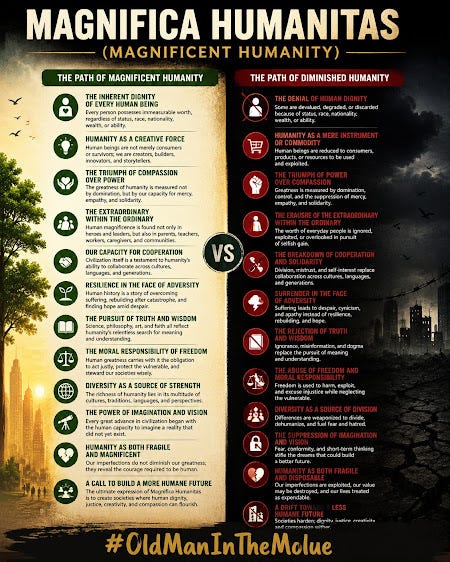
He proclaimed Magnifica Humanitas.
Magnificent Humanity.
Its vision is breathtakingly simple.
Every human being possesses inherent dignity.
Humanity is a creative force.
Compassion triumphs over power.
The extraordinary is found within ordinary people.
Human beings flourish through cooperation.
Resilience overcomes adversity.
Truth and wisdom are worth pursuing.
Freedom carries moral responsibility.
Diversity strengthens rather than weakens us.
Imagination shapes the future.
Humanity is simultaneously fragile and magnificent.
We are called to build a more humane world.
Humanity is magnificent not because we are perfect.
Not because we are innocent.
Not because we are wise.
But because every human being possesses an irreducible dignity that cannot be diminished by wealth—or the lack of it—by race, nationality, success, failure or power.
Let me say that again.
Humanity is magnificent because every human being possesses an irreducible dignity that neither wealth, power, race nor failure can erase.
Another Inversion
So I performed the same experiment again.
Rather than merely defend Magnifica Humanitas, I inverted it.
What would the anti-Magnifica Humanitas look like?
Perhaps something like this:
What if humanity possessed no inherent dignity?
What if human beings were merely instruments?
What if power mattered more than compassion?
What if ordinary people were expendable?
What if cooperation were weakness?
What if suffering demanded surrender rather than resilience?
What if truth were subordinate to utility?
What if freedom meant domination?
What if diversity meant division?
What if imagination itself became dangerous?
What if human fragility made us disposable rather than precious?
What if the future belonged not to hope, but to managed decline?
It would look like this:
Can you recognize the pattern?
From the vilification of Bill Gates...To the criticism of MacKenzie Scott...To the gratuitous insults directed at Pope Leo XIV...
The inversion reveals not merely a political ideology, but an entire moral imagination.
An anti-humanism.
A worldview in which people are valued according to productivity, utility, loyalty, market value, tribal identity or ideological usefulness.
A world in which compassion becomes weakness.
Mercy becomes naïveté.
Generosity becomes pathology.
The Strange Psychology of Our Time
Here we encounter one of history’s great ironies.
Many Americans—including many white Americans—view Trumpism and the MAGA movement as a warning rooted in painful historical experience.
Yet many others, including some Africans observing events from afar, see the same movement through a very different lens: as a symbol of strength, order, sovereignty or even salvation.
How fractured must our moral imagination become for the same figure to appear simultaneously as both warning and redeemer?
How damaged must it become before we begin to admire precisely those qualities that diminish our own humanity?
There is a deeper danger still.
A theology that persuades people to celebrate the very forces that diminish them.
A theology that teaches victims to defend their own victimhood.
In a recent essay titled, The Theology Of Self-Justification I described it this way:
Imagine a theology that not only oppresses its victims, but persuades them that they were created for their oppression.
A theology that convinces people they are less than—that they were created to be less than.
That their place beneath others is not injustice, but God’s design.
That their suffering is not the result of human evil, but the natural order of the universe.
Few lies have been more powerful—or more destructive.
Full essay: Click
The Molue Question
Back to more familiar surroundings.
The old Lagos molue.
There, these conversations were never theoretical.
Sooner or later, the old man sitting beside you would ask the only question that really matters.
“So, my friend... what kind of person does your philosophy—your theology—produce?”
Not what GDP it produces.
Not what elections it wins.
Not what stock prices it raises.
What kind of human being does it create?
Does it produce people who think about what is true, noble, just, pure, lovely and admirable?
Or does it produce people who dwell endlessly upon humiliation, domination, grievance, spectacle, outrage and contempt?
Because eventually...
Every civilization becomes the object of its contemplation.
We become what we choose to admire.
And perhaps that is why Paul’s ancient instruction remains so revolutionary.
Think on these things.
Not because doing so makes us weak.
But because it is one of the surest ways to remain fully human.
Don Kenobi
#OldManInTheMolue
#MyFrancisEssays
#BigAgendaAfrica
#MagnificaHumanitas
#TheGospelVsTheAntiGospel


No comments:
Post a Comment