Thursday, May 28, 2026

Ancestors, Christianity, and the World We Actually Live In


Ancestors, Christianity, and the World We Actually Live In

A meditation on Africa, faith, governance, human dignity, and why the treatment of the weak remains the ultimate test of any civilization.

Dear Friend,

Our ancestors were victims of those who wrote the 10 commandments? 

Hmmm...

Not victims of their kings and high priests, who offered them up as human sacrifices to false gods that could not save them?

False gods whose priests and kings stood by while they sold their own people to white slave traders?

Those priests, lying scumbags, much like today's evangelicals, were not among the most despicable human beings who ever lived?

Okay.
I'm learning.
Tell me more.

A Simple Question:

Across the world, many modern legal systems and constitutions reflect principles that overlap with the Ten Commandments, drawing, at least in part, from ideas rooted in that tradition.

You live in a country whose legal and moral foundations were shaped by many of those same precepts, supposedly handed down by the "most despicable human beings who ever lived."

The rights and freedoms you enjoy in your adopted country are built upon ideas that emerged from that tradition.

So why you no stay here, where the spirit of your ancestors still strong well well!!

The Spirit Is Still Here: 

The Spirit Is Still Here!!
E no go anywhere!!!

We see their spirit in the judiciary. 
We see it in policing.
We see it in the annual budgets.
We see it in the faces of the homeless and the hungry, those who lie by the roadside too weak to rise even as the sun shines upon them.

We see it in the lunatics left to wander the streets while the so-called leaders drive around in 200-car convoys and budget humongous salaries for themselves, while doing none of the things that ought to be done.

We see it in the indifference.
We see it in the neglect.

We see it in the normalization of suffering.
The spirit is not dead.
Far from it.

You for come stay near the spirit na.
And enjoy their benevolence. ðŸ™‚🤣

Why Christianity Remains Dangerous: 

It is Christianity, more than any other force in history, that has made the world more livable for the weak.
Not because it glorifies the successful, but because it demands that they remember the forgotten.

Why do you think people like Trump, many Republicans, and even some evangelicals attack it daily while pretending to defend it?

Should I tell you why?

Because Christianity is a hindrance.

A stumbling block.

An obstacle to the "perfect world" they wish to create.

Christianity insists that the weak matter.

That the poor matter.

That the stranger matters.

That the sick matter.

That the prisoner matters.

That the orphan and the widow matter.

It refuses to measure human worth solely by power, wealth, beauty, productivity, or usefulness.

It keeps whispering an inconvenient truth into the ears of empire:

"The last shall be first."

"The least among you is your brother."

"Whatever you do to the least of these, you do unto me."

The measure of a society is how it treats those who can do nothing for it in return.

That is why Christianity remains so dangerous.

Not because it seeks power, but because it questions power.

Not because it worships strength, but because it places limits upon strength.

All those spirituality books you've read haven't taught you these things?

Ancestors, Ancestors...

Ancestors.
Ancestors.
British people no get ancestors?

Or you think say Christianity na British religion?


People across the world hundreds of years ago, recognized wisdom in it. They took a chance on it.
They built institutions upon it.
They built societies upon many of its moral assumptions.

And those are the societies whose protections, freedoms, and opportunities you now enjoy.

Far away from societies built according to the precepts of traditional African religions.

Take a look at Africa, arguably the wealthiest continent on earth in terms of natural resources, and be humbled.

A few days ago, on Monday, 25 May, I had a conversation with a Sierra Leonean on a train in London.

He spoke of young people dying in the streets.

He spoke of drugs.

He spoke of hunger.

He spoke of hopelessness.

Whether every detail was accurate is almost beside the point. The story felt familiar because versions of it can be found across much of Africa.

Young men and women, stripped of opportunity, turn to whatever offers escape.

Communities rich in resources remain poor in outcomes.

Nations blessed with abundance struggle to provide dignity.

That is the tragedy.

And it is precisely what happens when societies fail to build institutions that protect the weak, restrain the powerful, and insist that every human being possesses inherent worth.

The central insight of Christianity is not merely that God exists.

It is that the poor matter.

That the weak matter.

That the stranger matters.

That power must answer to morality.

That rulers are accountable for how they treat the least among them.

Civilizations ignore those ideas at their peril.

History suggests that societies flourish when they embrace them, and suffer when they abandon them.

A Little Gratitude

Calm down.
Be grateful for the Bible.
Be grateful for Christianity.
Be grateful for Christ.
I rest my case.

Don Kenobi | #BigAgendaAfrica 

#MyFrancisEssays
#OldManInTheMolue


Tuesday, May 26, 2026

Don’t Miss Me When I’m Gone

Don’t Miss Me When I’m Gone 
A Prayer of Gratitude, Love, and Letting Go

A reflective meditation on gratitude, fear, love, and the people who become family. Written from a bus stop between Bluewater and Greenhithe, this is not a farewell message, but a prayer for kindness, remembrance, and grace.


Don’t miss me when I’m done.
Don’t miss me when I’m gone.

I was special, perhaps.
But all I truly tried to do was play my role.

And I waited for this role for such a long time.

When it finally came, I wanted to give it everything I had to give.

Everything.


Sometimes Weakness Is Just Fear

Sometimes I appeared weak.

Not because I did not care.
Not because I lacked love.

Sometimes I was weak simply because I was afraid.

Just afraid.

Afraid of failing.
Afraid of disappointing people.
Afraid of not becoming what I hoped to become.

Fear can make even loving people quiet.


This Is Not A Farewell Message

This is not a farewell message.

Not really.

It is simply a message to let you know how deeply grateful I am that I had a family like this around me.

Right now, I am sitting down waiting for the bus from Bluewater to Greenhithe, stunned that this is what I have decided to do.

Life becomes strange in moments like this.

Still.

Quiet.

The kind of quiet where your own thoughts begin speaking louder than the world around you.

And my thoughts tonight are full of gratitude.


A Prayer Of Gratitude And Love

Lord bless you guys.

Keep your ways.

Do not let the world harden you.

Be a prayer, both of gratitude and of love.

Because I am grateful for you all.

And that gratitude became love.

Real love.

The kind that remembers people quietly.

The kind that carries faces, voices, laughter, and ordinary moments long after they are gone.


What I Truly Mean

What I mean is this:

I worry.

I truly worry that you may miss me more than I deserve to be missed.

Perhaps that sounds strange.

But sometimes love exaggerates ordinary people and turns them into something unforgettable.

And maybe that is one of God’s sweetest mercies.


Be Good To One Another

So be good boys and girls.

Be kind to each other.

Protect each other gently through this difficult life.

Forgive quickly.

Love loudly while people are still alive enough to hear it.

And always, always love each other.


Don Kenobi
Tuesday 26th May 2026
Bluewater | Dartford

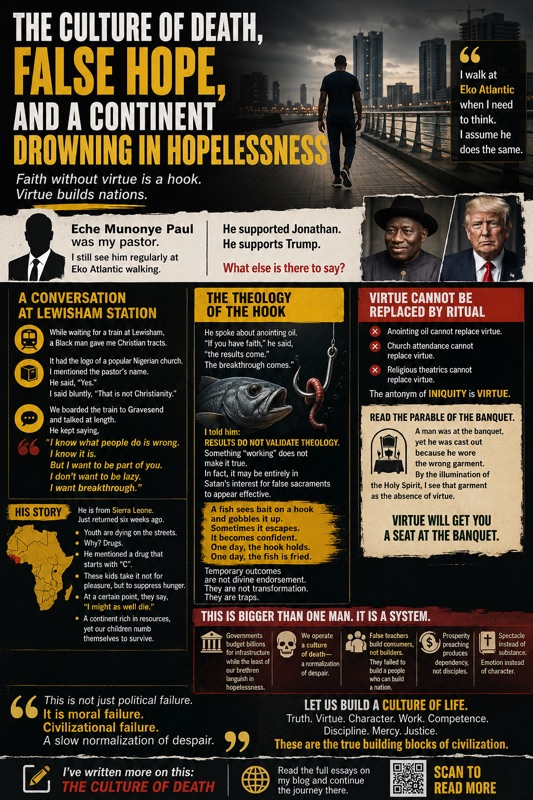
The Culture of Death, False Hope, and a Continent Drowning in Hopelessness

The Culture of Death, False Hope, and a Continent Drowning in Hopelessness


Paul was my pastor once.

I still see him occasionally at Eko Atlantic, walking.

I walk there too when I need to think.

I assume he does the same.

He supported Goodluck Jonathan.

He supports Donald Trump.

What else is there to say?

And yet, in all this, he has often aligned himself with governments that budget humongous sums for infrastructure projects while the least of our brethren languish in hopelessness.


A Conversation at Lewisham Station

Yesterday, while waiting for a train at Lewisham station, a Black man approached me and handed me some Christian tracts.

I opened them and immediately noticed the logo of a popular Nigerian church.

I mentioned the pastor’s name.

“Yes,” he replied.

And I answered bluntly:

“That is not Christianity.”

The man seemed genuinely interested, so we continued talking as we boarded the train toward Gravesend, a rather interesting name considering the direction of our conversation.

We spoke at length.

One thing struck me deeply.

Again and again he said:

“I know some of what people do is wrong. I know it is wrong. But I want to be part of you people. I don’t want to be lazy. I want breakthrough.”

That word again:

“Breakthrough.”


The Theology of the Hook

He began speaking about anointing oil.

“If you have faith,” he said, “the results come. The breakthrough comes.”

And I told him something important:

Results do not automatically validate theology.

Something “working” does not make it true.

In fact, it may be entirely in Satan’s interest for certain false sacraments to appear effective.

A fish sees bait on a hook and gobbles it up.

Sometimes it escapes.

And because it escaped, it becomes confident.

“Look at me,” the fish says.

“I have been feeding on hooks for weeks. I know how to pluck the worm without getting caught.”

But one day, the hook holds.

One day, the fish is fried.

That is how false religion often operates.

People see temporary outcomes and mistake them for divine endorsement.

They confuse spectacle for truth.

They confuse transactions for transformation.


Virtue Cannot Be Replaced by Ritual

Anointing oil cannot replace virtue.

Church attendance cannot replace virtue.

Religious theatrics cannot replace virtue.

The antonym of iniquity is virtue.

That is important to understand.

Many people reduce Christianity to:

“Just don’t go to hell.”

But the Gospel is not merely about avoiding punishment.

It is about becoming transformed.

It is about becoming virtuous.

And contrary to modern preaching, virtue matters immensely.

Read the Parable of the Banquet.

A man made it into the banquet hall, yet he was cast out because he wore the wrong garment.

By the illumination of the Holy Spirit, I increasingly understand that garment to represent the absence of virtue.

Not noise.

Not charisma.

Not prosperity.

Not church branding.

Virtue.


Sierra Leone, Drugs, and the Machinery of Despair

The gentleman I met was from Sierra Leone.

He had returned only six weeks earlier.

And he told me something devastating.

“Youth are dying on the streets,” he said.

I asked why.

“Drugs.”

He mentioned the name of one particular drug. I cannot fully remember it now, only that it began with the letter “C.”

But what struck me was not merely the drug itself.

It was why the young people were taking it.

Not pleasure.

Not excitement.

Hunger.

Hopelessness.

He explained that many take the drug because it suppresses hunger long enough for them to endure another day.

And eventually, despair reaches a point where the soul simply says:

“I might as well die.”

Think about that.

A continent rich in diamonds, oil, gas, gold, talent, and youth, yet its children numb themselves chemically because reality itself has become unbearable.


The Culture of Death

This goes beyond one preacher.

Beyond one politician.

Beyond one country.

It is systemic.

We operate what I have repeatedly called:

A culture of death.

Not because Nigeria is dead.

Nigeria is not dead.

Africa is not dead.

Our people are not dead.

But the culture we normalize is deeply diseased.

A culture where governments drown citizens in hopelessness.

A culture where institutions fail repeatedly without shame.

A culture where religion increasingly substitutes spectacle for moral formation.

A culture where prosperity preaching produces consumers instead of builders.

A culture where people are taught:

“Give money, pour oil on your head, shout louder, claim breakthrough…”

…while remaining morally undisciplined, economically unproductive, civically weak, and spiritually malformed.


The Failure of the False Teachers

And this is why the guild of false teachers bears enormous responsibility.

They failed to build a people capable of building a nation.

Instead, they built dependency.

Emotionalism.

Superstition.

Religious consumerism.

The nation collapses because the people themselves were never morally constructed.

A civilization cannot rise above the character of the people who compose it.

And no amount of anointing oil can substitute for integrity, discipline, competence, courage, restraint, mercy, and virtue.

These are the true building blocks of civilization.


Final Thoughts

I could go on and on.

But perhaps this is enough for now.

I invite you to read the essays on my blog and continue the journey there.

Because what we are witnessing across much of Africa is not merely political failure.

It is moral failure.

Civilizational failure.

A slow normalization of despair.

And until we confront the culture itself, no election, no slogan, no preacher, and no miracle crusade will save us.

Don Kenobi
#OldManInTheMolue 
#MyFrancisEssays 

Sunday, May 24, 2026

The Moths And The Lamp: Immigration, and the Moral Amnesia of Empire

The Moths And The Lamp: Immigration, and the Moral Amnesia of Empire


A provocative essay on immigration, colonialism, and historical memory. “The Moths And The Lamp” explores empire, borders, migration, and the moral contradiction

“And so a colony of moths came together and bought a lamp.

Then you came and stole the lamp, and took it to your house.

And the moths, at night, came to your house and danced around the lamp, because that was the reason they bought the lamp in the first place.

Then you went around town complaining:

‘These moths won’t leave my house alone!’

‘If they want to come to my house to dance around the lamp, let them come properly… get permission…’

And so you treated them like rats. Like cockroaches.

But you committed the crime.

You stole their lamp.

You did not “come properly” to their house either.”


Were You A Legal Thief?

That’s exactly how many people sound when they become enraged about immigration.

About “illegal immigrants.”

Were you a legal thief?

Did conquest become morality simply because enough time passed?

Did violence become legitimacy because it was eventually written into law?

History is full of nations that crossed oceans uninvited, planted flags on other people’s soil, extracted wealth, renamed rivers, redrew borders, and then, centuries later, developed an obsession with documentation.

Now the descendants of those who travelled freely across the world without visas, passports, immigration queues, biometric scans, or “proof of funds” suddenly stand at the gates demanding paperwork from the descendants of the dispossessed.

The irony is astonishing.


Gunboats And Backpacks

You invaded entire continents without permission.

Now you are furious because desperate people crossed a border fence.

You arrived with gunboats.

They arrived with backpacks.

You extracted gold, rubber, oil, diamonds, labour, and human beings.

They are arriving to wash dishes, drive taxis, study nursing, code software, clean hospitals, and survive.

And somehow, they are the criminals?


This Is Not An Argument Against Borders

This is not to argue that nations should not have borders.

Every society has the right to laws, order, and security.

A functioning state requires structure.

But moral seriousness also requires honesty.

You cannot spend centuries destabilizing regions, extracting wealth, supporting coups, redrawing civilizations with rulers on colonial maps, building prosperity from imperial advantage, and then pretend migration emerged in a vacuum.

Cause and effect still exist.


The Lamp Matters

The lamp matters.

The moths are not dancing randomly.

People move toward light.

Toward opportunity.

Toward stability.

Toward functioning institutions.

Toward currencies that hold value.

Toward electricity that stays on.

Toward systems that work.

And many of those systems were financed, directly or indirectly, by centuries of unequal extraction from somewhere else.

That does not mean every immigrant is automatically right.

It does not mean every immigration policy is evil.

It does not mean borders should disappear.

It simply means moral outrage should be tempered by historical memory.


The World Learned The Address

There is something deeply ironic about a civilization that spent centuries entering other people's houses uninvited, only to become obsessed with who is entering theirs.

The moths came because of the lamp. And when the lamp is stolen, the light itself becomes a map back to the house that took it.

I rest my case

Don Kenobi

#BigAgendaAfrica
#CultureNotStructure 
#OldManInTheMolue 
#MyFrancisEssays 


#HarryKane or Harry Kane

Harry Kane Doesn’t Win the Ballon d’Or? I Want My Money Back!

61 goals in one season??

This man is an absolute legend, and we owe it to history to do the right thing.

Harry Kane has entered absurd territory statistically.

This Season (2025–26)

• 61 goals in 51 matches

• Bundesliga top scorer again

• Won the domestic double with Bayern Munich

• Hat-trick in the German Cup final

Absolutely ridiculous numbers.

East Lansing, Michigan — July 2015

I still remember this clearly.

I was in a clothing shop in East Lansing, Michigan, with my daughter.

The young man behind the counter bore a striking resemblance to Harry Kane.

My daughter pointed it out and, to her embarrassment, I immediately said to the guy:

“You look like Harry Kane! Do you know who he is?”

He smiled and replied:

“Never heard of him.”

That was 11 years ago.

Since then, Kane has only gotten better and better.

I often think about that young man and wonder if he now knows who Harry Kane is, because I’m certain he hears it every time he meets anyone from Europe, or football enthusiasts from Africa.

Since Moving to Germany

Harry Kane’s numbers since joining Bayern Munich are simply outrageous:

• 146 goals across three seasons

• Averaging nearly a goal-and-a-half contribution per game

Absolutely insane output.

Entire Career

And then you look at the wider picture:

• 500+ career goals officially crossed earlier this year

• 645 appearances

• 436 club goals

• 78 England goals

These are not normal numbers.

These are historical numbers.

From an Arsenal Fan…

And let this be noted properly:

This praise is coming from an Arsenal supporter.

That alone tells you everything you need to know about this legend, Mr. Harry Kane.

What a career.

What a footballer.

What a legend.

I rest my case.

Don Kenobi

#OldManInTheMolue

#BallondOr #harrykane #BayernMunich #Arsenal #Tottenham

Saturday, May 23, 2026

To Whom Did God Say “I Will Bless Those Who Bless You”? | Genesis 12:3 Explained

To Whom Did God Say, “I Will Bless Those Who Bless You”?


A biblical reflection on Genesis 12:3, the promise God made to Abraham, and the modern debate surrounding justice, mercy, Israel, covenant theology, and the nature of God revealed in Christ.

Fact:
The statement: “I will bless them that bless thee, and curse him that curseth thee…”,  was spoken by God to Abraham, still called Abram at the time, an Iraqi by today’s geography.

It appears in Genesis 12:3:

“And I will bless them that bless thee,
and curse him that curseth thee:
and in thee shall all families of the earth be blessed.”
(KJV)

This was part of God’s covenant and calling of Abraham, when He instructed him to leave his country and promised to make of him a great nation.

The broader passage is found in Genesis 12:1–3.


Who Was Abraham?

To answer this, I made enquiries.

Here is what I found.

The Qur'an presents Ibrahim as:

  • a seeker of truth,

  • a destroyer of idols,

  • a man who rejected paganism,

  • a prophet of pure monotheism,

  • a model of submission to God,

  • and Khalilullah, “Friend of God.”

The Old Testament presents Abraham as:

  • the father of a covenant,

  • a man of faith,

  • a friend of God,

  • and the beginning of a people through whom God said the nations of the earth would be blessed.


The Call of Abraham

In Genesis 12, God calls Abram to leave his homeland.

God says:

“Get thee out of thy country, and from thy kindred, and from thy father’s house, unto a land that I will shew thee:

And I will make of thee a great nation, and I will bless thee, and make thy name great; and thou shalt be a blessing.”

(Genesis 12:1–2)

Then comes one of the most famous promises in Scripture:

“And I will bless them that bless thee, and curse him that curseth thee: and in thee shall all families of the earth be blessed.”

(Genesis 12:3)


What Did Abraham Do to Endear Himself to God?

Abraham’s search for God appears to have started early.

He was a seeker of truth.

One of the most famous Qur’anic passages about Abraham’s youth appears in Surah Al-An‘am (6:74–79).

The Qur’an says Ibrahim questioned idol worship, including the worship of celestial bodies.

He saw a star and said:

“This is my lord.”

But when it set, he said:

“I do not like those that disappear.”

Then he observed the moon.

“This is my lord.”

But when it set, he rejected it.

Then the sun.

“This is my lord; this is greater.”

But when it set, he declared that he would worship only the Creator of the heavens and the earth.

The passage ends with Ibrahim rejecting polytheism and devoting himself entirely to one God.


His Conflict With His Father and His People

The Qur’an says Ibrahim’s father, often identified in Islamic tradition as Azar, made or worshipped idols.

Ibrahim challenged him directly:

“Do you take idols as gods? I see you and your people in clear error.”

The Qur’an portrays Ibrahim as respectful, but firm.

He warned his father against worshipping things that “cannot hear, see, or benefit.”

This appears in Surah Maryam (19:41–48).


The Breaking of the Idols

One of the best-known Qur’anic stories is Ibrahim destroying the idols of his people.

In Surah Al-Anbiya (21:51–70), Ibrahim enters the temple and smashes the idols except the largest one.

He then leaves the axe with the large idol.

When the people accuse him, he replies sarcastically:

“Ask the big one, if it can speak.”

The story exposes the helplessness of idols.

The people become enraged and decide to burn him alive.


The Fire

The Qur’an says God miraculously saved Ibrahim:

“O fire, be coolness and peace upon Abraham.”

This is one of the most dramatic moments in the Qur’anic narrative.

Thus, before Shadrach, Meshach, and Abednego, God had already miraculously saved Abraham from fire.


Why Did God Call Him?

What did Abraham do to endear himself to God?

Perhaps all those things.

He sought truth.

He rejected falsehood.

He resisted idolatry.

He refused to worship what men created.

And clearly, after people attempted to burn him alive, he could not remain among them.

So God called him out.

And then God made one of the most famous promises in Scripture:

“And I will bless them that bless thee, and curse him that curseth thee: and in thee shall all families of the earth be blessed.”

(Genesis 12:3)

And this is the Scripture I want to write about.


A Scripture Frequently Quoted

For decades, I have heard this passage quoted, often with great seriousness, and sometimes even fear, as justification for the belief that unconditional support for Israel is a divine imperative for Christians.

And this is usually the Scripture invoked.

But those who know the Lord intimately, those who reflect deeply upon His nature, eventually encounter a profound tension.

For God is not merely powerful.

He is just.

He is compassionate.

He is merciful.

He is love.

And many believers simply could not reconcile the nature of God revealed in Christ with the idea that they were spiritually obligated to support injustice simply because a nation claimed covenantal significance.

They did not necessarily reject Scripture.

Rather, they wrestled with interpretation.

Because if God is truly just, then justice cannot suddenly become irrelevant.

If God is compassionate, then compassion cannot be suspended.

If God is love, then love cannot be optional.

These are not peripheral attributes of God.

They are central to His very nature.

So the dilemma becomes unavoidable:

How can one claim to serve a God of mercy while celebrating cruelty?

How can one claim to follow Christ while ignoring suffering?

How can injustice become righteous merely because it is politically or religiously convenient?


What the Scripture Actually Says

And here lies the important distinction.

God did not make this declaration to a modern nation-state.

He spoke it to Abraham.

To one man.

To Abram, before he even had children.

Before tribes.

Before kingdoms.

Before borders.

Before geopolitics.

That matters.

Because the passage is often expanded far beyond what the text itself explicitly says.

Many Christians inherited an interpretation that automatically transfers the promise made to Abraham directly onto every action of a modern political state.

But the text itself requires careful thought, humility, and honesty.


The Weight of Interpretation

Where does this leave those who sincerely believed that supporting Israel was spiritually mandatory because of Genesis 12:3?

I honestly do not know.

And perhaps it is above my pay grade to speak too dogmatically about matters so emotionally and spiritually charged.

Some will argue that the promise to Abraham extends covenantally to Israel and beyond.

Others will insist the promise must always be understood through the moral character of God revealed in Christ.

But one thing remains undeniable:

God spoke those words to Abraham.

To Abraham.

Not to a political slogan.

Not to a modern ideology.

Not to an exemption from justice.

To Abraham.


I Rest My Case

Don Kenobi

#MyFrancisEssays
#OldManInTheMolue

Friday, May 22, 2026

Budgets Are Moral Documents| Choose Life, Choose People | How Corruption and Waste Destroy Nations

Service Is Love. Choose Life. Choose People. 

A reflection on corruption, waste, governance, and moral failure in Nigeria. Exploring how normalized theft, public waste, and institutional decay quietly destroy lives, deepen poverty, and undermine national development.


Every Allocation Has Human Consequences

Every frivolous, unnecessary, non-audited allocation costs lives.

The perpetrators of such allocations often dismiss them as merely “ordinary stealing”, a phrase once used by a former Nigerian president.

In 2014, a former Nigerian President argued that most cases labeled as “corruption” in Nigeria were actually ordinary stealing rather than systemic corruption.

His anti-corruption czar, went even further, castigating Nigeria’s educated elite.

“Many educated people wrongly describe stealing as corruption.”

That, in a nutshell, explains part of the tragedy of Nigeria.

The debate gradually shifted away from confronting corruption itself, toward debating how corruption should be defined and discussed.


Corruption Behaves Like Contagion

“Ordinary stealing” compounds over time and helps create the multidimensional poverty we now see across Nigeria.

Consider this:

One man steals ₦1,000 and influences two others to steal ₦1,000 each, because he faced no consequences.

The next day, those two each influence two more people.

Then those four influence eight.

Then those eight influence sixteen.

The amount stolen each day still appears “small.”

Just ₦1,000 here and there.

But corruption behaves like contagion.

It multiplies socially before it multiplies financially.

By Day 20, over ₦1 billion would have been stolen cumulatively.

Not because one man stole a billion.

But because society normalized the first theft.


Nigeria Drowns in Waste

Nigeria is not the poverty capital of the world because it lacks resources.

Nigeria is the poverty capital of the world because the nation drowns in waste.

The choice before us is stark:

Cut waste, or watch opportunity disappear generation by generation.

Consider this.

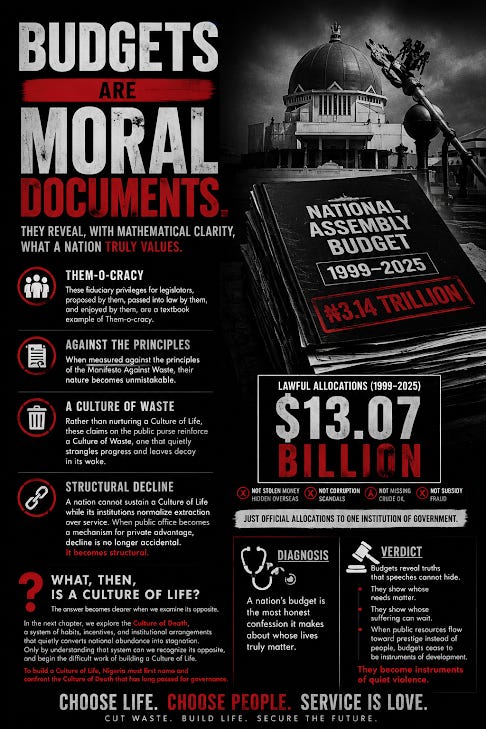
From 1999 to 2025, the cumulative allocation to Nigeria’s National Assembly amounted to approximately ₦3.14 trillion.

At today’s exchange rate, that figure would appear to be roughly $2.67 billion. But that would be misleading.

To understand the true historical value of these allocations, each year’s spending must be converted using the average exchange rate for that specific year.

When calculated properly, the cumulative allocation from 1999–2025 amounts to approximately:

$13.07 Billion

That is lawful expenditure.

Not stolen money hidden in foreign accounts.

Not corruption scandals.

Not missing crude oil.

Not subsidy fraud.

Just official allocations to one institution of government.

Before examining arguments, we must first examine arithmetic.

Below is a table calculating the lawful allocations to Nigeria’s National Assembly from the beginning of the Fourth Republic in 1999.

Budgets are moral documents - They reveal, with mathematical clarity, what a nation truly values.

These fiduciary privileges for legislators, proposed by them, passed into law by them, and enjoyed by them, are a textbook example of Them-o-cracy.

When measured against the principles of the Manifesto Against Waste, their nature becomes unmistakable.

Rather than nurturing a Culture of Life, these claims on the public purse reinforce a Culture of Waste, one that quietly strangles progress and leaves decay in its wake.

A nation cannot sustain a Culture of Life while its institutions normalize extraction over service. When public office becomes a mechanism for private advantage, Decline is no longer accidental. It becomes structural.

But what, then, is a Culture of Life?

The answer becomes clearer when we examine its opposite.

In the next chapter, we explore the Culture of Death, a system of habits, incentives, and institutional arrangements that quietly converts national abundance into stagnation.

Only by understanding that system can we recognize its opposite, and begin the difficult work of building a Culture of Life.

To build a Culture of Life, Nigeria must first name and confront the Culture of Death that has long passed for governance.


Diagnosis

A nation’s budget is the most honest confession it makes about whose lives truly matter.


Verdict

Budgets reveal truths that speeches cannot hide.

They show whose needs matter.

They show whose suffering can wait.

When public resources flow toward prestige instead of people, budgets cease to be instruments of development.

They become instruments of quiet violence.

Excerpt from:

APPRENTICE NATIONS: The Anatomy of FailureDon Kenobi | BigAgendaAfrica

Don Kenobi

Author: Of gods and Negroes

Baptismal Pools, Political Religion, and the Kingdom of God

  Baptismal Pools, Political Religion, and the Kingdom of God Baptismal Pools, Political Religion, and the Kingdom of God,  is a reflective ...