Sunday, July 12, 2026

Ham Was Never Cursed: How Did it Become Christianity's Most Persistent Racial Myth?

The "Curse of Ham"| (The Curse That Never Was)

Discover how racism wrung and twisted Scripture until the truth was drained away; then pulverised what remained, packed it into neat little capsules, and offered them to the very people it had wounded—gently assuring them that this was, and always had been, the divine order of things. 

Thus were slavery, colonialism, and racial supremacy clothed in the language of faith and presented as the will of God.

So I listened to a racist pastor—perhaps a priest—speaking about Africa on Bishop Talbert Swan's Facebook wall.

(A brief aside: Bishop Swan consistently exposes false teachers—Black or white—and defends the dignity of Black people in a way I deeply admire.)

His argument was simple.

The only period of sustained progress in Africa, he claimed, came under European colonial rule.

Then he declared that it was the natural order of things for Hamites to live under the supervision of Japhethites.

Those were his words.

"Hamites" I recognised. I assumed he was referring to Black people through that long-discredited interpretation of the so-called Curse of Ham.

But "Japhethites"?

I'd never even heard the term used in my life.

(Their label had to have more syllables than ours? 🤓😀)

And the man saying all this...

...was wearing a priest's collar.

I could have called him many things.

I won't.

His ignorance exposed him far more effectively than any insult ever could.


The "Curse of Ham" That Never Was

One of the strangest things about this entire doctrine is that Ham was never cursed.

Read the passage carefully.

After Noah awoke from his drunkenness, he did not say:

"Cursed be Ham."

He said:

"Cursed be Canaan." (Genesis 9:25)

Canaan.

Ham's son.

Not Ham.

That single fact should have ended centuries of racist theology before they ever began.

But it didn't.

The biblical text never explicitly explains why Canaan, rather than Ham, received the curse.

Many interpretations have been proposed over the centuries, but Scripture itself does not tell us.

Some argued that Ham's offence was simply seeing his father's nakedness and telling his brothers. Others proposed far more elaborate—and highly speculative—theories.

None of these explanations appears plainly in the text.

What is remarkable is not the ambiguity of Genesis.

What is remarkable is the determination with which people built an entire racial hierarchy upon that ambiguity.

The Bible never says Black Africans descended uniquely from Ham.

The Bible never says Ham was cursed.

The Bible never says skin colour had anything whatsoever to do with Noah's words.

Yet for centuries Christians in Europe and America transformed this obscure passage into a theological justification for slavery, colonialism, segregation and racial oppression.

That tells us far more about the human heart than it does about Scripture.

Sometimes we do not read our prejudices into the Bible.

We read them out of ourselves.


Racism Draped in Biblical Language

What struck me was not simply his racism.

It was the theology beneath it.

This was not Christianity.

This was racism draped in biblical language.

People like him love to quote passages from the pre-Christ era—the Old Testament—as though they justify a world built upon ethnic hierarchy.

It is true that, in the Old Testament, God chose a people for Himself.

That is beyond dispute.

But the Old Testament is also the story of those same chosen people repeatedly proving unfaithful to the covenant.

God did not revoke His covenant, for He remains faithful even when we are not.

Instead, He sent prophet after prophet calling His people back to Himself.

Then, at last, He sent His Son.

As Jesus explained in the Parable of the Tenants, the owner of the vineyard sent servant after servant.

They were rejected.

Beaten.

Killed.

Finally he said,

"They will respect my son."

Instead, they killed him too.

The parable reflected Israel's long history of rejecting those whom God had sent.

It is almost as though they believed they possessed God's PIN code.

God had entered into covenant with them.

Surely He could never take it back.

But that misses the point entirely.

God did not abolish His covenant.

He fulfilled it in Christ.

Then He did something astonishing.

Through Christ, He opened the covenant to every nation on earth.

Those who belong to Christ become the people of God—not through ethnicity, but through faith.

That is the Gospel.

So whenever people continue speaking the language of ethnic superiority after Christ, they diminish the work of Jesus.

They try to replace the Christ who came for the whole world with a Christ who came only for themselves.

That is not Christianity.

It is the very opposite of Christianity.


The Historical Myth

Then there was his historical claim.

He argued that Africa experienced sustained progress only under European colonisation.

History tells a rather different story.

One of Europe's greatest periods of intellectual renewal began when North African Muslims—the Moors—crossed the Strait of Gibraltar and established Al-Andalus in Spain.

They did not arrive merely with armies.

They brought mathematics.

Astronomy.

Medicine.

Engineering.

Irrigation.

Architecture.

Philosophy.

Libraries.

Universities.

They preserved, translated, commented upon and expanded the works of the ancient Greeks while much of Western Europe struggled through the centuries following the collapse of the Western Roman Empire.

Through Arabic scholarship, Europe recovered Aristotle and many other classical writers whose works had become scarce in the Latin West.

Knowledge flowed.

Ideas flowed.

Civilisations learned from one another.

Many historians regard this exchange of knowledge as one of the great foundations of the European Renaissance.

The point is not that Islamic civilisation was perfect.

It wasn't.

Nor is the point that Europe contributed nothing of its own.

It certainly did.

The point is simply this:

Civilisations borrow.

Civilisations lend.

Civilisations teach.

Civilisations learn.

Or, borrowing President Obama's cadence:

"It's what we do, stupid."

History is richer—and humbler—than the racist myth suggests.


The Hardness of the Human Heart

Perhaps the saddest lesson in all this is not about history.

It is about ourselves.

Human beings possess an astonishing capacity to construct elaborate theologies to justify what they already wish to believe.

They ignore what Scripture plainly says.

Invent what it never says.

Then preach with absolute certainty what God Himself never revealed.

Not because they love the truth.

But because they love the comfort that false certainty provides.

The so-called Curse of Ham remains one of history's greatest examples of this.

A doctrine built upon words the Bible never says.

Used to defend evils that Christ came to destroy.

That is what happens when hard hearts become more authoritative than Holy Scripture.

Which is why every Christian must read the Bible through the lens of Christ.

Because Jesus is not merely part of the story.

He is the key that unlocks the whole story.


I rest my case.

Don Kenobi

Clinton: The Rise They Could Not Forgive

 CLINTON: How A Nation Lost Its Way


A Molue Monologue on Bill Clinton, America's decline, oligarchy, race, power, and the political choices that reshaped the American Republic. 


(The Molue rattles along, its body creaking under the weight of tired commuters. The Old Man sits by the window, pen in hand, his gaze far beyond Lagos… across the Atlantic, into the soul of America.)

He writes:

He writes: The people most blind to America’s decline—an assured outcome under the Republican Party—are those who, historically, have always opposed America’s true promise: a promise meant for all.

“Do not be a city—nay, the city on the hill,” they cry.
“Be instead our city—
not a hilltop lighthouse for the world,
but hidden under our bushel—
for us alone.”

They hold America’s promise against her.


The Decline

The decline began when Clinton’s Vice President had the presidency snatched away—by a single Supreme Court vote.

And yes, that deciding vote was Clarence Thomas’s.

Everyone loves George now… but let’s be honest—
he was a step down from the brilliance of the Clinton years.

Watching Bill Clinton on TV was like watching Jesus.
We hung on every word.
He wasn’t just a president.
He was The Man.

The perfect man.
The perfect president.
The perfect backstory:

Born into poverty, father dead before birth,
raised by an alcoholic stepfather,
tall, good-looking—
and he played the saxophone.

It was the perfect American story.


The Original Sin

But here’s the catch:
He was the first non-millionaire to become president.

Don’t forget—Jimmy Carter, the “peanut farmer,” was already a millionaire.
Clinton wasn’t even close.

And to my probing mind, that was his original sin.
The oligarchy couldn’t have it.
The presidency was not meant for outsiders—
not for anyone outside their “bloodline.”

They had to destroy him.

And he was Irish—
poor and Irish?!

Nah.


I can almost hear those dissolute elites weeping each morning, inconsolable:

“How did this happen?
How did a poor Irish boy—whose closest friends were Black—
become president?
What will our ancestors think of us?”

At the time, even Black America called Clinton the first Black president.
That phrase—an open insult to the oligarchy.

They mocked it.
Derided it.
Laughed at Black people for daring to imagine.

I believe it was John Lewis—“Good Trouble” Lewis—who first used it.

And the backlash came fast:

“Black president?
Your Black a*!
Wake up. Smell the coffee. He’s not Black!”

They had to fix it.
And they did.


The Attack

They came for him with everything.

Asa Hutchinson. Lindsey Graham—then a little-known congressman—
already calling Clinton unfit for office,
demanding resignation for “desecrating” the Oval Office.

(He chuckles bitterly.)

Irony of ironies—Lindsey Graham may go down
as the single worst American in history,
the man who betrayed his country the most.

Where was I?
Ah yes—the Lewinsky affair.

A moral failing, yes.
But blown into a crisis of biblical proportions.


I remember Clinton pointing his finger at the camera and saying:

“I will not resign.
I will stay in this office until the last second of the last minute
of the last hour of the last day of my presidency.”

You know the rest.

But what you may not know
is its impact ten thousand kilometers away.


The Night of the Vote

I was visiting my mother in Benin City.
Mercifully, there was light—electricity—so the TV was on.
We followed the Senate vote to acquit or convict.

When the “Nays” crossed the threshold,
my mother and I held hands and danced.

I don’t think we ever held hands and danced before—or since.

Clinton was our man.
To us, he truly was the first Black president.


The Fix

And that is why I’m writing—
to remind you how we got to the Now.

The power structure had to fix it.
America, to them, was still a slave plantation.
They got to decide who the major domo would be.

To quote Eminem:

“How the hell did this metamorphosis happen?”

How did a poor Irish boy, so poor his only friends were Black,
become master of the Republic?

Answer: They had to fix it.

They unleashed Kenneth Starr—
a special counsel with one mission: destroy Clinton.

He failed so spectacularly
that I think he lost his mind.

Only to resurface decades later
as one of Trump’s defense lawyers during impeachment.

Poetic.
Tragic.
Ironic.


Starr was egregious.
And living with the Clintons in his head for thirty years
was punishment enough.

So—having failed to take Clinton down—
they moved to restore order to the plantation.

Enter George Bush, the son.
Order restored.


After September 11

The decline deepened after September 11,
when American Christianity allowed hate into its heart.

And as Hercule Poirot once said:

“Do not allow hate into your heart…
or it will make a permanent home there.”


(He looks up. Dawn filters through the Molue window.)

I’ll analyze that another day.

For now, it’s 04:37 on September 2,
and it’s time for coffee and the gym.

Good morning.

— Don Kenobi

(The Passenger at the back row of the Molue with a writing pad on his lap, watching the world go by.)

Originally published October 2025


Thursday, July 9, 2026

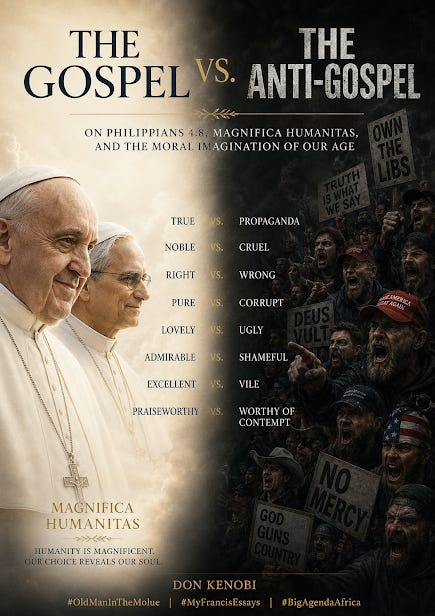
The Age of the Anti-Philippians | What exactly is wrong with Philippians 4:8?]

 Peter Thiel criticizes Pope Leo’s vision for AI, accusing him of serving China got me reflecting on technology, morality, and the steady erosion of VIRTUE…


What exactly is wrong with Philippians 4:8?

The question sounds absurd.

After all, Philippians 4:8 is one of the most universally admired passages in all of Scripture:

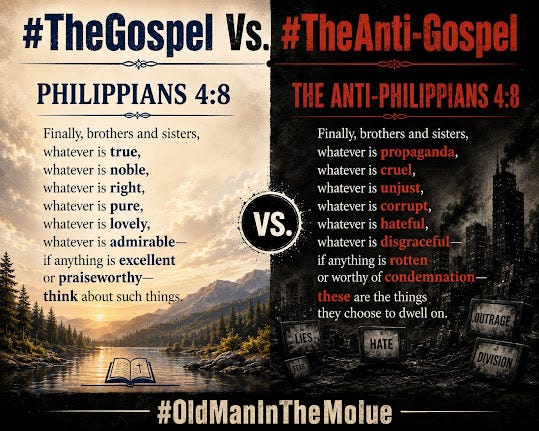
“Finally, brothers and sisters, whatever is true, whatever is noble, whatever is right, whatever is pure, whatever is lovely, whatever is admirable—if anything is excellent or praiseworthy—think about such things.”

It is difficult to imagine a more benign, more civilizational, more humanizing command.

Yet, if one pays close attention to our public discourse—particularly in this strange age of algorithmic outrage and ideological performance—it increasingly appears that many influential voices have, consciously or unconsciously, adopted its exact opposite.

So I decided to conduct a small experiment.

Rather than merely defend Philippians 4:8, I inverted it.

I asked:

What would the Anti-Philippians 4:8 look like?

It would sound something like this:

“Finally, brothers and sisters, whatever is false, whatever is cruel, whatever is wrong, whatever is corrupt, whatever is ugly, whatever is shameful—if anything is vile or worthy of contempt—set your minds on such things.”

Instead of truth — falsehood.
Instead of nobility — cruelty.
Instead of righteousness — wrongdoing.
Instead of purity — corruption.
Instead of loveliness — ugliness.
Instead of admirability — shame.
Instead of excellence — vileness.
Instead of what is praiseworthy — what deserves contempt.

It would look like this:

And perhaps most importantly:

Instead of deliberately fixing one’s mind on what elevates humanity, one deliberately dwells on what degrades it.

With that inversion, the landscape of modern outrage culture suddenly begins to make a terrifying kind of sense.

Do I need to spell it out?

It is a replacement.

A replacement of what?

Of an entire moral imagination.

From the spiritual to the political.

From the personal to the cultural.

At its heart lies a simple proposition:

These people do not seek the flourishing of all humanity.


The Gospel and the Anti-Gospel

This thought returned to me recently while watching two seemingly unrelated events unfold.

On one side, Peter Thiel launched yet another broadside against Pope Leo XIV and the moral vision he expressed regarding artificial intelligence.

Apparently, the Pope is now serving Chinese communism.

On the other side, Elon Musk—his ideological cousin in many respects—criticized MacKenzie Scott’s extraordinary philanthropy, lamenting that a woman who has voluntarily given away some $26 billion of her own wealth is somehow making the world worse.

Pause for a moment.

A woman gives away enough wealth to transform universities, hospitals, charities, communities and lives across the world.

The criticism is not that she has given too little.

It is that she has given at all.

At some point, one must stop asking political questions and begin asking theological ones.

Because beneath politics lies anthropology.

And beneath anthropology lies theology.

What, exactly, do these men believe a human being is?


What Did Pope Leo Actually Do?

He did something rather dangerous.

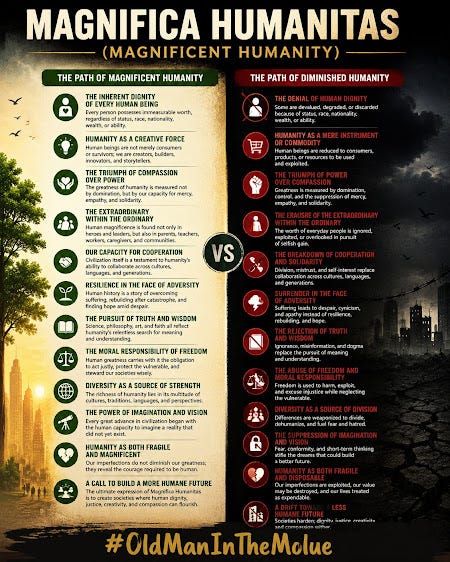
He proclaimed Magnifica Humanitas.

Magnificent Humanity.

Its vision is breathtakingly simple.

  • Every human being possesses inherent dignity.

  • Humanity is a creative force.

  • Compassion triumphs over power.

  • The extraordinary is found within ordinary people.

  • Human beings flourish through cooperation.

  • Resilience overcomes adversity.

  • Truth and wisdom are worth pursuing.

  • Freedom carries moral responsibility.

  • Diversity strengthens rather than weakens us.

  • Imagination shapes the future.

  • Humanity is simultaneously fragile and magnificent.

  • We are called to build a more humane world.

Humanity is magnificent not because we are perfect.

Not because we are innocent.

Not because we are wise.

But because every human being possesses an irreducible dignity that cannot be diminished by wealth—or the lack of it—by race, nationality, success, failure or power.

Let me say that again.

Humanity is magnificent because every human being possesses an irreducible dignity that neither wealth, power, race nor failure can erase.


Another Inversion

So I performed the same experiment again.

Rather than merely defend Magnifica Humanitas, I inverted it.

What would the anti-Magnifica Humanitas look like?

Perhaps something like this:

  • What if humanity possessed no inherent dignity?

  • What if human beings were merely instruments?

  • What if power mattered more than compassion?

  • What if ordinary people were expendable?

  • What if cooperation were weakness?

  • What if suffering demanded surrender rather than resilience?

  • What if truth were subordinate to utility?

  • What if freedom meant domination?

  • What if diversity meant division?

  • What if imagination itself became dangerous?

  • What if human fragility made us disposable rather than precious?

  • What if the future belonged not to hope, but to managed decline?

    It would look like this:

Can you recognize the pattern?

From the vilification of Bill Gates...To the criticism of MacKenzie Scott...To the gratuitous insults directed at Pope Leo XIV...

The inversion reveals not merely a political ideology, but an entire moral imagination.

An anti-humanism.

A worldview in which people are valued according to productivity, utility, loyalty, market value, tribal identity or ideological usefulness.

A world in which compassion becomes weakness.

Mercy becomes naïveté.

Generosity becomes pathology.


The Strange Psychology of Our Time

Here we encounter one of history’s great ironies.

Many Americans—including many white Americans—view Trumpism and the MAGA movement as a warning rooted in painful historical experience.

Yet many others, including some Africans observing events from afar, see the same movement through a very different lens: as a symbol of strength, order, sovereignty or even salvation.

How fractured must our moral imagination become for the same figure to appear simultaneously as both warning and redeemer?

How damaged must it become before we begin to admire precisely those qualities that diminish our own humanity?

There is a deeper danger still.

A theology that persuades people to celebrate the very forces that diminish them.

A theology that teaches victims to defend their own victimhood.

In a recent essay titled, The Theology Of Self-Justification I described it this way:

Imagine a theology that not only oppresses its victims, but persuades them that they were created for their oppression.

A theology that convinces people they are less than—that they were created to be less than.

That their place beneath others is not injustice, but God’s design.

That their suffering is not the result of human evil, but the natural order of the universe.

Few lies have been more powerful—or more destructive.

Full essay: Click

The Molue Question

Back to more familiar surroundings.

The old Lagos molue.

There, these conversations were never theoretical.

Sooner or later, the old man sitting beside you would ask the only question that really matters.

“So, my friend... what kind of person does your philosophy—your theology—produce?”

Not what GDP it produces.

Not what elections it wins.

Not what stock prices it raises.

What kind of human being does it create?

Does it produce people who think about what is true, noble, just, pure, lovely and admirable?

Or does it produce people who dwell endlessly upon humiliation, domination, grievance, spectacle, outrage and contempt?

Because eventually...

Every civilization becomes the object of its contemplation.

We become what we choose to admire.

And perhaps that is why Paul’s ancient instruction remains so revolutionary.

Think on these things.

Not because doing so makes us weak.

But because it is one of the surest ways to remain fully human.


Don Kenobi

#OldManInTheMolue
#MyFrancisEssays
#BigAgendaAfrica
#MagnificaHumanitas
#TheGospelVsTheAntiGospel

Wednesday, July 8, 2026

The Shepherd never teaches His sheep to hate


The Shepherd never teaches His sheep to hate

A television interview becomes a searching conversation about truth, persecution, corruption, false shepherds, and what it truly means to follow Christ. 

An excerpt from The Monologuist by Don Kenobi.


Under the Lights

The studio was brighter than Timotheus imagined.

Banks of white lights hung overhead, bleaching every colour into something slightly unreal. Cameras glided silently across polished tracks. A live audience filled the tiered seating, their anticipation amplified by the quiet choreography of floor managers, technicians and producers counting down to airtime.

Everything about television suggested certainty.

Timotheus felt none.

He sat between two men who represented very different worlds.

To his left was the host—a seasoned journalist whose reputation had been built asking questions that left politicians searching for exits.

To his right sat Father Gabriel, an articulate Catholic priest with an easy smile, a sharp mind, and a collar that immediately communicated authority.

Timotheus carried neither notes nor Bible.

Only a glass of water.

Behind them, a giant monitor flickered to life.

The audience watched images of crowded Molues weaving through Lagos traffic. Then came clips of university students laughing around him after lectures. Workers standing in circles on dusty street corners. Strangers listening as though ordinary conversations had somehow become sermons.

Finally, the recording settled on Timotheus himself.

"...Where is the profit?"

The clip ended.

Applause filled the studio.

The host smiled.

"So," he said, almost casually, "who exactly is Timotheus?"

He glanced at his card.

"A mathematics teacher?"

"A preacher?"

"A disappointed seminarian?"

The audience laughed.

Timotheus simply smiled.

Nothing more.

The host leaned forward.

"Let's begin there."

"You applied to become a Catholic priest."

"Twice."

"You were rejected."

"Twice."

He allowed the words to linger.

"Is everything we're seeing today..."

"...simply revenge?"

The audience fell silent.

Timotheus studied him for a long moment.

Then he nodded ever so slightly.

"Perhaps."

A collective gasp swept across the studio.

Even Father Gabriel turned to look at him.

Then Timotheus burst into laughter.

Not polite laughter.

Real laughter.

The audience joined him.

When he finally recovered, wiping tears from the corners of his eyes, he shrugged.

"Maybe."

The laughter returned, louder this time.

The host smiled despite himself.

He had not expected his first attack to dissolve into comedy.


A Priest Without Permission

"So now," the host continued, "instead of preaching inside churches..."

"...you preach in classrooms."

"On buses."

"On street corners."

He looked directly at Timotheus.

"Almost like..."

"...a priest without permission."

Timotheus considered the description.

Then shrugged.

"Perhaps God enjoys unusual architecture."

The audience laughed again.

Even Father Gabriel smiled.

Only briefly.

The host turned another page.

"You stopped attending Mass."

Timotheus looked genuinely puzzled.

"Who told you that?"

The journalist hesitated.

"Didn't you?"

Timotheus shook his head.

It was at that moment the audience began noticing something unusual.

Timotheus never answered questions directly.

He dismantled them.


Sundays

"No," he said.

"I attend church three..."

"...sometimes four..."

"...times every week."

A murmur travelled through the audience.

"Really?" the host asked.

"Yes."

"I simply avoid going on Sundays."

Laughter rolled across the studio.

Father Gabriel remained expressionless.

"You avoid..."

"...sermons?"

"I go," Timotheus replied quietly, "for an encounter with the Holy Spirit."

"To renew my Creed."

"To pray the Hail Mary."

He paused.

"Sometimes..."

"...sometimes silence teaches better than microphones."

The laughter disappeared.

Even those who disagreed found themselves listening.

Father Gabriel finally spoke.

"Then surely..."

"...you're still Catholic."

Timotheus smiled warmly.

"Entirely."

The host frowned.

"Yet many Catholics accuse you of attacking the Church."

Timotheus reflected before answering.

"No."

"I attack darkness."

He paused.

"Sometimes..."

"...darkness wears a collar."

The audience shifted uneasily.

Father Gabriel straightened in his chair.

"That's unfair."

"Priests have devoted their lives to Christ."

Timotheus nodded before the sentence had even finished.

"Many have."

"Some are saints."

"Some carried Christianity upon bleeding shoulders."

"They gave us hospitals."

"Schools."

"Universities."

"Orphanages."

"Some died anonymous deaths serving Christ."

He turned towards Father Gabriel.

"They deserve monuments."

For the first time that evening, Father Gabriel visibly relaxed.

Then Timotheus quietly added,

"Others..."

"...deserve investigation."

Silence returned to the studio.

Not hostile.

Reflective.

It lingered long enough for everyone to recognise that he had not spoken those words in anger.

Only sorrow.


The Gift

The host sensed the interview changing.

He leaned forward.

"Are you saying..."

"...the Church failed you?"

Timotheus smiled.

"No."

"The Church gave me something priceless."

"What?"

"Rejection."

Even Father Gabriel blinked.

"You're grateful..."

"...for rejection?"

"Very."

Timotheus folded his hands.

"Rejection gave me distance."

"Distance gave me perspective."

"Perspective..."

"...gave me a bird's-eye view."

The host leaned forward.

"A bird's-eye view..."

"...of what?"

Timotheus did not answer immediately.

Instead, he looked directly into Camera One.

The small red tally light glowed steadily.

"The Body of Christ."

He paused.

"From above..."

"...patterns become visible."

"Light..."

"...and shadow."

"Truth..."

"...and performance."

No one interrupted him.

Not even the host.

For reasons none of them could quite explain, the interview had stopped feeling like an interview.

It had become something else.

A conversation in which everyone, including the interviewer, had quietly become a student.

The hardest questions, however, were still waiting.


The Hardest Question

The host sat back in his chair.

For a moment, he simply watched Timotheus.

Then, almost deliberately, he changed direction.

"Let's talk about persecution."

The atmosphere shifted.

On the screen behind them appeared images of burned churches, grieving families, and villages scarred by violence.

The audience grew quiet.

"Churches burned."

"Christians murdered."

"Families displaced."

He looked directly at Timotheus.

"Many people call this Christian genocide."

"Why won't you?"

Applause swept through the studio.

Timotheus did nothing.

He simply waited.

He had learned long ago that applause often interrupted thought.

Only after the room had become silent again did he answer.

"Because truth..."

"...must never become a casualty..."

"...even while defending truth."

The silence that followed was heavier than the applause.

The host frowned.

"That's not an answer."

"It is the only answer."

"Are Christians suffering?"

"Absolutely."

"Then why hesitate?"

Timotheus folded his hands.

"Because Christianity was born suffering..."

"...not escaping it."

He spoke almost gently now.

"The first Christians were never promised safety."

"They were fed to lions."

"Burned alive."

"Crucified."

"Some upside down."

"They were hunted across an empire like rabid dogs."

"They worshipped in catacombs."

The host interrupted.

"What's a catacomb?"

Timotheus smiled.

"An underground cemetery."

"The early Christians buried their dead there."

"They also worshipped there whenever it became too dangerous to worship above ground."

He paused.

"In one place..."

"...they preserved both memory..."

"...and hope."


Define the Word

Father Gabriel leaned forward.

"Fine."

"Are Christians being persecuted in Nigeria?"

"Yes or no?"

Timotheus smiled almost sympathetically.

"Before I answer..."

"...we must first agree on what persecution means."

Father Gabriel shook his head.

"No."

"Yes or no."

Timotheus ignored the interruption.

"In the first three centuries, Christians suffered repeated waves of persecution under Nero..."

"...Decius..."

"...and Diocletian."

"Yes or no."

For the first time that evening, Timotheus raised his voice.

Not angrily.

Precisely.

"Persecution meant being arrested simply for refusing to sacrifice to the Roman gods."

"Being arrested for refusing to acknowledge the emperor's divinity."

"Losing property."

"Losing employment."

"Imprisonment."

"Torture."

"Public execution."

He paused.

"Beheading."

"Crucifixion."

"Burning."

"Being thrown into an arena before cheering crowds."

The studio had become motionless.

Father Gabriel refused to surrender.

"Yes..."

"...or no?"

Timotheus continued as though he had not spoken.

"The Romans called Christians..."

"...atheists."

A ripple of surprise passed through the audience.

"Imagine that."

"Atheists."

"Not because they believed in no god..."

"...but because they refused to worship Rome's gods."

He looked towards Father Gabriel.

"The principal accusation was never..."

"'You worship Jesus.'"

"It was..."

"'You refuse to worship the gods who protect Rome.'"

Again the priest interrupted.

"Yes..."

"...or no?"

Timotheus took one slow step towards him.

"Very well."

"Let us use the Roman definition."

"Are Christians in Nigeria arrested by the State for refusing to sacrifice to other gods?"

"Yes or no, Father Gabriel?"

No answer.

"Are Christians imprisoned by the constituted authorities for refusing to acknowledge another religion's lordship?"

No answer.

"Are Christians stripped of their property..."

"...their employment..."

"...their civil rights..."

"...because they refuse to worship another god?"

Again...

silence.

Father Gabriel smiled.

"Why did you stop?"

"Why not ask whether Christians are publicly beheaded in Northern Nigeria?"

Timotheus never broke eye contact.

"By the constituted authorities?"

"Or by criminals?"

"There is a difference."

"A profound difference."

"And if we lose that distinction..."

"...we lose the meaning of the word."

His voice softened.

"I am not frightened by marauding criminals wielding machetes and axes against Christians trying to live in peace."

"They are wolves."

"Without question."

"But they are wolves..."

"...outside the sheepfold."

No applause followed.

Only thought.

Wolves

Elsewhere, the nation had stopped moving.

In a crowded beer parlour, untouched bottles warmed on the tables as every eye remained fixed upon the television.

In a barber's shop, electric clippers hung motionless in mid-air while a customer sat with only half his haircut completed.

Inside a seminary common room, young seminarians leaned closer to the screen.

No one was taking notes anymore.

Back in the studio, the host's voice had almost become a whisper.

"Then..."

"...what frightens you?"

Timotheus answered immediately.

"Corruption..."

"...within the Church."

"The wolves within."

He looked slowly around the audience.

"Outside wolves rarely destroy Christianity."

"It is the wolves inside..."

"...the wolves in shepherds' clothing."

The room shifted uneasily.

Father Gabriel folded his arms.

"Are you calling priests wolves?"

Timotheus turned towards him.

His expression carried neither anger nor accusation.

Only sadness.

"Some."

"Not all."

"Never all."

"But enough."

"Enough that Christ warned us."

"Not once."

"Repeatedly."

He allowed the words to settle.

Then quietly continued.

"A wolf outside the sheepfold..."

"...looks like a wolf."

"A wolf inside..."

"...usually carries a Bible."

No one moved.

Even the host had stopped interrupting.

Somehow...

without anyone noticing exactly when...

Timotheus had taken control of the room.


The Shepherd

The host glanced at his notes.

Then quietly placed them face down upon the table.

For the first time that evening, he asked a question he had not prepared.

"May I ask you something..."

"...not as a journalist..."

"...but as a Christian?"

The audience became perfectly still.

Father Gabriel noticed immediately.

This was dangerous.

The interview had changed.

The journalist was no longer interviewing.

He was searching.

Timotheus nodded.

"Of course."

A long silence followed.

Then—

"How..."

"...do I know..."

"...I'm following the Shepherd..."

"...and not merely..."

"...someone speaking about Him?"

The room froze.

Father Gabriel closed his eyes.

He knew this answer would outlive the programme.

Timotheus reached quietly for his glass of water.

He took a sip.

Placed it gently back on the table.

Then turned.

Not towards the host.

Towards Camera One.

Towards millions of people watching at home.

When he finally spoke, his voice was almost tender.

"The Shepherd..."

"...never teaches His sheep..."

"...to hate."

Silence.

"Start there."

He paused once more.

Almost as though the final thought had arrived unexpectedly.

"Any shepherd..."

"...who teaches his flock to hate..."

"...is merely speaking about Jesus."

"He is not following Jesus."

"And he is certainly not..."

"...leading his sheep..."

"...towards the Lord."


After the Broadcast

Across the country, nobody spoke.

In the barber's shop.

The beer parlour.

The convent.

The seminary.

Even in a small mosque, where a television murmured quietly in one corner, no one reached for the remote.

In a yellow Molue rattling through Lagos traffic, the conductor forgot to call for passengers.

The old bus simply kept moving.

Silently.


The Next Morning

The newsroom was unusually quiet.

Editors replayed the interview without saying a word.

Finally, the presenter looked up.

"Who is he?"

An editor shrugged.

"I'll find out."

He glanced at a sheet of paper lying on his desk.

"I hear...he's a janitor."


An excerpt from The Monologuist by Don Kenobi.


Who Owns God? Christian Faith, Immigration and Compassion

Who Owns God?  On Christian Faith, Immigration and Compassion? From a squirrel on a cable to the vast cosmos and the stranger at the border,...