Sunday, July 26, 2026

Aryan Paganism and the Replacement of Christ


Aryan Paganism: White Supremacism and the Replacement of Christ

Why Did Influential Figures Within Nazi Germany Seek to Replace Christianity With a Mythic Aryan Religion? This researched article explores the spiritual dimension of Nazi ideology and then asks a deeper theological question: What happens when race, nation, or politics takes the place of Christ?

The Spiritual Experiment Behind Nazi Germany

One of the lesser-known aspects of the Third Reich was its attempt to forge an entirely new spiritual identity for Germany.

What has come to be known as Nazi Aryan Paganism was an ideological and quasi-religious movement promoted by influential figures within the Nazi regime, particularly Heinrich Himmler and elements of the SS.

It sought to revive, or in many cases reinvent, a pre-Christian “Aryan” faith rooted in Germanic mythology, racial mysticism and hostility towards Christianity.

Rather than merely governing a nation, some Nazi leaders envisioned creating an entirely new civilisation, with its own myths, rituals, symbols, heroes and theology.

This raises an intriguing question.

Why Do Supremacist Ideologies So Often Find Themselves in Conflict With Christ?

History suggests that this is no coincidence.

The Gospel proclaims a Kingdom open to every tribe, every tongue, every nation and every people.

The New Testament teaches that every human being bears the image of God and that salvation is offered without distinction of race or ethnicity.

That universal message sits uneasily beside any ideology that elevates one race above another

Christ breaks down walls,
Supremacist ideologies build them.

Christ calls people to humility.
Supremacist ideologies glorify pride.

Christ commands us to love our neighbour.
Racial ideologies divide humanity into the "superior" and the "inferior."

The two visions cannot peacefully coexist.

The next time you hear someone claiming to speak for Christianity dismiss compassion as the "weakness of Western civilization,"

Or ridicule empathy as though it were a vice.

Or mock the poor while dismantling the fragile safety nets that keep many from utter despair.

Pay close attention.

When you hear such words or witness such actions, recognize the spirit at work. It is not the Spirit of Christ.

For we are God's workmanship, created in Christ Jesus to do good works, which God prepared in advance for us to do (Ephesians 2:10).

Any ideology that exalts one people over another,
That glorifies hardness of heart,
Or treats mercy as weakness,

Is anathema.

It stands in direct opposition to the Gospel.

Christianity Was Seen as an Obstacle

For many Nazi ideologues, Christianity was not rejected merely because they regarded it as “Semitic.”

It was rejected because its moral vision challenged the foundations of racial supremacy.

The Gospel’s emphasis on mercy, humility, forgiveness, compassion and the equal dignity of every person stood in direct conflict with a worldview built upon bloodlines, conquest and biological destiny.

Not every Nazi leader held identical religious views, and historians continue to debate Adolf Hitler’s personal beliefs.

Nor did the Nazi regime completely replace Christianity throughout Germany.

Nevertheless, influential figures such as Heinrich Himmler deliberately promoted alternative myths, symbols, ceremonies and rituals within the SS. These were intended to displace Christianity and cultivate a new spiritual identity rooted in an imagined Aryan past.

This was about more than politics.
It was an attempt to relocate the sacred.

Race became sacred.
Blood became sacred.
The nation became sacred.
History became sacred.

For many followers, even the Führer assumed an almost messianic significance.

Politics had begun to function as religion.

When Politics Becomes Religion

Political philosopher Eric Voegelin warned that politics can become a substitute religion whenever it claims ultimate authority over human destiny.

History has witnessed this in many forms.

Whenever race, nation, ideology or political power occupies the place that belongs to God alone, politics ceases to be merely political.

It becomes an object of worship.

For Christians, this presents a profound challenge.

Whenever any movement asks us to place race above Christ...
Nation above Christ...
Leader above Christ...
Party above Christ...
Or ideology above Christ...

Christians should recognise the danger immediately.
The issue is not merely political.
It is profoundly spiritual.

It is the replacement of Christ.

Perhaps that has always been the oldest deception - not merely to deny Christ, but to redefine him.

Don Kenobi
 
#OldManInTheMolue 
#MyFrancisEssays 


Tuesday, July 21, 2026

Lord, I Saw Him: Seeing Christ in the Forgotten

Lord, I Saw Him

A MOnoLogUE on Friendship with a man in a wheelchair (at the GloverRoad-AlfredRewane Intersection becomes a reflection on compassion, dignity, poverty, and finding Christ in the forgotten among us.


May His Soul Rest in Peace

Sunday, July 19, 2026

“Where's my friend?” I asked the little guy who sometimes pushed his wheelchair around. The same little guy who sold DVDs featuring little people.

His face fell.

“I know,” I said quietly. “The last time I saw him…”

The traffic light turned green.

“I'll come again,” I shouted. “We'll talk, okay?”

He nodded.

I drove away.


I Saw Him

The last time I spoke with him, I realized I hadn't seen him for quite a while.

So I asked,

“Where have you been? I haven't seen you around?”

He sighed.

“These environmental people keep driving us away.”

I looked at him, puzzled.

“Driving you where?”

He shook his head.

“Nowhere. They just drive us away. They don't want us hanging around the roads begging. Once they see our wheelchairs and our things, they chase us.”

Not to a shelter.

Not to a rehabilitation centre.

Not to somewhere they could receive food, medical care, or dignity.

Just...

...away.

I drove off feeling suffocated by the quiet cruelty we have learned to normalize.


We Would Rather They Disappear

It struck me that perhaps the greatest tragedy is not poverty itself.

It is our desire not to see it.

The little these men and women do, sitting quietly by the roadside hoping someone might stop and help, has somehow become too much for society.

So rather than solve the problem...

...we remove the evidence of the problem.

We would rather they simply disappear.


"Lord... I Saw Him"

Later that day I found myself unexpectedly emotional.

There were tears in my eyes.

Not because I had done something extraordinary.

Quite the opposite.

I simply whispered,

"Lord... I saw him."

Thank You for giving me eyes that can still see.

Because it is frighteningly easy to stop seeing.

To drive past.

To become accustomed to suffering.

To become comfortable with invisible people.

Yet another question would not leave me.

Obi... did you do enough?


How I Came to Notice Him

People often ask how I came to know him.

The answer is simple.

I passed him almost every time I drove to the Ikoyi Club.

Like many Lagosians, I was often in a hurry.

And like many Lagosians, I hardly ever carried cash.

So I would lower my window, bow slightly, smile, and gesture,

"I'll circle back."

He always nodded.

Not impatiently.

Not suspiciously.

Just...

...gratefully.


The Gift of Trust

Looking back, I think that was what first caught my attention.

Unlike many who asked for alms, he never continued pleading once I had spoken.

He never chased the car.

Never argued.

Never tried to make me feel guilty.

Instead, he did something remarkable.

He trusted me.

In that brief exchange, he gave me something I had not expected.

He gave me dignity.

It was as though he was saying,

"I believe you will keep your word."

That simple act of trust made it much harder for me not to.


More Than Money

Sometimes I genuinely had no cash.

But once or twice I happened to have a bottle of cold water with me, probably left over from a packed lunch.

I would hand it to him.

It wasn't much.

But he always received it with the same gratitude.

Looking back now, I realize our relationship was never really about money.

It was about recognition.

About acknowledging another human being.

About seeing one another.


One of Our Last Conversations

One of the conversations we shared, I took the liberty of recording.

Today, I am grateful that I did.

It is now one of the few remaining memories I have of my friend.

Watch our conversation here:

▶️ https://www.facebook.com/share/v/1cKkop7vCE/


The Tyres of a Wheelchair

One day I asked him,

“Is there anything you think I can do for you?”

His answer surprised me.

He didn't ask for money.

He pointed at his wheelchair.

“The tyres.”

I asked how much they would cost.

Perhaps ten or twelve thousand naira.

A few days later I returned with the money in an envelope.

He was deeply grateful.

It wasn't a fortune.

But it mattered.

Sometimes compassion is not measured by how much we give.

It is measured by whether we listened.


I Want to Know My Friend

I had planned to go back.

This time with a camera.

Not because I wanted another "poverty video."

Quite the opposite.

I wanted to know my friend.

Who was he?

Where was he from?

How did he end up here?

What had he dreamed of becoming before life took this turn?

What hopes did he still carry?

Because before he became "the man in the wheelchair," he was someone's son.

Perhaps someone's brother.

Perhaps someone's father.

A man with a name.

A story.

A life.

Now...

I never will.


A Small Idea

His passing has strengthened an idea that has been growing in my mind.

What if we created a simple interview format?

Nothing elaborate.

Just honest conversations.

Questions like:

  • What is your name?
  • Where are you from?
  • How do you survive each day?
  • Do you have a bank account or an Opay account?
  • What number is linked to it?
  • What are your hopes?
  • What would you like the world to know about you?

The videos could be recorded by volunteers and uploaded to the Intent Makers community.

Not to make people objects of pity.

But to restore something even more valuable.

Their identity.


One Person. One Connection.

I've also been thinking about how people should help.

Should everything go into one central charity account?

Perhaps.

But I increasingly believe something else may be even more powerful.

One person.

One relationship.

One act of kindness.

You hear someone's story.

You decide what you want to do.

Perhaps you send ₦1,000.

Perhaps ₦5,000.

Perhaps more.

Perhaps you simply call every now and then to ask,

"How are you today?"

Real compassion is personal.


Technology Can Help Us See

Our lives are busy.

Most of us don't have the time to stop and get to know everyone we pass.

But technology gives us another opportunity.

From your living room.

From your office.

From your car.

You could watch a three-minute interview.

Learn someone's name.

Pray for them.

Call them.

Encourage them.

Help them.

Suddenly, the invisible become visible again.


Compassion Is Good Economics

Compassion is not only good Christianity.

It is also good economics.

Imagine one million disabled Nigerians becoming more productive because ordinary citizens helped them obtain mobility, medical care, equipment, training, or employment.

If each created just the equivalent of US$1,000 of economic value every year...

Nigeria's GDP would increase by US$1 billion annually.

Helping people become productive does not make society poorer.

It enriches us all.


"You Did It Unto Me"

Jesus spoke about these people far more often than we remember.

"I was hungry and you gave me food.

I was thirsty and you gave me drink.

I was a stranger and you welcomed me.

I was sick and you visited me."

Then He added words that should unsettle every Christian:

"Whatever you did for one of the least of these brothers and sisters of mine, you did for me."

Matthew 25:40

Perhaps that man in the wheelchair was never merely a beggar.

Perhaps Christ was sitting there all along.

Perhaps every time I slowed down at that traffic light...

...it was Jesus waiting patiently by the roadside.


Let Us Become Our Brother's Keeper

This is only the beginning of an idea.

But perhaps ideas like these can become something larger than charity.

A community.

A movement.

A network of compassion.

A society that refuses to look away.

Let us use the technology we now have to restore names, stories, dignity, and hope to those we have forgotten.

Because the opposite of love is not hatred.

The opposite of love is invisibility.

And perhaps our first duty is simply this:

To see.

For perhaps the greatest miracle is not that we see Christ in the poor...
but that, in learning to see the poor, we finally begin to see Christ.


Obi Akaraiwe | Don Kenobi

#OldManInTheMolue
#MyFrancisEssays

Monday, July 20, 2026

The Lord of the Sabbath: Mercy Before Religion…..Every Time.

Religion Sees The Rule, Jesus Sees The Person

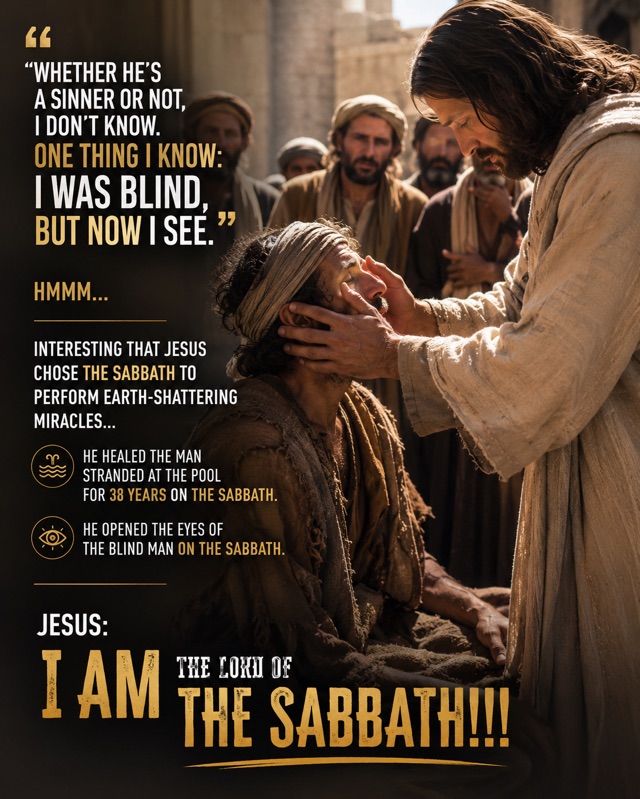
“Whether he is a sinner or not, I do not know. One thing I do know: I was blind, but now I see.”

Hmmm…

Interesting that Jesus repeatedly chose the Sabbath to perform earth-shattering miracles?

He healed the man who had been lying helpless by the pool for thirty-eight years on the Sabbath. He opened the eyes of the man born blind on the Sabbath. Again and again, He deliberately confronted a religion that had become more concerned with rules than with restoration, more interested in ritual than in mercy.

His message was unmistakable: the Sabbath was made for humanity, not humanity for the Sabbath. Mercy is not a violation of God’s law. Mercy is its fulfillment.

Jesus was not merely breaking with tradition. He was revealing His authority over it.

“I am Lord of the Sabbath.”

That is the question the miracles forced everyone to confront.

Not simply, “Was this done on the Sabbath?” but, “Who has the authority to command even the Sabbath?”

The healed man’s answer remains one of the most powerful testimonies in Scripture:

“Whether he is a sinner or not, I do not know. One thing I do know: I was blind, but now I see.”

Sometimes a transformed life is the strongest argument of all.

I rest my case

Obi Akaraiwe | Don Kenobi #OldManInTheMolue | #MyFrancisEssays

Wednesday, July 15, 2026

When the Science of #ClimateChange Meets the Silence of #ClimateDeniers

The Silence of #ClimateDeniers


As record-breaking heat sweeps the world, Don Kenobi asks a simple question: Where are the politicians and preachers who spent years mocking climate science? A reflection on silence, propaganda, Herman Cain, and the Marlboro Man.

Where Are They?

With record-breaking heat.

Literally record-breaking heat.

All the Republicans and evangelicals who oppose the science of climate change...

Where dem dey? You can't find them.

(Probably laughing at the rest of us from behind the glass walls of their air-conditioned penthouses).

The Marlboro Man

They're like the Marlboro Man.
Big. Strong. Virile.

On horseback. A Marlboro dangling from his lips, advertising the life-enhancing benefits of cigarette smoking.

No one tells you that the Marlboro Man died of lung cancer.

There were no cameras to record his decline. The tubes running through his nostrils, helping him breathe.

Marlboro, which paid him for as long as he fit their narrative, never showed up at the hospital to hold his hand.

And?

And another Marlboro Man has since taken his place.
Sitting on another horse.
Big. Strong. Virile.

And Marlboro pays him too, for as long as he fits their narrative.

The Useful Idiot

Herman Cain fits this pattern.

He publicly supported a political movement that mocked precautions and downplayed the danger of COVID-19.

Then he contracted the virus and died.
Afterwards, the movement moved on.
Another loyal face took his place.
That is how the useful idiot works.
Celebrated while useful.

Forgotten when the narrative no longer needs him.

While the Earth Burns...

So? So, while the earth burns....

...the deceivers of the world stay as silent as they possibly can, hoping you'll forget their lies and perfidy.

But not for long.

The moment winter temperatures drop to -45°C, they'll be back on Fox News, performing the same old routine: moulding a snowball, throwing it at the camera, and mocking:

"See? Where is your global warming now?"

From My Molue

Me? I just de look from my Molue, thinking...
Perhaps they hope to be safely tucked away on Mars.

Or wealthy enough to surround the beaches they frequent, the golf courses they play, and the penthouses they own with climate-controlled domes.

Perhaps they believe air conditioning can negotiate with a changing planet.

Could that explain the frantic transfer of wealth to the very top?
I don't know.

As I said...

I just de look from my Molue.
Jeje.

Fitfully, I rest.

Don Kenobi

#BigAgendaAfrica 
#MolueMonologues
#OldManInTheMolue 
#MyFrancisEssays 

Originally written: 16 July 2023


STOP PRESS (9 July 2026)

The headlines keep coming...

• Western Europe recorded its hottest June ever, driven by exceptionally warm land and sea temperatures.

• More than 2,700 excess heat-related deaths are estimated in England and Wales following the May and June heatwaves.

• A powerful heat dome brought record-breaking temperatures across the western United States, stressing ecosystems and communities.

• Extreme heat is damaging Europe's infrastructure, buckling railways, softening roads, straining power grids and affecting airports.

• Northern India has exceeded 48°C (118°F), with rising hospital admissions and millions struggling to cope with the heat.

• Pressure is mounting in the UK for legal workplace temperature limits to protect workers during extreme heat.

• Heat, drought and wildfires have combined to create unprecedented "firewave" conditions across parts of the UK.

Sunday, July 12, 2026

Ham Was Never Cursed: How Did it Become Christianity's Most Persistent Racial Myth?

The "Curse of Ham"| (The Curse That Never Was)

Discover how racism wrung and twisted Scripture until the truth was drained away; then pulverised what remained, packed it into neat little capsules, and offered them to the very people it had wounded—gently assuring them that this was, and always had been, the divine order of things. 

Thus were slavery, colonialism, and racial supremacy clothed in the language of faith and presented as the will of God.

So I listened to a racist pastor—perhaps a priest—speaking about Africa on Bishop Talbert Swan's Facebook wall.

(A brief aside: Bishop Swan consistently exposes false teachers—Black or white—and defends the dignity of Black people in a way I deeply admire.)

His argument was simple.

The only period of sustained progress in Africa, he claimed, came under European colonial rule.

Then he declared that it was the natural order of things for Hamites to live under the supervision of Japhethites.

Those were his words.

"Hamites" I recognised. I assumed he was referring to Black people through that long-discredited interpretation of the so-called Curse of Ham.

But "Japhethites"?

I'd never even heard the term used in my life.

(Their label had to have more syllables than ours? 🤓😀)

And the man saying all this...

...was wearing a priest's collar.

I could have called him many things.

I won't.

His ignorance exposed him far more effectively than any insult ever could.


The "Curse of Ham" That Never Was

One of the strangest things about this entire doctrine is that Ham was never cursed.

Read the passage carefully.

After Noah awoke from his drunkenness, he did not say:

"Cursed be Ham."

He said:

"Cursed be Canaan." (Genesis 9:25)

Canaan.

Ham's son.

Not Ham.

That single fact should have ended centuries of racist theology before they ever began.

But it didn't.

The biblical text never explicitly explains why Canaan, rather than Ham, received the curse.

Many interpretations have been proposed over the centuries, but Scripture itself does not tell us.

Some argued that Ham's offence was simply seeing his father's nakedness and telling his brothers. Others proposed far more elaborate—and highly speculative—theories.

None of these explanations appears plainly in the text.

What is remarkable is not the ambiguity of Genesis.

What is remarkable is the determination with which people built an entire racial hierarchy upon that ambiguity.

The Bible never says Black Africans descended uniquely from Ham.

The Bible never says Ham was cursed.

The Bible never says skin colour had anything whatsoever to do with Noah's words.

Yet for centuries Christians in Europe and America transformed this obscure passage into a theological justification for slavery, colonialism, segregation and racial oppression.

That tells us far more about the human heart than it does about Scripture.

Sometimes we do not read our prejudices into the Bible.

We read them out of ourselves.


Racism Draped in Biblical Language

What struck me was not simply his racism.

It was the theology beneath it.

This was not Christianity.

This was racism draped in biblical language.

People like him love to quote passages from the pre-Christ era—the Old Testament—as though they justify a world built upon ethnic hierarchy.

It is true that, in the Old Testament, God chose a people for Himself.

That is beyond dispute.

But the Old Testament is also the story of those same chosen people repeatedly proving unfaithful to the covenant.

God did not revoke His covenant, for He remains faithful even when we are not.

Instead, He sent prophet after prophet calling His people back to Himself.

Then, at last, He sent His Son.

As Jesus explained in the Parable of the Tenants, the owner of the vineyard sent servant after servant.

They were rejected.

Beaten.

Killed.

Finally he said,

"They will respect my son."

Instead, they killed him too.

The parable reflected Israel's long history of rejecting those whom God had sent.

It is almost as though they believed they possessed God's PIN code.

God had entered into covenant with them.

Surely He could never take it back.

But that misses the point entirely.

God did not abolish His covenant.

He fulfilled it in Christ.

Then He did something astonishing.

Through Christ, He opened the covenant to every nation on earth.

Those who belong to Christ become the people of God—not through ethnicity, but through faith.

That is the Gospel.

So whenever people continue speaking the language of ethnic superiority after Christ, they diminish the work of Jesus.

They try to replace the Christ who came for the whole world with a Christ who came only for themselves.

That is not Christianity.

It is the very opposite of Christianity.


The Historical Myth

Then there was his historical claim.

He argued that Africa experienced sustained progress only under European colonisation.

History tells a rather different story.

One of Europe's greatest periods of intellectual renewal began when North African Muslims—the Moors—crossed the Strait of Gibraltar and established Al-Andalus in Spain.

They did not arrive merely with armies.

They brought mathematics.

Astronomy.

Medicine.

Engineering.

Irrigation.

Architecture.

Philosophy.

Libraries.

Universities.

They preserved, translated, commented upon and expanded the works of the ancient Greeks while much of Western Europe struggled through the centuries following the collapse of the Western Roman Empire.

Through Arabic scholarship, Europe recovered Aristotle and many other classical writers whose works had become scarce in the Latin West.

Knowledge flowed.

Ideas flowed.

Civilisations learned from one another.

Many historians regard this exchange of knowledge as one of the great foundations of the European Renaissance.

The point is not that Islamic civilisation was perfect.

It wasn't.

Nor is the point that Europe contributed nothing of its own.

It certainly did.

The point is simply this:

Civilisations borrow.

Civilisations lend.

Civilisations teach.

Civilisations learn.

Or, borrowing President Obama's cadence:

"It's what we do, stupid."

History is richer—and humbler—than the racist myth suggests.


The Hardness of the Human Heart

Perhaps the saddest lesson in all this is not about history.

It is about ourselves.

Human beings possess an astonishing capacity to construct elaborate theologies to justify what they already wish to believe.

They ignore what Scripture plainly says.

Invent what it never says.

Then preach with absolute certainty what God Himself never revealed.

Not because they love the truth.

But because they love the comfort that false certainty provides.

The so-called Curse of Ham remains one of history's greatest examples of this.

A doctrine built upon words the Bible never says.

Used to defend evils that Christ came to destroy.

That is what happens when hard hearts become more authoritative than Holy Scripture.

Which is why every Christian must read the Bible through the lens of Christ.

Because Jesus is not merely part of the story.

He is the key that unlocks the whole story.


I rest my case.

Don Kenobi

Clinton: The Rise They Could Not Forgive

 CLINTON: How A Nation Lost Its Way


A Molue Monologue on Bill Clinton, America's decline, oligarchy, race, power, and the political choices that reshaped the American Republic. 


(The Molue rattles along, its body creaking under the weight of tired commuters. The Old Man sits by the window, pen in hand, his gaze far beyond Lagos… across the Atlantic, into the soul of America.)

He writes:

He writes: The people most blind to America’s decline—an assured outcome under the Republican Party—are those who, historically, have always opposed America’s true promise: a promise meant for all.

“Do not be a city—nay, the city on the hill,” they cry.
“Be instead our city—
not a hilltop lighthouse for the world,
but hidden under our bushel—
for us alone.”

They hold America’s promise against her.


The Decline

The decline began when Clinton’s Vice President had the presidency snatched away—by a single Supreme Court vote.

And yes, that deciding vote was Clarence Thomas’s.

Everyone loves George now… but let’s be honest—
he was a step down from the brilliance of the Clinton years.

Watching Bill Clinton on TV was like watching Jesus.
We hung on every word.
He wasn’t just a president.
He was The Man.

The perfect man.
The perfect president.
The perfect backstory:

Born into poverty, father dead before birth,
raised by an alcoholic stepfather,
tall, good-looking—
and he played the saxophone.

It was the perfect American story.


The Original Sin

But here’s the catch:
He was the first non-millionaire to become president.

Don’t forget—Jimmy Carter, the “peanut farmer,” was already a millionaire.
Clinton wasn’t even close.

And to my probing mind, that was his original sin.
The oligarchy couldn’t have it.
The presidency was not meant for outsiders—
not for anyone outside their “bloodline.”

They had to destroy him.

And he was Irish—
poor and Irish?!

Nah.


I can almost hear those dissolute elites weeping each morning, inconsolable:

“How did this happen?
How did a poor Irish boy—whose closest friends were Black—
become president?
What will our ancestors think of us?”

At the time, even Black America called Clinton the first Black president.
That phrase—an open insult to the oligarchy.

They mocked it.
Derided it.
Laughed at Black people for daring to imagine.

I believe it was John Lewis—“Good Trouble” Lewis—who first used it.

And the backlash came fast:

“Black president?
Your Black a*!
Wake up. Smell the coffee. He’s not Black!”

They had to fix it.
And they did.


The Attack

They came for him with everything.

Asa Hutchinson. Lindsey Graham—then a little-known congressman—
already calling Clinton unfit for office,
demanding resignation for “desecrating” the Oval Office.

(He chuckles bitterly.)

Irony of ironies—Lindsey Graham may go down
as the single worst American in history,
the man who betrayed his country the most.

Where was I?
Ah yes—the Lewinsky affair.

A moral failing, yes.
But blown into a crisis of biblical proportions.


I remember Clinton pointing his finger at the camera and saying:

“I will not resign.
I will stay in this office until the last second of the last minute
of the last hour of the last day of my presidency.”

You know the rest.

But what you may not know
is its impact ten thousand kilometers away.


The Night of the Vote

I was visiting my mother in Benin City.
Mercifully, there was light—electricity—so the TV was on.
We followed the Senate vote to acquit or convict.

When the “Nays” crossed the threshold,
my mother and I held hands and danced.

I don’t think we ever held hands and danced before—or since.

Clinton was our man.
To us, he truly was the first Black president.


The Fix

And that is why I’m writing—
to remind you how we got to the Now.

The power structure had to fix it.
America, to them, was still a slave plantation.
They got to decide who the major domo would be.

To quote Eminem:

“How the hell did this metamorphosis happen?”

How did a poor Irish boy, so poor his only friends were Black,
become master of the Republic?

Answer: They had to fix it.

They unleashed Kenneth Starr—
a special counsel with one mission: destroy Clinton.

He failed so spectacularly
that I think he lost his mind.

Only to resurface decades later
as one of Trump’s defense lawyers during impeachment.

Poetic.
Tragic.
Ironic.


Starr was egregious.
And living with the Clintons in his head for thirty years
was punishment enough.

So—having failed to take Clinton down—
they moved to restore order to the plantation.

Enter George Bush, the son.
Order restored.


After September 11

The decline deepened after September 11,
when American Christianity allowed hate into its heart.

And as Hercule Poirot once said:

“Do not allow hate into your heart…
or it will make a permanent home there.”


(He looks up. Dawn filters through the Molue window.)

I’ll analyze that another day.

For now, it’s 04:37 on September 2,
and it’s time for coffee and the gym.

Good morning.

— Don Kenobi

(The Passenger at the back row of the Molue with a writing pad on his lap, watching the world go by.)

Originally published October 2025


Thursday, July 9, 2026

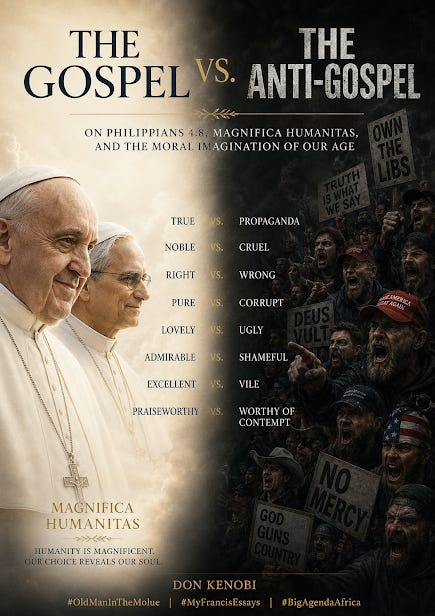
The Age of the Anti-Philippians | What exactly is wrong with Philippians 4:8?]

 Peter Thiel criticizes Pope Leo’s vision for AI, accusing him of serving China got me reflecting on technology, morality, and the steady erosion of VIRTUE…


What exactly is wrong with Philippians 4:8?

The question sounds absurd.

After all, Philippians 4:8 is one of the most universally admired passages in all of Scripture:

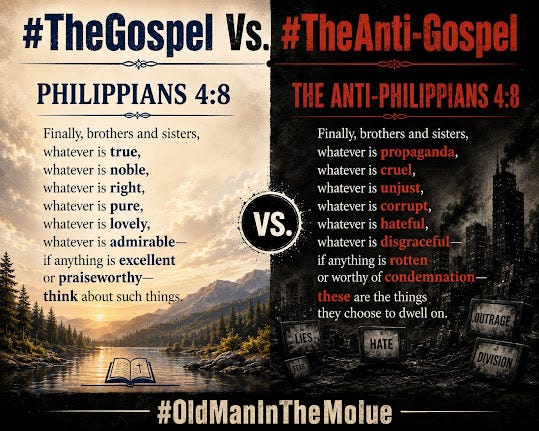
“Finally, brothers and sisters, whatever is true, whatever is noble, whatever is right, whatever is pure, whatever is lovely, whatever is admirable—if anything is excellent or praiseworthy—think about such things.”

It is difficult to imagine a more benign, more civilizational, more humanizing command.

Yet, if one pays close attention to our public discourse—particularly in this strange age of algorithmic outrage and ideological performance—it increasingly appears that many influential voices have, consciously or unconsciously, adopted its exact opposite.

So I decided to conduct a small experiment.

Rather than merely defend Philippians 4:8, I inverted it.

I asked:

What would the Anti-Philippians 4:8 look like?

It would sound something like this:

“Finally, brothers and sisters, whatever is false, whatever is cruel, whatever is wrong, whatever is corrupt, whatever is ugly, whatever is shameful—if anything is vile or worthy of contempt—set your minds on such things.”

Instead of truth — falsehood.
Instead of nobility — cruelty.
Instead of righteousness — wrongdoing.
Instead of purity — corruption.
Instead of loveliness — ugliness.
Instead of admirability — shame.
Instead of excellence — vileness.
Instead of what is praiseworthy — what deserves contempt.

It would look like this:

And perhaps most importantly:

Instead of deliberately fixing one’s mind on what elevates humanity, one deliberately dwells on what degrades it.

With that inversion, the landscape of modern outrage culture suddenly begins to make a terrifying kind of sense.

Do I need to spell it out?

It is a replacement.

A replacement of what?

Of an entire moral imagination.

From the spiritual to the political.

From the personal to the cultural.

At its heart lies a simple proposition:

These people do not seek the flourishing of all humanity.


The Gospel and the Anti-Gospel

This thought returned to me recently while watching two seemingly unrelated events unfold.

On one side, Peter Thiel launched yet another broadside against Pope Leo XIV and the moral vision he expressed regarding artificial intelligence.

Apparently, the Pope is now serving Chinese communism.

On the other side, Elon Musk—his ideological cousin in many respects—criticized MacKenzie Scott’s extraordinary philanthropy, lamenting that a woman who has voluntarily given away some $26 billion of her own wealth is somehow making the world worse.

Pause for a moment.

A woman gives away enough wealth to transform universities, hospitals, charities, communities and lives across the world.

The criticism is not that she has given too little.

It is that she has given at all.

At some point, one must stop asking political questions and begin asking theological ones.

Because beneath politics lies anthropology.

And beneath anthropology lies theology.

What, exactly, do these men believe a human being is?


What Did Pope Leo Actually Do?

He did something rather dangerous.

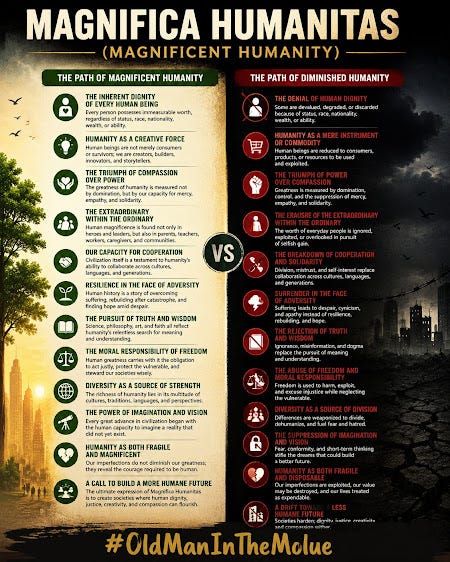
He proclaimed Magnifica Humanitas.

Magnificent Humanity.

Its vision is breathtakingly simple.

  • Every human being possesses inherent dignity.

  • Humanity is a creative force.

  • Compassion triumphs over power.

  • The extraordinary is found within ordinary people.

  • Human beings flourish through cooperation.

  • Resilience overcomes adversity.

  • Truth and wisdom are worth pursuing.

  • Freedom carries moral responsibility.

  • Diversity strengthens rather than weakens us.

  • Imagination shapes the future.

  • Humanity is simultaneously fragile and magnificent.

  • We are called to build a more humane world.

Humanity is magnificent not because we are perfect.

Not because we are innocent.

Not because we are wise.

But because every human being possesses an irreducible dignity that cannot be diminished by wealth—or the lack of it—by race, nationality, success, failure or power.

Let me say that again.

Humanity is magnificent because every human being possesses an irreducible dignity that neither wealth, power, race nor failure can erase.


Another Inversion

So I performed the same experiment again.

Rather than merely defend Magnifica Humanitas, I inverted it.

What would the anti-Magnifica Humanitas look like?

Perhaps something like this:

  • What if humanity possessed no inherent dignity?

  • What if human beings were merely instruments?

  • What if power mattered more than compassion?

  • What if ordinary people were expendable?

  • What if cooperation were weakness?

  • What if suffering demanded surrender rather than resilience?

  • What if truth were subordinate to utility?

  • What if freedom meant domination?

  • What if diversity meant division?

  • What if imagination itself became dangerous?

  • What if human fragility made us disposable rather than precious?

  • What if the future belonged not to hope, but to managed decline?

    It would look like this:

Can you recognize the pattern?

From the vilification of Bill Gates...To the criticism of MacKenzie Scott...To the gratuitous insults directed at Pope Leo XIV...

The inversion reveals not merely a political ideology, but an entire moral imagination.

An anti-humanism.

A worldview in which people are valued according to productivity, utility, loyalty, market value, tribal identity or ideological usefulness.

A world in which compassion becomes weakness.

Mercy becomes naïveté.

Generosity becomes pathology.


The Strange Psychology of Our Time

Here we encounter one of history’s great ironies.

Many Americans—including many white Americans—view Trumpism and the MAGA movement as a warning rooted in painful historical experience.

Yet many others, including some Africans observing events from afar, see the same movement through a very different lens: as a symbol of strength, order, sovereignty or even salvation.

How fractured must our moral imagination become for the same figure to appear simultaneously as both warning and redeemer?

How damaged must it become before we begin to admire precisely those qualities that diminish our own humanity?

There is a deeper danger still.

A theology that persuades people to celebrate the very forces that diminish them.

A theology that teaches victims to defend their own victimhood.

In a recent essay titled, The Theology Of Self-Justification I described it this way:

Imagine a theology that not only oppresses its victims, but persuades them that they were created for their oppression.

A theology that convinces people they are less than—that they were created to be less than.

That their place beneath others is not injustice, but God’s design.

That their suffering is not the result of human evil, but the natural order of the universe.

Few lies have been more powerful—or more destructive.

Full essay: Click

The Molue Question

Back to more familiar surroundings.

The old Lagos molue.

There, these conversations were never theoretical.

Sooner or later, the old man sitting beside you would ask the only question that really matters.

“So, my friend... what kind of person does your philosophy—your theology—produce?”

Not what GDP it produces.

Not what elections it wins.

Not what stock prices it raises.

What kind of human being does it create?

Does it produce people who think about what is true, noble, just, pure, lovely and admirable?

Or does it produce people who dwell endlessly upon humiliation, domination, grievance, spectacle, outrage and contempt?

Because eventually...

Every civilization becomes the object of its contemplation.

We become what we choose to admire.

And perhaps that is why Paul’s ancient instruction remains so revolutionary.

Think on these things.

Not because doing so makes us weak.

But because it is one of the surest ways to remain fully human.


Don Kenobi

#OldManInTheMolue
#MyFrancisEssays
#BigAgendaAfrica
#MagnificaHumanitas
#TheGospelVsTheAntiGospel

Who Owns God? Christian Faith, Immigration and Compassion

Who Owns God?  On Christian Faith, Immigration and Compassion? From a squirrel on a cable to the vast cosmos and the stranger at the border,...